
Why Won’t My Furnace Turn On?
When a furnace will not turn on, “nothing happens” is only one version of the problem. Some furnaces are completely silent. Others start a small inducer fan, click, glow, or light the burners before shutting down. A few run the main blower without producing heat. Each version marks a different point where the heating sequence stopped.
Begin with the controls you are meant to use: the thermostat, breaker, service switch, filter, vents, and a visible status light. Do not open the burner compartment, jump a safety switch, or keep cycling power after repeated failed starts. A modern furnace refuses to run when it cannot prove safe draft, ignition, flame, airflow, or condensate removal. Defeating that shutdown creates a hazard; it does not repair the furnace.
The steps below will help you decide whether you have a simple settings problem or need professional furnace repair in Linden. They also explain which observations are useful when you call, so the technician is not starting with a vague “no heat” complaint.
Quick answer: Confirm that the thermostat is set to Heat and several degrees above room temperature. Replace weak thermostat batteries if it has them. Check the furnace switch and labeled breaker, inspect the filter, open the vents, and note any LED fault code. Reset a tripped breaker only once. If the furnace tries to start but cannot light, shuts down after a few seconds, trips power again, leaks water, or shows the same fault after one reset, leave it alone and schedule service.
Do not troubleshoot a suspected gas or carbon monoxide emergency.
If you smell rotten eggs or sulfur, hear gas escaping, see soot or flame outside the burner area, or a carbon monoxide alarm sounds, move everyone outside. Do not operate switches, appliances, phones, vehicles, or flames near the building. Call 911 or the gas utility from a safe location.
What “The Furnace Won’t Turn On” Can Mean
Listen before changing anything. A completely silent furnace suggests that the heat call or power is missing, though a control-board or transformer failure can look the same. A low humming or whirring sound usually means at least part of the furnace has power. Clicking without flame points farther into the startup sequence. Flame that lasts only a few seconds suggests the furnace cannot prove it. A blower that runs by itself may be responding to a thermostat fan command or an overheat fault.
Note whether the thermostat screen is on, whether it shows “Heat On,” which motors you hear, whether there is a click, whether the igniter glows, and how long any flame remains. You do not need to remove a panel to make these observations. On many furnaces, a small window gives a safe view of the status LED and sometimes the burner compartment.
Safe Furnace Checks in the Right Order
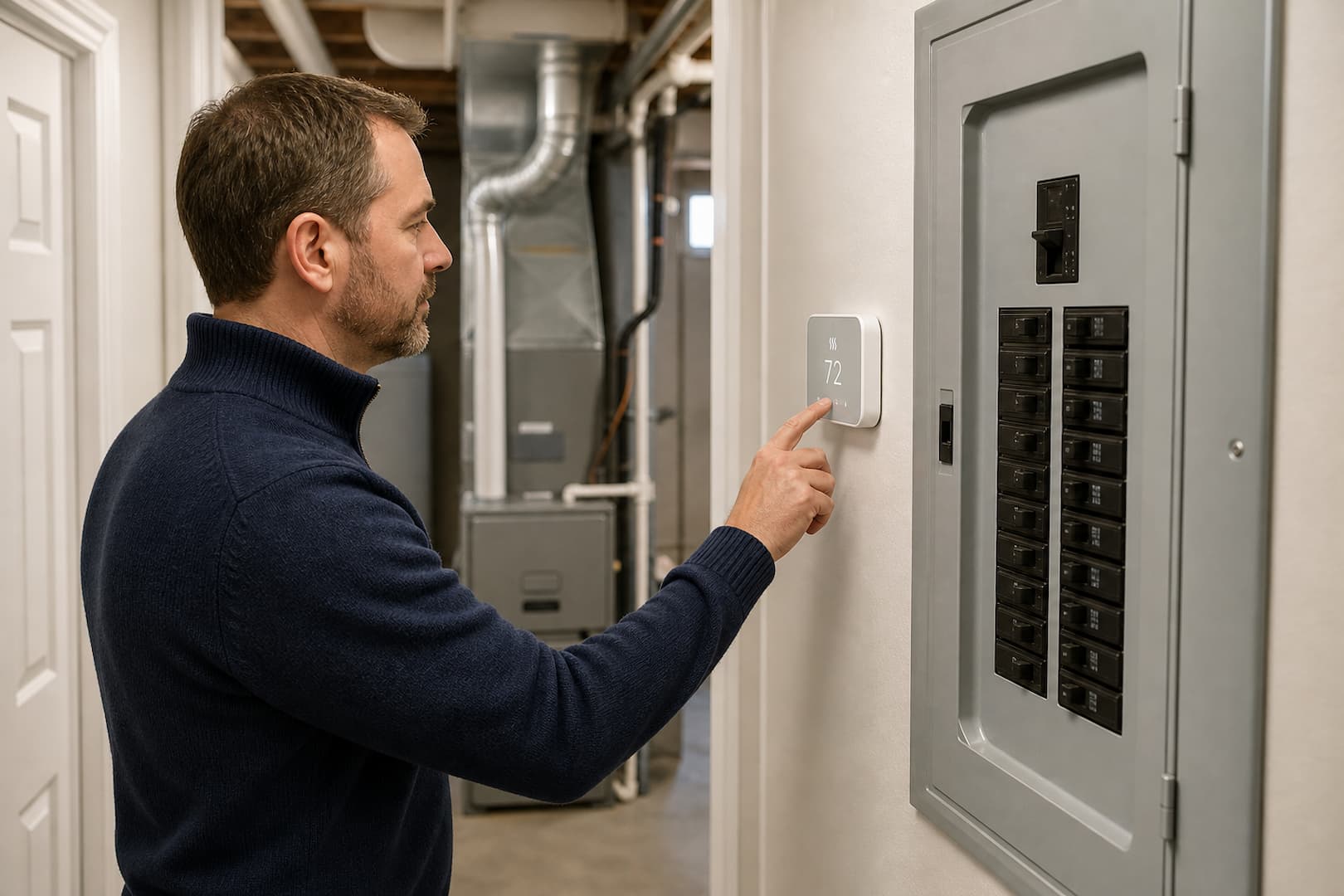
1. Confirm the Thermostat Is Actually Calling for Heat
Set the mode to Heat, the fan to Auto, and the target three to five degrees above the displayed room temperature. Wait up to five minutes; some thermostats and control boards use an anti-short-cycle delay. If the thermostat has replaceable batteries, install fresh ones. Check for a vacation schedule, geofencing rule, utility demand-response event, or smart-home automation that is overriding the manual setting.
A blank screen can indicate dead batteries, lost low-voltage power, an open furnace switch, a tripped breaker, a blown low-voltage fuse, a condensate float switch, or a failed transformer. A working display proves only that the thermostat has some power; it does not prove that the heat signal reaches the furnace.
2. Check the Furnace Switch and Electrical Panel
The service switch often looks like an ordinary light switch near the furnace or at the basement stairs. It can be turned off accidentally. Put it in the On position. At the electrical panel, find the breaker labeled Furnace, Heat, Air Handler, or HVAC. If its handle is centered, move it fully Off and then On one time.
If the breaker trips again, do not reset it. A shorted wire, failing motor, damaged igniter, wet electrical component, or other fault may be drawing unsafe current. Leave the circuit off and arrange service.
3. Inspect the Filter and Air Path
A clogged filter does not usually make a cold furnace completely silent, but it can cause repeated overheating and a protective lockout. Replace a dirty disposable filter with the same size. Make sure the airflow arrow points toward the furnace. Clear return grilles and open supply registers; do not close most vents in an attempt to force more heat into one room.
4. Make Sure an Accessible Panel Is Seated
The blower-door safety switch prevents operation when the cabinet panel is removed. A panel may be slightly out of position after a filter change or recent service. Without opening the burner compartment, check that the exterior access doors appear flush and properly latched. Never tape down, hold, or bypass the door switch.
5. Look at the Status Light Before Resetting Power
Count the flashes and record whether they are slow, fast, or grouped. A phone video through the viewing window can preserve the pattern for the technician. The code is not a full diagnosis. A pressure-switch code, for instance, describes what the board did not see; the cause could be a blocked vent, inducer problem, condensate issue, tubing problem, wiring fault, or the switch itself.
How the Furnace Startup Sequence Narrows the Problem
Troubleshooting makes more sense when you know what should happen. After the thermostat calls for heat, the furnace board checks its safety circuit. The inducer starts and establishes draft. A pressure switch proves that the vent path is working. The igniter heats or the spark begins. The gas valve opens, the burners light, and the flame sensor confirms combustion. Once the heat exchanger is warm, the main blower starts. The sequence stops if any required proof is missing.
| Last thing that happens | Possible area of trouble | What to do |
|---|---|---|
| Nothing; thermostat may also be blank | Power, service switch, transformer, fuse, float switch, thermostat | Check settings and external power; call if power will not remain on |
| Inducer starts, but ignition never begins | Draft proof, venting, condensate, pressure-switch circuit | Check visible vent blockage; do not bypass the switch |
| Igniter glows or spark clicks, but no flame | Gas supply, gas valve, igniter position, burner or control | Stop repeated attempts and schedule service |
| Flame appears, then goes out in seconds | Flame proving, grounding, burner carryover, gas pressure | Record the timing and fault code; arrange diagnosis |
| Burners stay on, but main blower does not start | Blower motor, capacitor, module, relay, board, wiring | Turn the furnace off before it overheats and call |
Common Reasons a Furnace Will Not Turn On
Thermostat, Wiring, or Low-Voltage Power Failure
The thermostat starts the call, but several things can prevent that signal from reaching the board: depleted batteries, a loose thermostat base, damaged cable, incorrect smart-thermostat setup, a missing common wire, a failed transformer, or a blown low-voltage fuse. A fuse that blows again after replacement is evidence of a wiring or component fault, not a reason to install a larger fuse.
A Condensate Safety Switch Has Opened
Condensing furnaces produce water, and many systems share drains or pumps with cooling equipment or humidifiers. A clogged trap, blocked line, failed pump, frozen drain, or full auxiliary pan can open a float switch. Depending on the wiring, the thermostat may go blank or the heat call may be interrupted. Water near the furnace is a clue, but an internal restriction may not be visible.
The Furnace Cannot Prove Draft
The inducer has to move combustion gases through the heat exchanger and vent. If the motor is weak, the vent or intake is blocked, condensate is interfering, tubing is damaged, or the pressure-switch circuit does not close correctly, the board prevents ignition. Replacing the pressure switch without checking draft conditions can miss the real cause.
The Igniter Has Failed
Hot-surface igniters become brittle with age and can crack. Spark systems can have electrode, cable, module, or grounding faults. If every earlier step in the sequence succeeds but the ignition source never appears, the furnace cannot safely open or sustain the gas valve. Igniters are model-specific and easily damaged; diagnosis should confirm power and control operation before a part is ordered.
The Burners Light but Flame Is Not Proven
A dirty or poorly grounded flame sensor can cause a shutdown within seconds, but the sensor is not the only possibility. Weak flame carryover, rusted burners, wiring problems, poor ground, low gas pressure, or board trouble can produce the same behavior. The flame-signal measurement, flame appearance, and burner condition should be considered together.
A Limit or Rollout Safety Is Open
High-limit switches respond to overheating; rollout switches respond to flame or heat where it should not be. Some reset automatically, some require manual reset, and some indicate a condition that must be investigated before operation resumes. Never press a rollout reset repeatedly. Burner, venting, draft, heat-exchanger, or airflow problems may be present.
The Blower Motor or Its Controls Have Failed
If the burners light but the blower never moves air, the furnace can overheat and shut down. Permanent-split-capacitor motors may have a failed capacitor; electronically commutated motors may have module or communication problems. Relays, boards, connectors, and seized blower wheels are also possible. Shut the furnace off if the heat exchanger is heating without airflow.
The Control Board Is in Lockout—or Has Failed
After a set number of unsuccessful ignition or safety checks, the control may enter soft or hard lockout. A reset can clear the state, but it cannot clear the cause. Boards can also fail because of age, moisture, voltage events, damaged connections, or downstream component faults. Before condemning the board, a technician verifies its inputs, outputs, grounds, and power supply.
Can You Reset a Furnace That Will Not Start?
If there is no gas odor, electrical smell, water on components, or alarming noise, one power reset may be appropriate after you correct a thermostat, panel, filter, or power issue. Set the thermostat to Off. Turn the furnace switch off for about five minutes. Restore power, select Heat, and observe the next attempt without opening the cabinet.
Stop after one unsuccessful reset. Frequent power cycling can erase stored faults, repeat unsafe ignition attempts, and delay a real diagnosis. A system that returns only after every manual reset is still malfunctioning.
What to Do While You Wait for Furnace Repair
Protect people first, then plumbing and the building. Use only listed indoor heating equipment according to its instructions. Keep portable electric heaters on a firm, level surface away from bedding, curtains, furniture, children, and pets; plug them directly into a suitable wall outlet, not an extension cord or power strip. Never use an oven, grill, outdoor heater, or generator to heat the house.
In freezing weather, open sink-cabinet doors on exterior walls, let vulnerable faucets drip if local guidance recommends it, and keep interior doors open so remaining heat circulates. Know where the main water shutoff is. If indoor temperature is dropping rapidly or occupants are vulnerable, relocate to a safe warm place rather than relying on improvised heat.
What a Technician Will Test
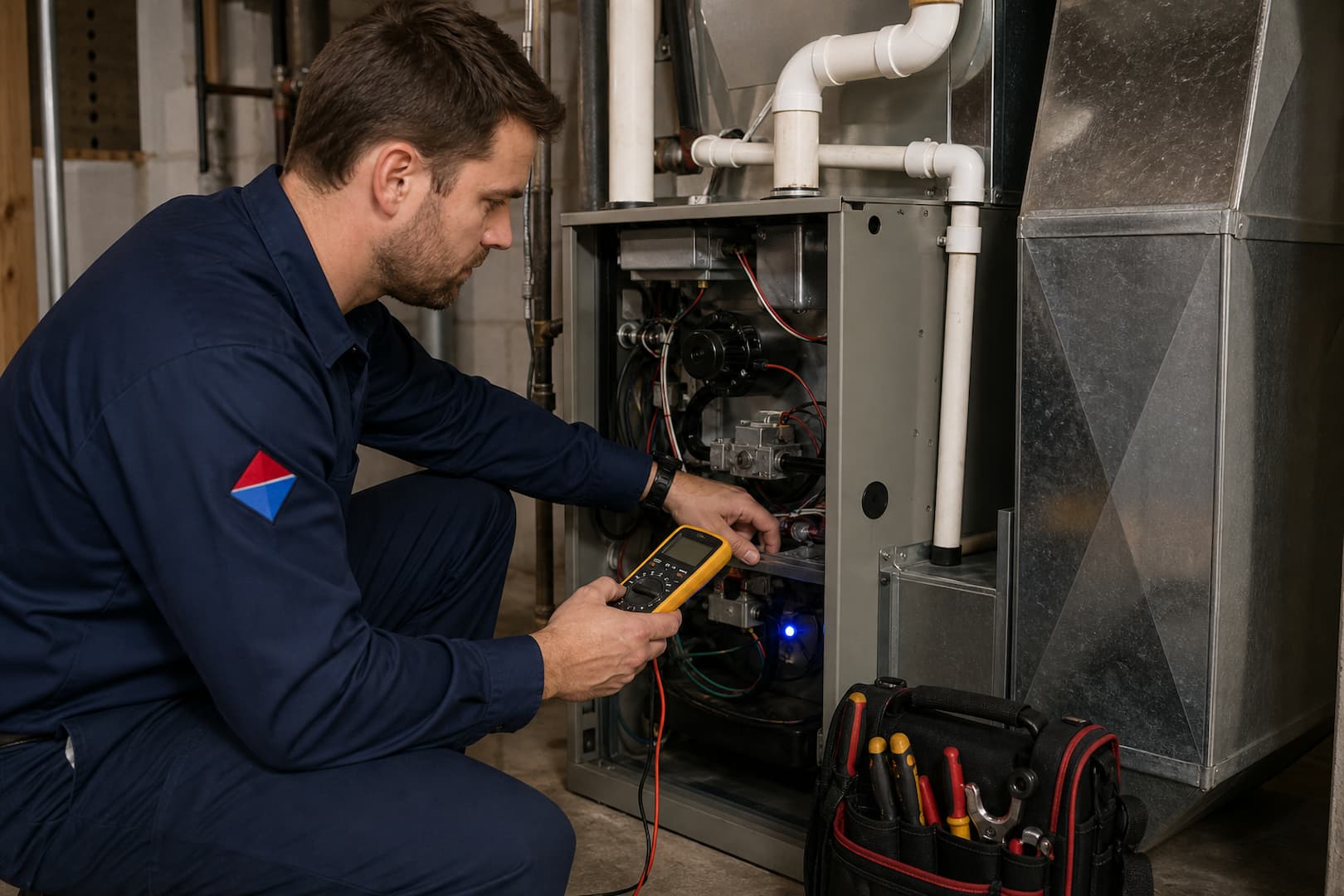
The service visit should begin with the complaint and the saved status code. The technician confirms thermostat demand and voltage, then observes the complete sequence. That prevents a common diagnostic error: replacing the component named in the fault code without finding the condition that made the code appear.
A no-start diagnosis may include:
- Thermostat programming, low-voltage call, transformer output, fuse, grounding, and wiring continuity.
- Line voltage, disconnect, breaker behavior, neutral connections, and motor current.
- Inducer performance, intake and exhaust condition, pressure, tubing, and pressure-switch response.
- Condensate trap, drain slope, pump, float switches, and signs of freezing or backup.
- Igniter or spark operation, gas-valve signal, gas pressure, burner condition, and ignition carryover.
- Flame-sensor signal, equipment grounding, limit circuit, rollout safety, and fault history.
- Blower motor, capacitor or module, wheel, relay, speed settings, static pressure, and temperature rise.
- Control-board inputs and outputs rather than the board’s appearance alone.
Does a Furnace That Will Not Start Need Replacement?
Usually not. Failed thermostats, igniters, flame sensors, drain components, switches, capacitors, relays, and many motor or wiring problems are repairable. A single no-start event tells you little about the overall condition of the equipment.
Replacement becomes more reasonable when the diagnosis finds a serious heat-exchanger problem, widespread corrosion or water damage, an unavailable major component, repeated expensive failures, or a furnace that remains unreliable and inefficient after previous repairs. The decision should include equipment age, repair history, combustion safety, duct condition, comfort, and the cost of restoring dependable operation—not a rule based on age alone.
How to Prevent Avoidable No-Start Calls
- Check the filter monthly during the heating season and use the correct size and type.
- Keep supply registers open, returns unobstructed, and the furnace area clear.
- After heavy snow, confirm that sidewall intake and exhaust openings are not buried.
- Do not store chemicals, litter, paint, or flammable products next to the furnace.
- Test smoke and CO alarms and replace them according to the manufacturer’s instructions.
- Schedule fall furnace maintenance so ignition, venting, drainage, electrical connections, blower operation, and safety controls can be checked before peak demand.
Frequently Asked Questions
Why is my furnace completely silent?
A silent furnace may not be receiving a thermostat call or electrical power. Check Heat mode, setpoint, thermostat batteries, the furnace switch, and the breaker. If those are normal, low-voltage power, wiring, a float switch, the transformer, or the control board may need testing.
Why does my furnace click but not start?
Clicking can come from a relay, spark igniter, or gas valve command. The point in the sequence matters. Repeated clicks without flame may involve ignition, gas supply, controls, or a safety circuit. Stop repeated resets and note any fault code.
Can a thermostat cause the furnace not to turn on?
Yes. Wrong mode, a low setpoint, dead batteries, poor wiring contact, a schedule override, incorrect smart-thermostat configuration, or a failed thermostat can interrupt the heat call. A lit screen does not guarantee that the heating output works.
Why does the furnace start and shut off after a few seconds?
If flame appears and disappears quickly, the furnace may not be proving flame. Sensor contamination is one possibility, but grounding, burner carryover, gas pressure, wiring, and control problems can create the same symptom.
How many times should I reset my furnace?
At most once, after checking for hazards and correcting a simple external issue. If the fault returns, stop. Repeated resets can hide diagnostic information and force the furnace through the same failed safety sequence.
When is a furnace no-start an emergency?
Gas odor, a CO alarm, flame rollout, soot, delayed-ignition booms, fire, or symptoms of CO exposure are emergencies. Evacuate and call 911 or the gas utility. Loss of heat can also become urgent when the house is approaching unsafe temperatures or plumbing is at risk; emergency HVAC service may then be appropriate.
Bottom Line
The best clue is the last successful step. Silence points toward the thermostat or power path. An inducer without ignition points toward draft proof. An igniter without flame points toward fuel or ignition control. Flame that disappears quickly points toward flame proof. Burners without a blower point toward airflow equipment and an overheating risk.
Make the external checks once, save the status code, and resist the urge to bypass or repeatedly reset anything. A furnace that refuses to start is often preventing an unsafe or damaging operating condition. The right repair finds out why—and confirms a complete, stable heating cycle before the system goes back into service.