

Makeup Air Unit Repair in Linden, NJ
A makeup air unit has one practical job: replace the air your building exhausts. When the blower stops, a damper sticks, or the heat section trips, the trouble spreads quickly to kitchen pressure, door operation, odor control, and comfort.
Describe the makeup air problem
Share the building, unit location, and what changed. A model number or recent fault message helps, but it is not required.
Repair the cause, not the pressure symptom
A commercial makeup air system can run and still deliver too little air. That happens when a loaded filter, loose belt, incorrect damper position, slipping pulley, or control sequence limits the unit before it ever reaches the occupied space.
At restaurants, the first complaint is often a hard-to-open entrance door or a rush of outdoor air through every gap. A warehouse may develop cold drafts near loading areas. In a production space, odors can travel in the wrong direction. Those clues matter because they show how the MAU interacts with exhaust fans and the rest of the building.
The diagnostic trail starts at the intake and damper, then follows the filter, blower, conditioning section, ductwork, and controls. What the unit actually does under a call matters more than a symptom guessed from the hallway.
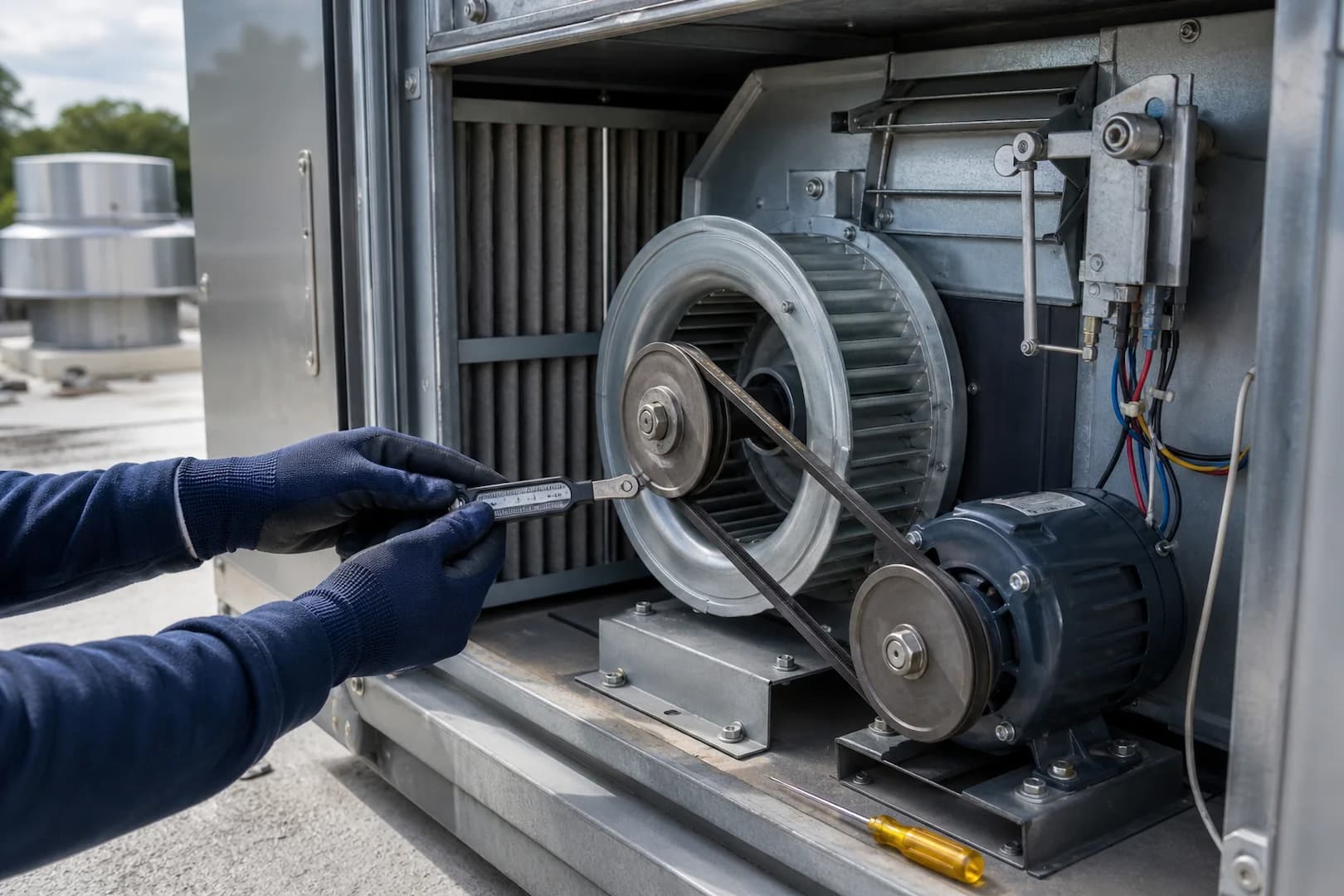
Common makeup air unit problems we diagnose
Little or no supply air
A stopped motor is only one possibility. We also look at belts, pulleys, overloads, filters, damper linkage, rotation, control calls, and any safety that is holding the fan off.
Kitchen doors pull inward
Strong negative pressure can mean the exhaust volume exceeds replacement air. The MAU, exhaust fans, occupied schedules, dampers, and air distribution have to be considered together.
Cold air during heating season
The fan may be operating while the burner, heat exchanger controls, hydronic coil, gas valve, ignition sequence, freeze protection, or discharge-air sensor is not doing its part.
Unit starts and stops
Intermittent trips often leave useful clues. Motor amperage, belt condition, dirty coils, airflow restrictions, limits, relays, contactors, and control history can narrow the cause.
Noise or vibration
Rattling panels are different from bearing noise. We check the blower wheel, shaft, bearings, motor base, pulley alignment, belt tension, fasteners, and anything contacting the cabinet.
Odors move through the building
Pressure balance, fan schedules, duct leakage, blocked intake paths, and poorly aimed supply air can let kitchen or process odors travel where they should not.
Parts of the system that deserve attention
Makeup air units vary. Some are simple ventilation boxes; others include direct-fired or indirect-fired heat, chilled-water or DX cooling, energy recovery, variable-frequency drives, and building automation connections.
- Outside-air intake, screens, filters, and motorized dampers
- Forward-curved or backward-inclined blowers, shafts, bearings, belts, and pulleys
- Motors, starters, contactors, overloads, disconnects, and VFDs
- Gas heat, hydronic coils, DX sections, drain pans, and freeze protection
- Discharge-air sensors, pressure switches, thermostats, relays, and BAS points
- Kitchen hood or exhaust-fan interlocks and occupied scheduling
When a repair still makes sense
A failed contactor, actuator, belt, bearing, sensor, or motor does not automatically make the whole unit a replacement candidate. Condition, access, parts availability, cabinet integrity, coil condition, and the fit between current airflow and building demand all affect the decision.
Replacement becomes more reasonable when corrosion has damaged the cabinet or heat section, major components are failing together, controls no longer support the operating sequence, or the unit cannot provide the outside-air volume the building now needs.
If the equipment is serviceable, we say so. If a larger retrofit question is driving the failure, we separate that from the immediate repair so the next step stays clear.
How we approach MAU troubleshooting
Confirm the complaint
We ask when the issue occurs, what exhaust equipment is running, and whether weather, occupancy, or a recent repair changed the pattern.
Inspect the unit
Intake, filters, damper, blower, motor, belt drive, coils or heat section, electrical components, safeties, and visible duct connections are checked in context.
Test the sequence
We follow the enable signal, interlocks, sensors, fan operation, conditioning call, discharge behavior, and shutdown sequence instead of guessing from one failed part.
Explain the repair
You get a clear description of the fault, the work that makes sense now, and any maintenance or system-balance issue worth planning for.
Keep the surrounding system in the conversation
Makeup air unit repair FAQ
What is the difference between makeup air and regular supply air?
Makeup air replaces air removed by exhaust systems. Regular supply air is usually part of the building's comfort-conditioning loop. They may share ductwork or controls in some buildings, but their jobs and operating sequences are not the same.
Why does the entrance door get hard to open when the kitchen is busy?
The building may be under negative pressure because exhaust airflow is higher than the replacement-air volume. A failed MAU is one cause; closed dampers, loaded filters, slipping belts, incorrect schedules, or changes to exhaust fans can create the same symptom.
Can you repair a rooftop makeup air unit?
Yes, many MAUs are installed on roofs. Safe access, roof condition, weather, equipment clearance, and the unit's construction affect how the visit is planned.
Does a makeup air unit need to run with the exhaust fan?
In many commercial kitchens and process spaces, the systems are interlocked so replacement air is available when exhaust starts. The exact sequence depends on the design and applicable controls. We verify the installed sequence rather than assuming it.
How often should a makeup air unit be maintained?
There is no useful one-size schedule. Filter loading, hours of operation, grease or dust exposure, belt drive, heating type, outdoor conditions, and manufacturer guidance matter. A restaurant unit often needs attention more frequently than lightly used ventilation equipment.
What information should I send with a service request?
The property address, roof or mechanical-room location, unit label or model if available, recent fault message, affected area, and a plain description of the symptom are enough to start. Photos can help with access planning.
Get the makeup air problem on the schedule
Tell Sadowski HVAC what changed and where the unit is located. We will use those details to prepare for a focused commercial service visit in Linden.
Sadowski HVAC Corp. · 633 Pierce Ave Unit 7, Linden, NJ 07036 · Mon–Fri 8:00 AM–5:00 PM