

Fan Coil Unit Service in Linden, NJ
A fan coil can leave one room hot, drip into a ceiling, or rattle for weeks while the rest of the building seems fine. We service the blower, coil, condensate, valves, and controls as one small system.
Describe the fan coil issue
Tell us the room or unit, whether heat or cooling is affected, and if you have noticed water, noise, weak airflow, or a control problem.
Start with the symptom and the operating mode
Weak cooling does not automatically mean a bad coil. The fan may be slow, the filter may be loaded, a hydronic valve may remain closed, chilled water may be unavailable, or the thermostat may never send the correct call.
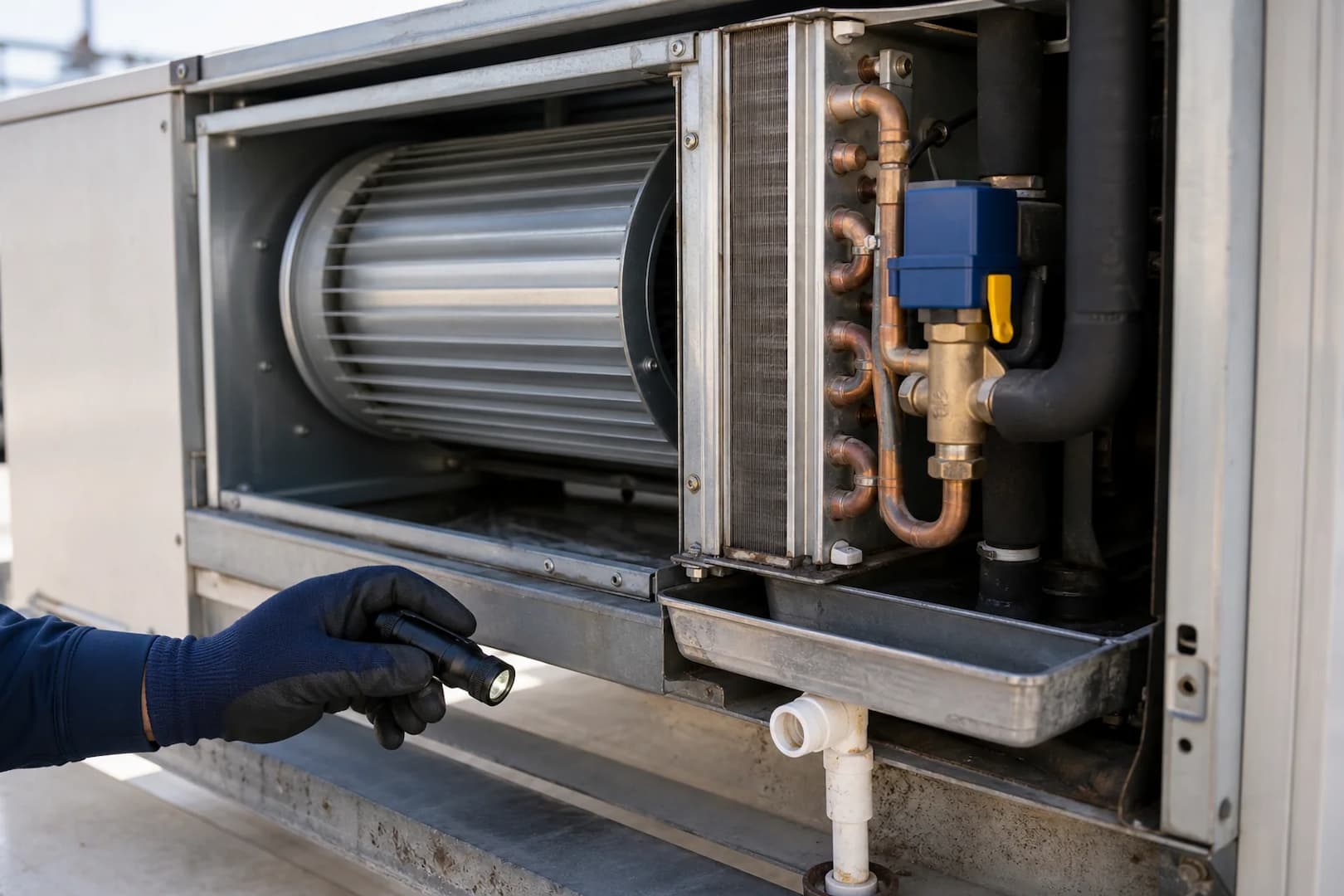
Fan coil units show up in condominium suites, offices, hotels, medical spaces, schools, and mixed-use properties. Some are vertical cabinets; others sit above a ceiling or inside a wall chase. Access changes, but the diagnostic questions remain familiar: Is air moving? Is the coil receiving the right hot or chilled water? Is condensate leaving safely? Are the controls asking for the right mode?
Those answers point to the next test. They also keep a room-level complaint from becoming a parts-swapping exercise.
Our fan coil service sequence
Identify the system
We note cabinet type, access, heating and cooling source, valve arrangement, thermostat, condensate path, and the building's current operating mode.
Test the complaint
Fan speeds, airflow, coil temperatures, valve movement, control call, and water behavior are checked while the symptom is present when possible.
Inspect inside the cabinet
Blower, motor, filter, coil face, pan, drain, insulation, wiring, valves, and accessible piping get a visual and functional review.
Set the repair scope
We explain what belongs to the individual FCU and what may involve the building's central hydronic loop, controls, or drainage system.
Fan coil problems and their likely paths
No airflow
A failed motor, seized blower, capacitor, relay, speed control, loose connection, blocked filter, or missing thermostat call can stop air at the cabinet.
Airflow is weak or uneven
Filter condition, blower-wheel buildup, motor speed, cabinet restrictions, duct or grille blockage, and the physical condition of the coil all affect delivery.
Fan runs but the room stays warm
We check the cooling call, control valve and actuator, water temperature and flow, coil condition, air volume, and whether the building's central loop is available.
Fan runs but there is no heat
The same logic applies on the heating side: thermostat mode, valve position, hot-water availability, coil temperature, fan operation, and any changeover control.
Water appears around the unit
A blocked drain, cracked pan, failed condensate pump, dirty coil, damaged insulation, sweating pipe, frozen coil, or poor cabinet pitch can each leave a different water pattern.
Rattle, hum, or vibration
Blower balance, debris, bearing wear, loose panels, motor mounts, contact between piping and cabinet, and an overworked actuator are common places to listen.
What fan coil maintenance should actually cover
Changing a filter helps, but it does not tell you whether the condensate drain is restricted or the valve actuator reaches full travel. A useful visit looks at the parts that affect air, water, and control.
- Filter condition and correct fit
- Blower wheel cleanliness, free rotation, motor condition, and speed operation
- Coil face, accessible fins, and temperature change across the unit
- Drain pan, drain line, trap, condensate pump, and evidence of overflow
- Hydronic valve, actuator, isolation valves, unions, and visible leaks
- Thermostat, changeover control, relays, wiring, and safe shutdown devices
One failed FCU can reveal a larger pattern
If only one room is affected, the fault often sits at the local unit: its blower, valve, sensor, drain, or wiring. When several rooms lose cooling at once, central chilled-water temperature, pump operation, changeover mode, system pressure, or a shared controls problem deserves attention.
That distinction matters in condominiums and multi-tenant buildings because responsibility and access may be split between the suite and the property system. We document what the local unit shows so the next conversation is based on evidence.
For older cabinets, replacement may enter the discussion when the coil leaks, the pan or casing is badly deteriorated, parts are no longer practical, or repeated motor and valve work no longer makes financial sense.
Service around the fan coil
Fan coil unit service FAQ
What is a fan coil unit?
A fan coil unit moves room air across a heating or cooling coil. Many commercial and multi-unit buildings supply hot or chilled water to the coil, while the local fan and valve control the room's response.
Why is my fan coil leaking water?
Common causes include a blocked drain, failed condensate pump, cracked or rusted pan, dirty coil, frozen coil, missing insulation, sweating hydronic piping, or water coming from an unrelated source above the cabinet.
Can a fan coil have heat but no cooling?
Yes. Two-pipe systems may switch seasonally between hot and chilled water, while four-pipe systems can have separate valves or coils. A control, valve, central-loop, or local airflow issue can affect only one mode.
Why does the fan keep running after the room reaches temperature?
Some systems are designed for continuous or minimum fan operation. In other cases, a thermostat setting, relay, controller output, wiring fault, or stuck fan-speed control keeps it on. The installed sequence has to be verified.
How often should an FCU be maintained?
Use, filter loading, condensate conditions, water quality, access, and manufacturer guidance determine the interval. Units above finished ceilings or in humid spaces deserve careful drain and leak checks.
Do you service condo fan coil units?
Yes, subject to access and property requirements. Building management may need to coordinate water isolation, ceiling access, central-loop status, parking, or service hours.
Arrange service for the room that will not behave
Send the room or unit number, operating mode, and what you hear, feel, or see. Those details help us arrive ready to test the fan coil in context.
Sadowski HVAC Corp. · 633 Pierce Ave Unit 7, Linden, NJ 07036 · Mon–Fri 8:00 AM–5:00 PM