

Commercial Furnace Repair in Linden, NJ
A furnace that will not light, drops out during a call, or moves air without useful heat needs a safe sequence-of-operation check. Sadowski HVAC works from the thermostat call through ignition, flame proving, airflow, limits, and venting.
Request commercial furnace repair
Share the property, affected area, controller message, sounds or odors, when the furnace last operated, and equipment access details.
Commercial furnace symptoms and likely test paths
Nothing starts
Thermostat or building-control calls, schedules, interlocks, disconnects, breakers, transformers, fuses, boards, wiring, and safety circuits establish whether the furnace is being enabled.
Inducer runs but no flame appears
Pressure switch status, tubing and ports, venting, condensate on condensing equipment, igniter condition, board output, and gas-valve command shape the next test.
Burners light and shut off
Flame signal, sensor condition, grounding, burner carryover, gas pressure, control timing, venting, and combustion air may explain a brief flame.
Warm air stops and restarts
Filter and coil restriction, blower speed, belts where fitted, motor performance, supply and return paths, temperature rise, limits, and duct conditions need review.
Blower runs with cool air
The heating call may have ended on a fault while the board keeps the blower on for protection. Ignition history, limit state, fan settings, and controller commands help explain it.
New odor or unusual noise
Burners, inducer bearings, blower assembly, belts, loose panels, debris, venting, electrical parts, overheating, and nearby sources should be assessed without bypassing safeties.
The point where the furnace stops matters
A heating call normally moves through a chain of checks before the blower delivers warm air. The inducer, pressure proving, ignition, gas valve, flame signal, temperature limits, and blower each have a place in that chain.
The exact stopping point is the clue. A control may never send the call; a safety may open for a reason. A dirty filter or weak blower can raise temperature enough to trip a limit. A blocked pressure path can prevent ignition. Brief flame points us toward flame proving, grounding, fuel supply, or combustion conditions.
Commercial equipment may be a standalone furnace, part of a split system, or the heating section of a packaged rooftop unit. Access, controls, ventilation interlocks, and building schedules can affect the service plan.
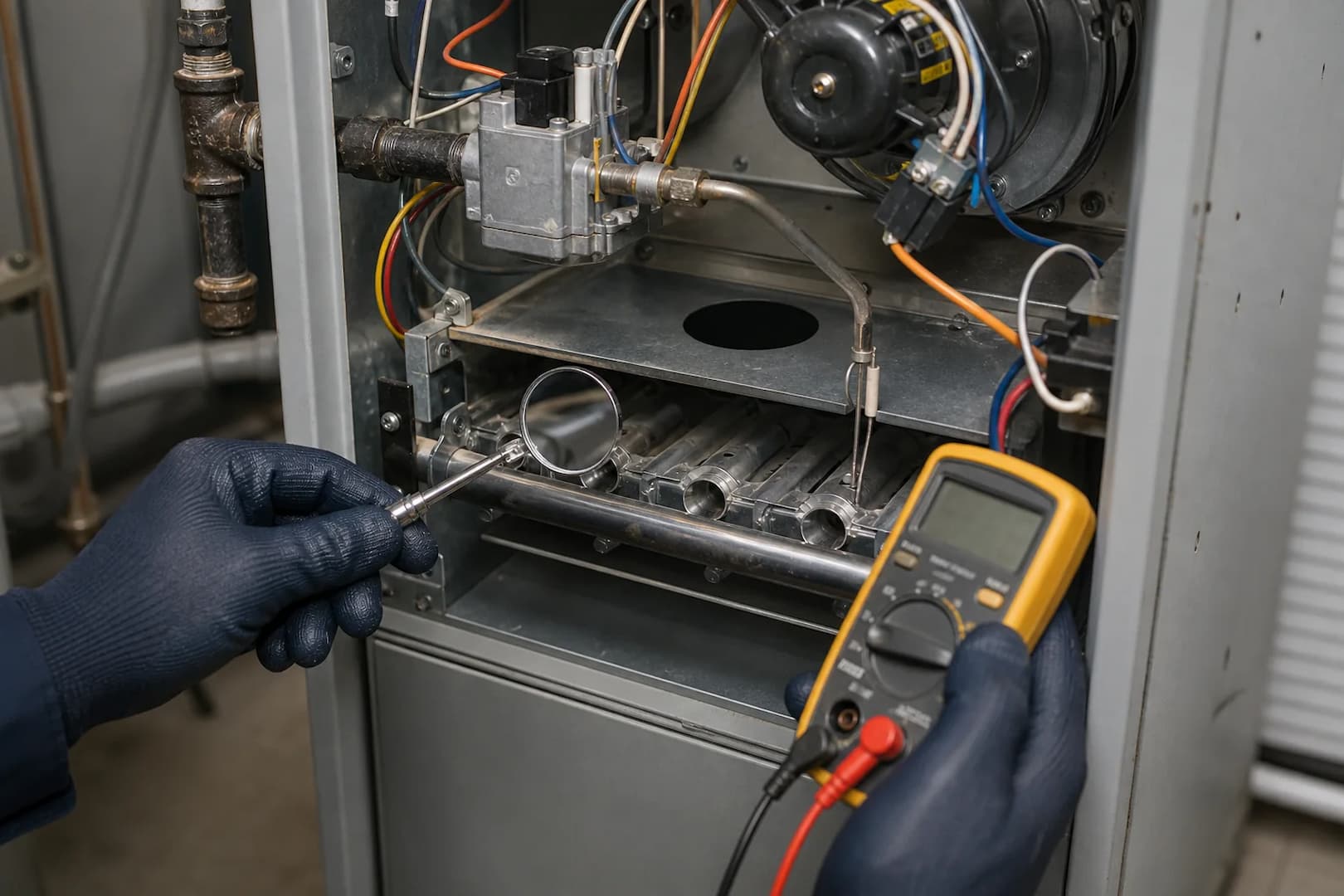
Heating components, airflow, and the building call
- Thermostat or BAS request, schedules, relays, transformers, control board, wiring, and accessible interlocks
- Inducer, pressure switch, tubing, ports, vent connector, termination observations, and combustion-air path
- Igniter, pilots where present, gas-valve command, burners, crossover, flame sensor, and grounding
- Filters, blower wheel, motor, capacitor where used, belt and pulleys where fitted, and temperature rise
- High limits, rollout and other safety devices, cabinet condition, panels, and signs of overheating
- Heat-exchanger surfaces visible without destructive disassembly and evidence that warrants a deeper evaluation
Resetting a trip is not the same as repairing it
Limits and pressure switches protect the equipment and building. Bypassing them hides the condition the furnace is reporting. We look for the cause of the open circuit, which may be airflow, venting, condensate, heat, wiring, or the device itself.
Service history adds context. Repeated igniter replacements, nuisance limit trips, growing blower noise, or seasonal pressure-switch trouble can reveal a pattern that a single startup does not show.
If testing points toward a larger condition, such as a questionable heat-exchanger area, venting defect, or fuel-supply issue, we explain the next evaluation and keep it separate from ordinary maintenance items.
How a commercial furnace call moves forward
Hear the history
We ask when heat stopped, whether the fault repeats, which zones are affected, what the controller shows, and what work occurred recently.
Observe the sequence
The call, inducer, proving, ignition, flame, blower, temperature, and shutdown behavior identify where operation changes.
Test that stage
Electrical readings, control inputs, airflow, temperature, components, safeties, venting observations, and fuel-side checks follow the evidence.
Define the repair
We explain the failed condition, related risks, available correction, and any maintenance or follow-up item as separate decisions.
Commercial furnace repair FAQ
Why does the furnace light and then shut down?
A weak flame signal is one possibility, but grounding, burner carryover, gas pressure, venting, airflow, control timing, or another safety response can produce similar behavior. The operating sequence needs to be tested.
Why does the blower run when there is no heat?
Some controls keep the blower running after a limit or other heating fault to remove heat and protect the equipment. A fan setting, BAS command, relay issue, or control-board problem can also run the blower.
Can a dirty filter stop a commercial furnace?
Yes. Restricted airflow can raise furnace temperature and open a high limit. Filters are only one possible restriction; coils, dampers, belts, blower speed, blocked returns, and duct conditions also affect airflow.
Should a pressure switch be bypassed to restore heat?
No. It is part of a safety sequence. A switch that does not prove may be reporting an inducer, tubing, port, venting, condensate, wiring, or pressure condition. Bypassing it removes protection without resolving the fault.
Can you repair the heating section of a rooftop unit?
Yes, a packaged rooftop unit can contain gas heat components similar to a furnace, alongside cooling, ventilation, economizer, and rooftop controls. The whole unit's sequence and interlocks may need to be considered.
What information helps before the visit?
Send the equipment label, controller or thermostat photo, fault code, affected area, time the failure occurs, recent filter or control work, roof or mechanical-room access steps, and any odor or alarm details.
Find the page that fits the equipment
Tell us where the heating sequence stops
If you can safely observe whether the inducer, igniter, flame, or blower starts, include that detail with the service request. Do not open panels or reset safety devices to investigate.
Sadowski HVAC Corp. · 633 Pierce Ave Unit 7, Linden, NJ 07036 · Mon–Fri 8:00 AM–5:00 PM