Commercial Air Conditioning Repair in Linden, NJ
When a store, office, restaurant, or facility will not cool, the fastest useful answer is not a guess at refrigerant. It is a diagnosis that connects the control call, airflow, electrical circuit, refrigerant system, and actual load.
Request commercial AC service
Tell us which area is affected, what the equipment is doing, any alarm or ice you noticed, and whether the problem is constant or comes and goes.
Common commercial AC repair scenarios
Unit will not start
Thermostat or BAS call, disconnect, fuses, transformers, safeties, contactors, overloads, motors, compressor protection, and control wiring are checked in sequence.
Fan runs, air stays warm
The cooling call may not reach the compressor, a safety may be open, refrigerant conditions may be wrong, or the economizer and dampers may be mixing in too much outdoor air.
Cooling is weak on hot afternoons
Dirty coils, condenser airflow, low supply volume, duct loss, sensor location, capacity, staging, refrigerant condition, and changing building loads can all show up under peak demand.
Unit starts and stops
Short cycling can follow a control fault, pressure trip, condensate safety, low airflow, dirty condenser, motor overload, unstable power, thermostat location, or oversized equipment.
Water around the equipment
Drain blockage, cracked pan, failed pump, missing trap, poor slope, negative cabinet pressure, frozen coil, or damaged insulation leaves different evidence.
One area is hot
A local damper, diffuser, duct, VAV box, zone sensor, return-air path, occupancy change, or internal heat load may be responsible even when the central unit is operating.
“Not cooling” is a result, not a fault code
A unit can blow warm air because a compressor is off, but it can also lose capacity through poor airflow, a dirty coil, failed economizer, incorrect sensor, loose contactor, tripped safety, duct issue, or a load the equipment cannot currently handle.
The first useful question is simple: what changed? One warm zone, a unit that falls behind only in the afternoon, a silent fan, or a drain safety that tripped after water backed up each sends the diagnosis in a different direction before the service panel comes off.
Refrigerant readings matter only after airflow, load, coil condition, and operating mode make sense. Adding refrigerant without finding why the charge is low leaves the real problem in place.
A commercial cooling diagnostic sequence
Confirm the complaint
We review affected zones, schedules, setpoints, weather pattern, recent work, filter history, alarms, and how the unit behaves now.
Check air and controls
Return and supply conditions, filters, fan operation, dampers, coils, thermostat or BAS call, safeties, and condensate controls come first.
Test electrical and refrigeration
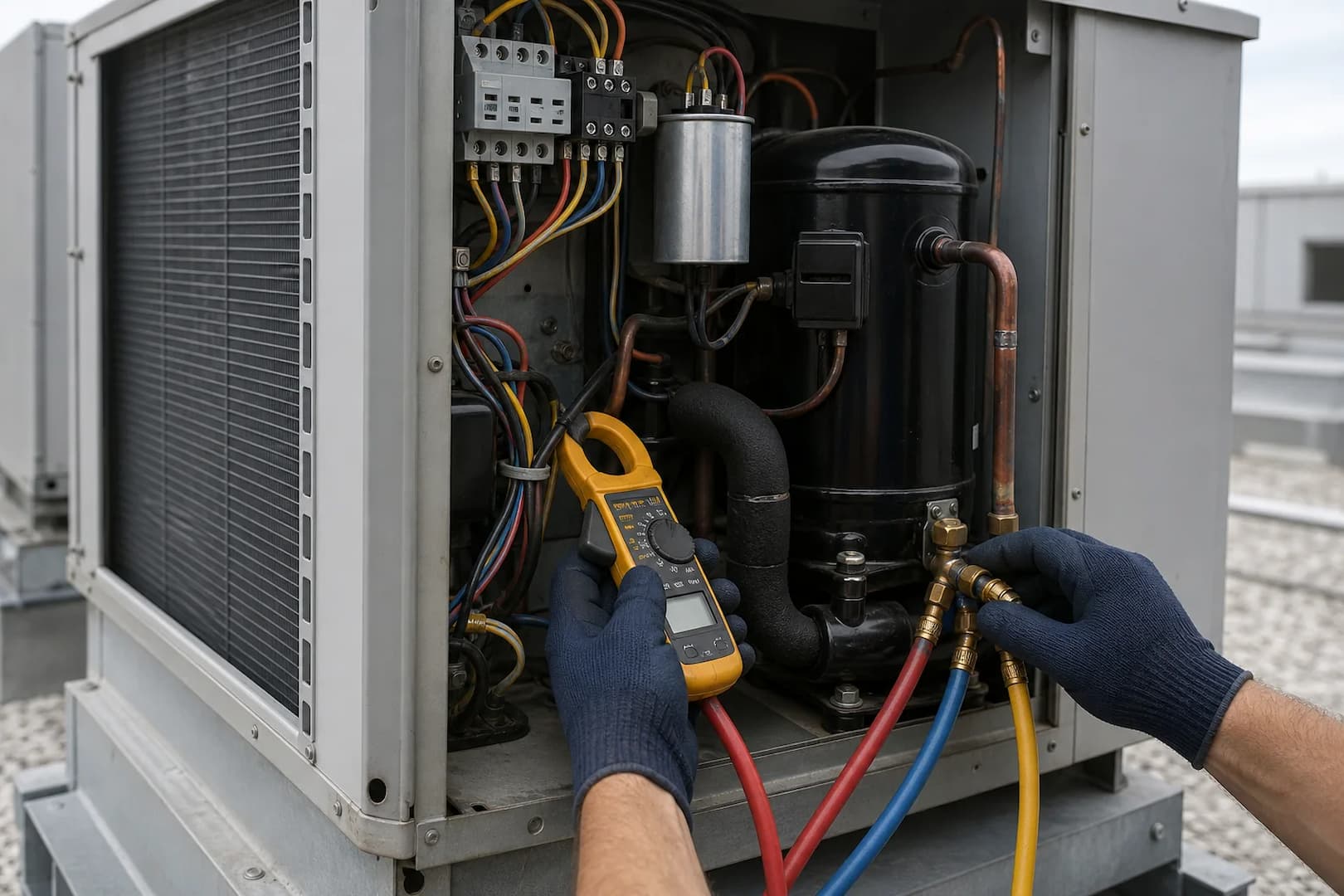
Motors, capacitors, contactors, voltage, current, compressor response, temperatures, pressures, and accessible leak evidence are evaluated under a valid load.
Explain the repair
We separate the failed component from maintenance conditions, control issues, distribution problems, and replacement questions.
Commercial systems have different access and sequences
- Packaged rooftop units and gas/electric RTUs
- Commercial split systems and condensing units
- Air handlers with DX cooling sections
- Heat pumps operating in cooling mode
- Multi-stage and variable-capacity equipment
- Economizers, zoning controls, VAV connections, and building automation interfaces
Equipment make and model help with preparation, but the building use is just as important. A restaurant kitchen, server room, retail sales floor, office suite, and warehouse each impose a different cooling pattern.
One failed compressor does not tell the whole story
A contactor, capacitor, motor, sensor, actuator, drain component, control board, or localized refrigerant leak may support repair when the rest of the system is sound and parts remain practical.
Replacement deserves a closer look when major components fail together, the cabinet or coils are badly deteriorated, refrigerant or parts constraints make future work difficult, comfort problems come from poor sizing or distribution, or repair cost no longer fits the unit's condition.
We explain what gets cooling back, then identify any separate planning issue. That lets a property manager solve today's problem without losing sight of the equipment's trajectory.
Choose the page that matches the job
Commercial air conditioning repair FAQ
Why is the commercial AC running but not cooling?
The fan can operate without the compressor or cooling stage. Control calls, safeties, contactors, compressor protection, refrigerant conditions, coil airflow, dampers, and load all need to be checked.
Does low refrigerant mean the unit only needs a recharge?
Refrigerant does not get used up in normal operation. If the charge is low, there may be a leak or a previous service issue. The system should be evaluated before refrigerant is added.
Why does the rooftop unit freeze?
Low airflow, dirty filters or coils, fan trouble, incorrect control operation, refrigerant issues, metering-device faults, or operation in unsuitable conditions can drop the coil below freezing.
Can an economizer cause warm-air complaints?
Yes. A stuck outdoor-air damper, failed actuator, bad sensor, poor changeover logic, or incorrect minimum position can bring in more hot or humid air than the unit can handle.
How much does commercial AC repair cost?
Access, system type, diagnostic time, failed part, refrigerant work, controls, permits where applicable, and after-repair testing affect cost. A useful estimate follows diagnosis rather than a symptom alone.
What should I include in the form?
Send the property and unit location, affected areas, current thermostat or BAS reading, recent alarm, whether the fan is running, any ice or water, and safe roof or mechanical-room access details.
Get the cooling problem diagnosed
Describe what the unit does, when the space warms up, and which areas are affected. Sadowski HVAC will use that information to prepare for the visit.
Sadowski HVAC Corp. · 633 Pierce Ave Unit 7, Linden, NJ 07036 · Mon–Fri 8:00 AM–5:00 PM