

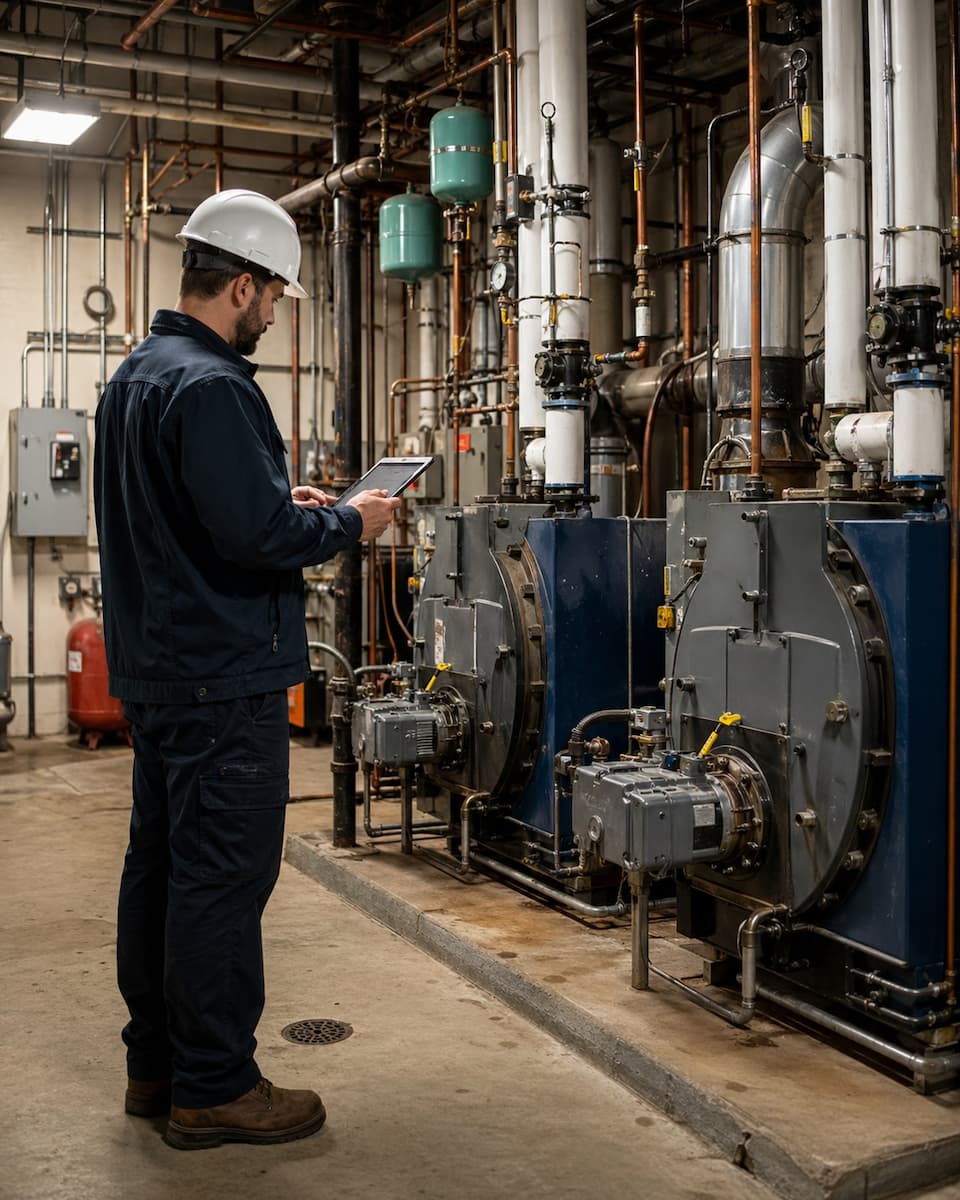
Commercial Boiler Replacement • Linden, NJ
Commercial Boiler Replacement in Linden, NJ
When an aging commercial boiler becomes unreliable, inefficient, oversized, undersized, or too costly to keep repairing, replacement needs to be planned carefully. Sadowski Heating & Air Conditioning helps Linden building owners replace boiler systems with the right capacity, proper hydronic integration, safe venting, and a practical installation plan that respects business operations.
NJ HVAC License #13VH11514600, 633 Pierce Ave Unit 7, Linden, NJ 07036, Mon-Fri 8:00 AM-5:00 PM
Replacement Triggers
When repair stops being the best business decision.
Commercial boilers are often repaired for years before replacement becomes urgent. The smarter time to evaluate replacement is when the system is still operating, but the pattern of failures, costs, or performance problems is becoming difficult to justify.
Repeated Breakdowns
Frequent ignition failures, lockouts, leaking components, or emergency calls can make replacement more practical than continuing to patch the system.
Uneven Building Heat
If some areas are too cold while others overheat, the issue may involve boiler output, circulation, controls, or a system no longer suited to the building.
Obsolete Parts
Older boilers can become harder and slower to repair when controls, burners, valves, or manufacturer-specific components are difficult to source.
High Operating Costs
Aging boilers may use more fuel, cycle inefficiently, or require expensive maintenance that does not meaningfully improve long-term reliability.
Venting or Safety Concerns
Combustion air, flue condition, clearance, and safety control issues can make replacement a better path than trying to keep outdated equipment alive.
Building Changes
Renovations, tenant changes, added zones, or changed occupancy patterns may mean the existing boiler no longer matches the actual heating load.
Replacement Assessment
A commercial boiler replacement starts with the building load.
Replacing a commercial boiler with the same size by default can repeat old problems. We review the heating demand, existing piping, controls, venting, mechanical room constraints, and the way the property is used so the replacement plan makes sense beyond the first day of operation.
- 1Capacity and load review: helps avoid equipment that short cycles, struggles to recover, or wastes energy during mild weather.
- 2Hydronic compatibility: pumps, piping, expansion, air elimination, pressure, and zones must support the new boiler's operation.
- 3Venting and combustion air: replacement may require attention to flue path, intake requirements, clearances, and mechanical room conditions.
- 4Controls and sequencing: thermostats, building controls, outdoor reset, staging, and safety controls affect comfort and operating behavior.
- 5Access and logistics: boiler room layout, removal path, equipment weight, and work timing all matter in an occupied commercial property.
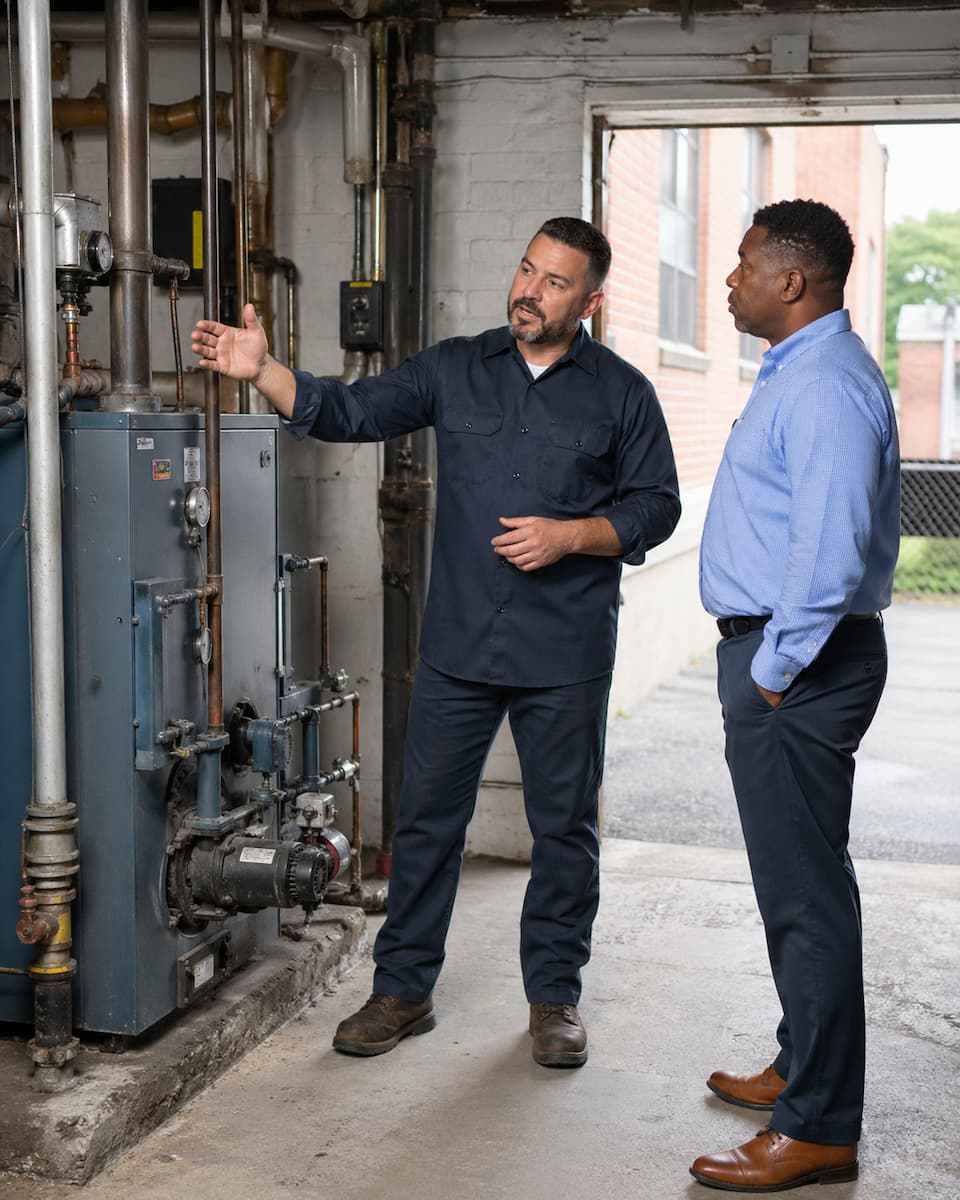
Commercial Boiler System Design
The replacement has to work with everything connected to it.
A boiler is the heat source, but commercial comfort depends on the full system. During replacement planning, we look for compatibility problems that can affect reliability, noise, comfort, efficiency, and serviceability.
Key system areas we review
The goal is to install a boiler that operates correctly in the real mechanical environment. That means checking the components that help the boiler move heat through the building safely and consistently.
Standard or High-Efficiency Options
Depending on the building and venting path, replacement may involve different boiler types, efficiency levels, and installation requirements.
Single Boiler or Staged Strategy
Some commercial properties benefit from staged equipment or modular planning when load variation, redundancy, or future service access matters.
Replacement Process
Designed to reduce disruption and avoid surprises.
Commercial boiler replacement affects access, heat availability, business schedules, tenants, and mechanical room logistics. A structured process helps the project move from evaluation to operation with fewer unknowns.
Site Review
We inspect existing equipment, access, piping, venting, controls, and reported heating problems.
Replacement Scope
The plan identifies equipment needs, related components, removal requirements, and integration concerns.
Scheduling
Work timing is planned around building use, weather, access, and the need to limit downtime where possible.
Installation
The old boiler is removed, new equipment is installed, and connected components are addressed according to the approved scope.
Startup
The system is checked for operation, heating response, pressure behavior, control function, and practical readiness.
Budget Planning
Commercial boiler replacement cost depends on more than boiler size.
A useful estimate should explain what is included and why. The boiler itself is only one part of the project. Labor, removal, piping changes, venting, controls, pumps, access, safety components, and commissioning can all affect the final scope.
Equipment Type and Capacity
Standard efficiency, high-efficiency, staged, modular, gas-fired, and hydronic system requirements can lead to very different project scopes.
Mechanical Room Access
Tight boiler rooms, stairs, roof or basement access, removal path, and equipment handling can affect labor and scheduling.
Piping and Components
Replacement may involve pumps, valves, expansion tank, air separator, backflow prevention, isolation valves, or piping corrections.
Venting and Controls
Flue changes, combustion air needs, thermostats, safety controls, building automation connections, and startup requirements can affect cost.
Local Linden Replacement Support
Boiler replacement for commercial properties near Linden and Union County.
Sadowski Heating & Air Conditioning is based in Linden, NJ, and works with commercial properties that need practical heating replacement guidance, responsive scheduling, and clear communication from evaluation through startup.
- Linden
- Roselle
- Rahway
- Elizabeth
- Cranford
- Union County
Commercial Boiler Replacement FAQ
Questions before replacing a commercial boiler.
Commercial boiler replacement should be planned with enough detail to protect comfort, budget, safety, and building operations.
How do I know if our commercial boiler should be replaced instead of repaired?
Replacement becomes worth evaluating when repairs are frequent, parts are difficult to source, operating costs keep rising, heating is uneven, safety concerns appear, or the boiler no longer matches the building's heating demand.
Can you replace a boiler without shutting down the building for a long time?
Downtime depends on the equipment, piping, access, weather, and project scope. A good replacement plan identifies heat interruption risks early and schedules the work as practically as possible for an occupied commercial property.
Should we install the same size boiler again?
Not automatically. The existing boiler may have been oversized, undersized, or no longer suitable after building changes. Replacement planning should review load, zones, usage patterns, and hydronic system requirements.
What affects the cost of commercial boiler replacement?
Major cost factors include boiler type and capacity, removal difficulty, mechanical room access, piping changes, pumps, expansion components, venting, controls, safety devices, and startup requirements.
Do you replace boilers for mixed-use and multifamily buildings?
Yes. Sadowski Heating & Air Conditioning can help with commercial boiler replacement planning for mixed-use properties, multifamily buildings, offices, retail spaces, and light commercial facilities in and around Linden.
Request Replacement Planning
Ready to evaluate a commercial boiler replacement in Linden?
Contact Sadowski Heating & Air Conditioning to review your existing boiler, building needs, replacement options, and installation logistics before the system becomes an emergency problem.
