Commercial HVAC Controls in Linden, NJ
When equipment runs at the wrong time, ignores a call, or heats and cools the same zone, the fault may live in the control sequence rather than the compressor, fan, or burner. We troubleshoot the signal path before parts get replaced.
Tell us what the system is doing
Include the affected area, any alarm or error code, and whether the problem follows a schedule, weather change, or occupied period.
Controls decide when good equipment can work
A rooftop unit may be mechanically healthy and still leave a suite uncomfortable because a sensor reads badly, an actuator stalls, a relay drops out, or the building schedule never sends the expected enable command.
Controls problems tend to blur together. A tenant reports “no heat,” yet the burner never receives a heat call. Another zone overheats because its damper remains open. A unit starts overnight because the clock, occupancy mode, override, or BAS point does not match the building's actual schedule.
The dividing line is whether the command is wrong or the equipment fails to obey a correct one. Finding that line keeps an expensive component from being blamed for a missing signal.
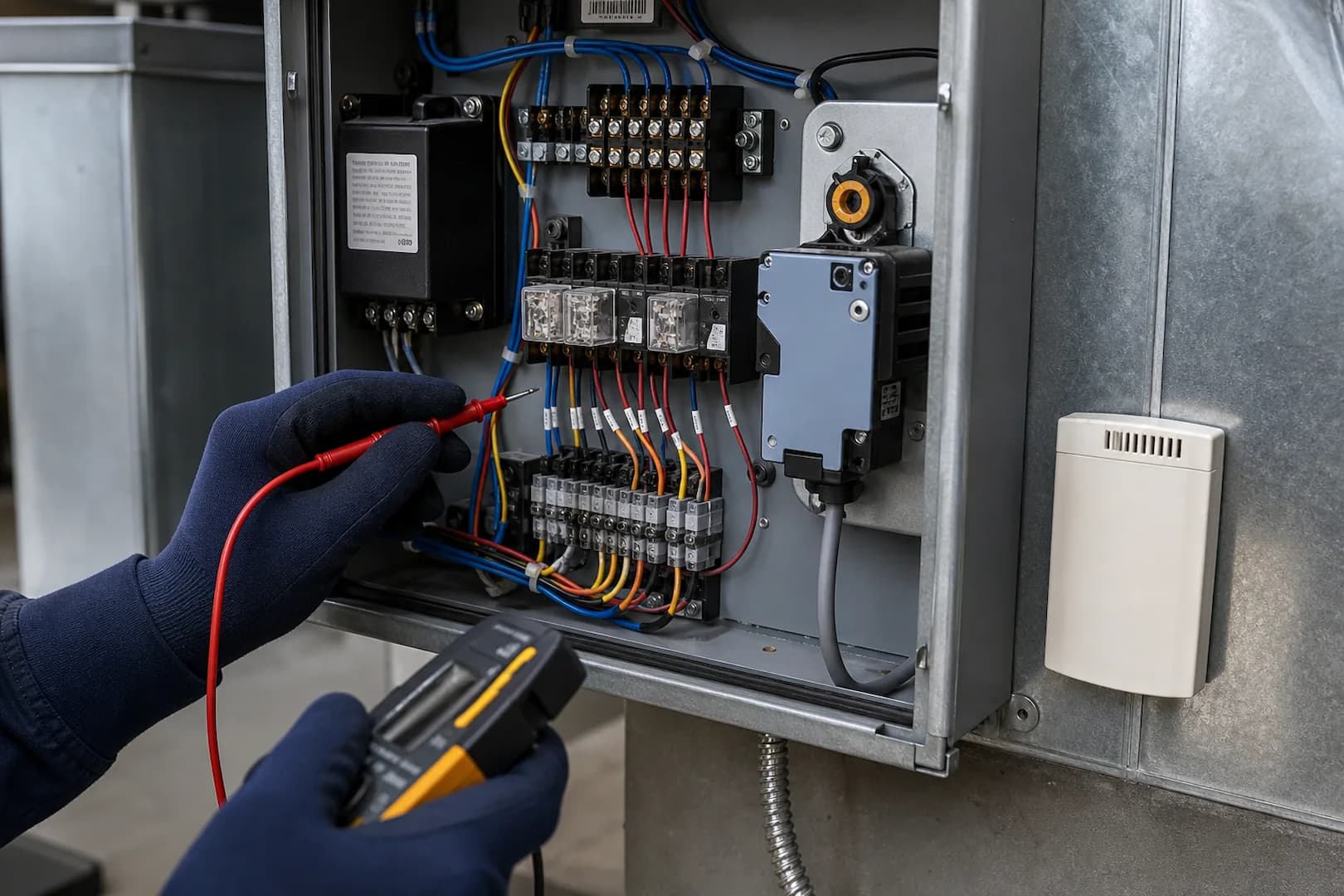
Commercial control faults we investigate
Unit does not start
We check power and safeties first, then trace the thermostat or BAS call through transformers, fuses, relays, interlocks, terminal connections, and equipment enable inputs.
Wrong temperature in one zone
A drifting sensor, failed actuator, stuck damper, valve problem, airflow shortage, or bad setpoint can create the same room-level complaint. Each needs a different fix.
Short cycling or repeated resets
Control bounce, unstable sensors, loose low-voltage wiring, pressure switches, limits, minimum-run settings, and the mechanical condition of the unit all deserve a look.
Heating and cooling overlap
Simultaneous calls can come from crossed wiring, failed valves, incorrect economizer logic, bad changeover control, zoning conflicts, or a sequence that no longer fits the equipment.
Damper or valve will not move
We distinguish a failed actuator from a seized linkage, missing control signal, wrong power supply, broken end switch, binding damper, or hydronic valve problem.
Schedule and communication issues
Occupied mode, holiday schedules, local overrides, network alarms, disconnected controllers, and stale points can make the system appear random even when the pattern is repeatable.
Controls we work around every day
Commercial control systems range from stand-alone thermostats to DDC networks with dozens of points. The labels differ, but the chain still depends on accurate inputs, a valid sequence, usable outputs, and equipment that responds.
- Space, duct, outdoor-air, discharge-air, humidity, and pressure sensors
- Thermostats, zone controllers, relays, contactors, transformers, and fuses
- Damper actuators, valve actuators, end switches, and position feedback
- Economizer, freeze-stat, smoke, condensate, airflow, pressure, and limit circuits
- VFD enable and speed signals, fan proving, and equipment interlocks
- Occupied schedules, setbacks, overrides, alarms, and selected BAS points
The right fix depends on what failed
Loose wiring, a weak transformer, bad sensor, failed relay, or worn actuator usually calls for a focused repair. A schedule or setpoint issue may need a controlled adjustment and a quick check that the new behavior matches the space.
A retrofit conversation makes more sense when obsolete controllers have no practical replacement, repeated field failures point to aging infrastructure, or the current sequence cannot support new equipment and zoning needs. That is a different decision from getting one unit back online.
We keep those questions separate. The immediate fault is explained first; broader controls work follows only when the evidence supports it.
How we narrow the fault
Reproduce the behavior
We compare the complaint with the current mode, setpoint, schedule, outdoor condition, tenant demand, and any active alarm.
Trace input to output
Sensor values, calls, safety circuits, controller outputs, relays, actuators, contactors, and the equipment response are followed in order.
Verify the mechanical side
A correct command cannot overcome a stuck damper, failed motor, closed valve, low airflow, ignition fault, or refrigerant problem.
Document the next step
We explain the failed point, what can be repaired or adjusted, and whether programming or proprietary support is still needed.
Commercial HVAC controls FAQ
What is the difference between DDC and a BAS?
Direct digital controls are the controllers and logic operating equipment or zones. A building automation system is the broader platform that connects controllers, graphics, schedules, alarms, and trends. People often use the terms together because the systems overlap.
Can a bad thermostat make a commercial unit look broken?
Yes. A thermostat or zone sensor can fail, drift, lose power, break communication, or send the wrong mode. The unit may never receive a valid call, or it may run longer than the space needs.
Why does the BAS say a fan is on when it is not moving?
The displayed command and actual proof are different points. A controller may issue an “on” command while a starter, VFD, motor, belt, safety, or proving switch prevents operation. Both sides must be checked.
Do you change programming in every controls service call?
No. Many faults are field-device, wiring, power, safety, or mechanical problems. Programming changes should be made only when the sequence is understood, access is authorized, and the change fits the equipment design.
Can you troubleshoot zoning controls?
We can trace thermostats or sensors, zone calls, dampers, actuators, control wiring, and equipment response. Large proprietary zoning networks may also require the system's controls provider.
What details help before the visit?
Send the affected zone, unit name if known, screenshots or exact alarm text, the time the problem occurs, recent schedule changes, and whether a local override changes anything.
Controls rarely fail in isolation
Get a control problem traced in the right order
Describe the zone, equipment, alarm, or schedule issue. Sadowski HVAC will use those details to prepare for a focused commercial controls visit in Linden.
Sadowski HVAC Corp. · 633 Pierce Ave Unit 7, Linden, NJ 07036 · Mon–Fri 8:00 AM–5:00 PM