

Commercial Heat Pump Services in Linden, NJ
Repair, planned maintenance, and installation support for commercial heat pumps that must handle both heating and cooling. We follow the operating mode, building load, airflow, controls, and refrigeration circuit instead of treating every comfort call as the same problem.
Tell us what the heat pump is doing
Include the property type, affected area, current mode, thermostat or controller message, equipment label, and when access is available.
The diagnosis changes when refrigerant flow reverses
A commercial heat pump may cool normally and struggle in heating, or fail only during defrost. That split in behavior helps separate airflow and control problems from components used differently in each mode.
We look at the call from the thermostat or building control, indoor and outdoor coil conditions, fan operation, compressor performance, refrigerant temperatures and pressures where appropriate, reversing-valve response, sensors, safeties, and auxiliary heat where fitted.
A mechanically sound unit can still fall behind after a schedule change, an open loading door, a blocked return, a new internal load, or a tenant control adjustment. The repair decision has to answer the measured condition, not merely the loudest symptom.
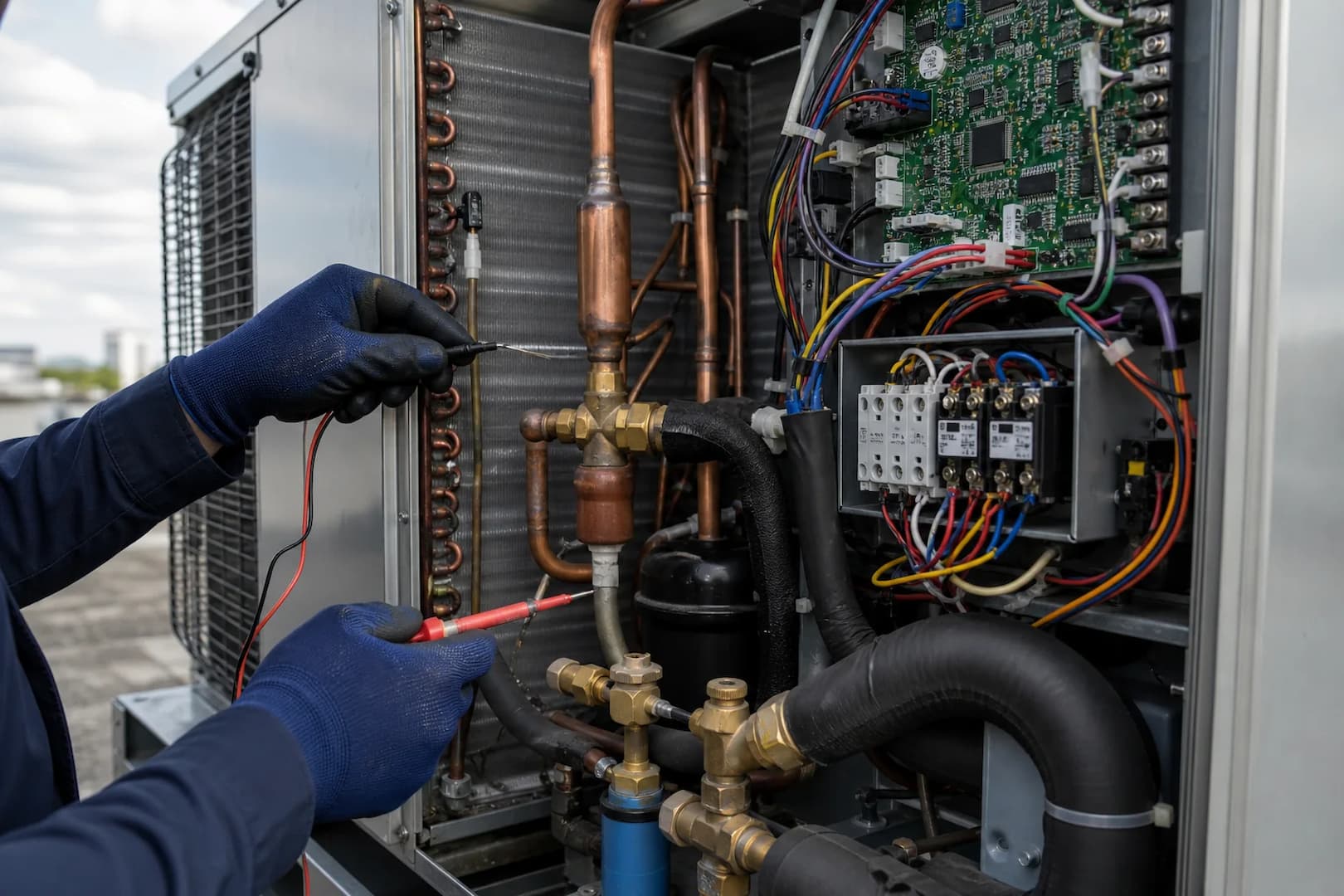
Checks on both sides of the cycle
- Thermostat or building-control calls, schedules, setpoints, mode commands, and displayed faults
- Filters, indoor and outdoor coils, supply and return airflow, blowers, fans, belts where fitted, and dampers
- Compressor, contactors, capacitors where used, inverters where fitted, electrical terminations, and safeties
- Reversing valve, defrost board or sequence, thermistors, pressure controls, and auxiliary heat components
- Refrigerant circuit observations, temperatures and pressures where warranted, service valves, piping, and insulation
- Condensate pan, drain, trap, pump where present, cabinet condition, vibration, and accessible duct connections
Capacity alone does not define a good replacement
A commercial heat pump has to fit the available electrical service, roof or equipment area, duct system, ventilation requirement, controls, condensate route, sound limits, and the building's heating conditions. Replacement planning begins with those constraints.
We also look at how the space is used now. Occupancy, operating hours, exhaust, outside-air load, zoning, process heat, and future tenant changes can make a like-for-like selection a poor fit even when the old nameplate is easy to read.
Commissioning closes the loop: airflow, controls, stages, safeties, mode change, defrost setup, auxiliary heat, drainage, and documented operating readings should be verified after startup.
Heat pump symptoms that narrow the search
Heat in cooling mode
Controller output, thermostat wiring, reversing-valve operation, board logic, valve coil condition, and refrigerant behavior help show why the mode did not change.
Little heat on a cold day
Outdoor coil condition, defrost, airflow, compressor staging, refrigerant performance, sensors, auxiliary heat, and actual building load all influence delivered heat.
Outdoor unit covered in ice
Defrost controls, coil sensors, fan operation, drainage, airflow, refrigerant condition, weather, and cycle timing must be separated from normal light frost.
Frequent starting and stopping
Controls, sensor location, low airflow, safeties, charge condition, equipment sizing, staging, short circuiting of air, or a changing load may shorten cycles.
High electric demand
Auxiliary heat operation, dirty coils, fan or compressor condition, low capacity, schedule changes, setpoints, simultaneous calls, and building envelope changes can raise use.
One area stays uncomfortable
Dampers, duct leakage, diffusers, filters, fan speed, zoning controls, local loads, sensor placement, and equipment capacity should be checked before condemning the unit.
How we approach commercial heat pump work
Define the mode
We start with heating or cooling, affected areas, outdoor conditions, schedule, displayed faults, and what changed before the complaint.
Check air and controls
Calls, sensors, fans, coils, filters, dampers, airflow paths, zoning, and accessible controls are tested in context.
Evaluate the equipment
Electrical, compressor, reversing, defrost, auxiliary heat, refrigeration, drainage, and safety conditions follow the evidence.
Set the scope
The outcome may be adjustment, repair, planned maintenance, deeper testing, or an installation conversation based on condition and use.
Repair the fault or plan the next system
Commercial heat pump FAQ
Do commercial heat pumps provide both heating and cooling?
Yes. Most move heat in either direction by changing the refrigerant circuit through a reversing valve. The exact arrangement varies among packaged, split, water-source, and variable-refrigerant systems.
Why does the outdoor unit run during heating?
In heating mode, the outdoor coil collects heat and the outdoor fan and compressor normally operate. The unit may stop or change sound during defrost. Persistent icing, alarms, or no indoor heat is different from normal operation.
Why is auxiliary heat running so often?
Low outdoor temperature, recovery from a deep setback, a defrost call, control setup, heat-pump capacity loss, sensor error, or an auxiliary-heat fault can affect staging. Actual control inputs and delivered temperatures should be checked.
Can a heat pump be repaired if it cools but will not heat?
Often, yes. A mode-specific problem may involve the reversing valve, controls, sensors, defrost system, auxiliary heat, or refrigeration performance. Testing is needed before the repair scope is clear.
How often does a commercial heat pump need maintenance?
Run hours, environment, filter loading, roof exposure, occupancy, operating season, equipment design, and manufacturer guidance influence the interval. Heavily used equipment may need attention more often than a calendar-only plan suggests.
When should we discuss replacement?
Consider condition, repair history, parts availability, refrigerant and electrical constraints, comfort, operating demands, controls, remaining equipment life, and upcoming building changes. Age alone does not answer the question.
Tell us which mode is falling behind
A description of the affected area, outdoor conditions, schedule, and controller message gives the service call a useful starting point.
Sadowski HVAC Corp. · 633 Pierce Ave Unit 7, Linden, NJ 07036 · Mon–Fri 8:00 AM–5:00 PM