Commercial VRF/VRV Repair & Maintenance in Linden, NJ
When one zone drifts, several indoor units stop, or the outdoor system posts an error, the fault may sit anywhere from the room sensor to the refrigerant network. Sadowski HVAC traces the system before deciding what needs attention.
Request VRF/VRV service
Tell us which zones are affected, the displayed code, when the issue began, and whether the system is heating, cooling, or changing modes.
A system-level diagnosis for a connected HVAC network
VRF and VRV systems tie multiple indoor units to one or more outdoor units through refrigerant piping, electronic expansion devices, sensors, controls, and a communication bus. A single alarm does not always identify the failed part.
If one cassette is uncomfortable while neighboring zones operate normally, we begin locally: filter and coil condition, fan operation, sensor readings, condensate safety, addressing, and the electronic expansion valve. If many zones fail at once, power, communications, common controls, branch devices, or the outdoor unit move higher on the list.
Timing often does more work than the error label. A fault limited to low outdoor temperatures, mode changes, or full building load leaves a different trail from a hard lockout after a power event.
How a VRF/VRV service visit proceeds
Map the complaint
We identify affected zones, operating modes, controller messages, timing, recent work, power events, and access points.
Read system behavior
Indoor and outdoor status, sensor values available at the equipment, calls, responses, and communication patterns narrow the fault area.
Test the likely path
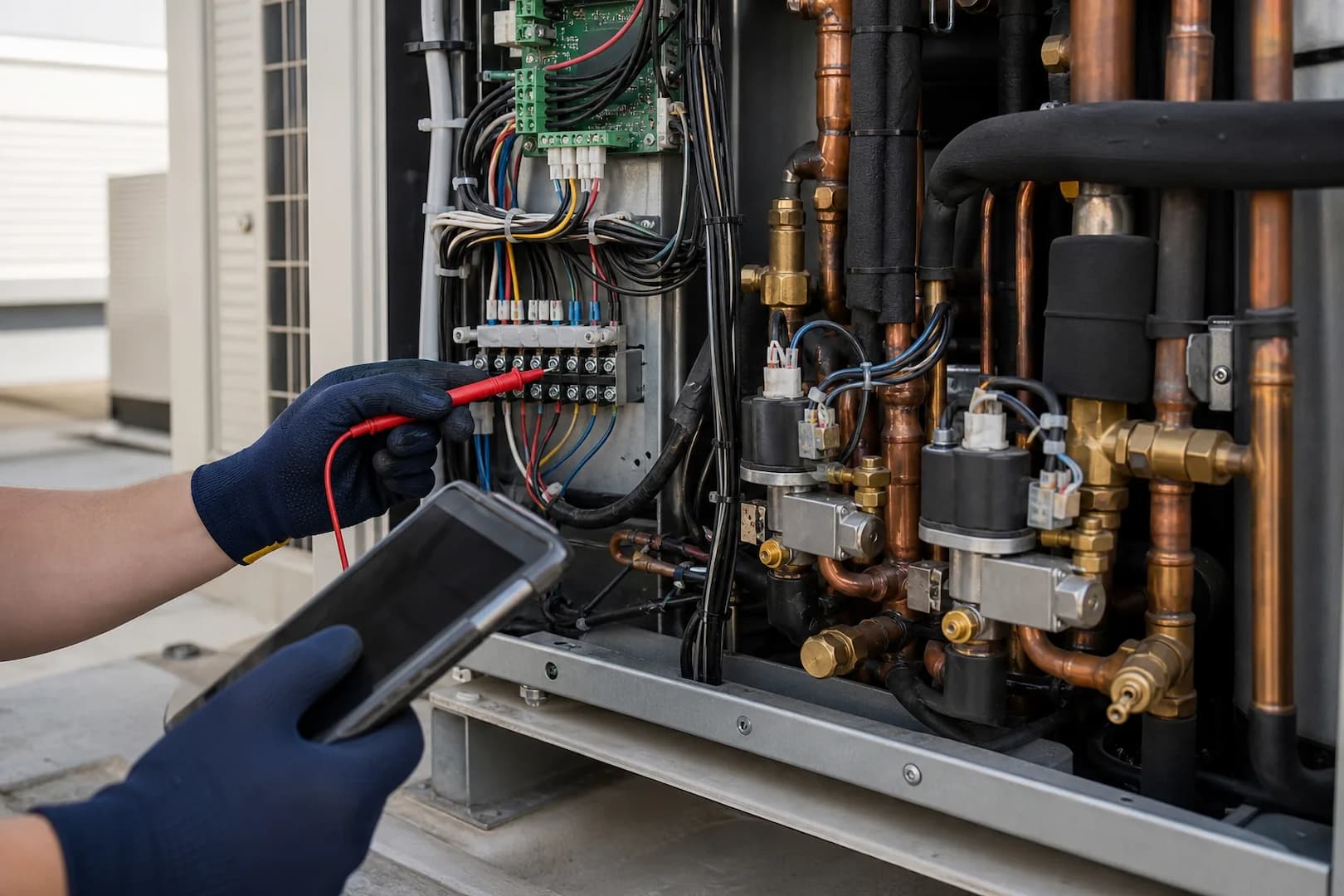
Airflow, drains, wiring, devices, boards, refrigerant performance, and branch components are checked as the evidence requires.
Explain the next move
We distinguish correction, further testing, part replacement, maintenance needs, and operating observations without bundling them together.
What VRF/VRV behavior can tell us
One indoor unit will not condition
Local power, controller settings, addressing, fan operation, sensor input, condensate safety, expansion-valve response, airflow, and coil condition deserve attention.
Several zones stop together
A shared communication path, outdoor-unit fault, branch controller, network addressing, central schedule, power supply, or common protective input may affect the group.
Heating and cooling conflict
System mode, heat-recovery configuration, branch selector operation, controller priority, simultaneous demand, outdoor conditions, and setup parameters shape what each zone can do.
Capacity fades under peak load
Coil fouling, fan speed, refrigerant distribution, outdoor airflow, compressor staging, sensor accuracy, piping conditions, or a load change can reduce available capacity.
Recurring communication alarm
Loose terminations, polarity, shielding and routing, damaged cable, duplicate addresses, power quality, control boards, or an intermittent device can disturb the network.
Water appears below a cassette
Drain restriction, lift-pump trouble, poor slope, pan condition, float switch, insulation gaps, dirty coil, or high humidity may be responsible.
Indoor, outdoor, and control-side checks
- Controller messages, stored history available at the equipment, operating mode, schedules, and setpoints
- Indoor filters, coils, fans, louvers, thermistors, drains, pumps, floats, and electronic expansion devices
- Outdoor coils, fans, compressors, inverters, boards, sensors, service valves, and accessible safeties
- Branch selector or heat-recovery components where fitted, including control and piping observations
- Communication wiring, addressing, terminations, supply voltage, disconnects, and visible electrical condition
- Refrigerant temperatures and pressures where appropriate, piping insulation, oil traces, and leak indications
Service should preserve the system's baseline
A useful maintenance visit records how the system behaves, not only whether it starts. Indoor and outdoor coil condition, fan response, drain performance, controller history, temperatures, and operating modes provide a reference for later calls.
Access planning is especially important in occupied buildings. Ceiling cassettes, concealed ducted units, branch boxes, rooftop equipment, and tenant controls may sit in different spaces. Identifying those locations before the visit keeps diagnosis from ending at a locked ceiling or electrical room.
When an active fault is found, we separate the repair decision from routine cleaning and adjustment, then explain what can wait and what is affecting operation now.
Commercial VRF/VRV repair and maintenance FAQ
What is the difference between VRF and VRV?
Both terms describe variable-refrigerant-flow, multi-zone systems. VRV is a manufacturer-used name for the same general system concept. The installed make and model determine the controls, service information, and component layout.
Why is only one zone not working?
The fault may be local to the indoor unit, controller, sensor, fan, drain safety, expansion device, address, or wiring. It can also result from a system mode or branch condition, so the neighboring zones still provide useful context.
Can you diagnose a VRF error code?
The code is a starting point. It should be read with the operating state, equipment history, model-specific information, and physical measurements because a code may describe a protective condition rather than name the failed part.
Does a low-capacity VRF system always need refrigerant?
No. Airflow, dirty coils, sensor error, fan performance, mode conflict, controls, outdoor conditions, compressor staging, and building load can resemble a refrigerant problem. Adding refrigerant without evidence can create a second problem.
What belongs in VRF preventive maintenance?
Indoor and outdoor coils, filters, fans, condensate components, controls, error history, wiring condition, airflow, sensors, outdoor-unit operation, piping observations, and accessible branch devices should be considered.
What should our facility team send before service?
Provide controller photos, fault codes, affected room numbers, equipment labels, the current operating mode, when the issue occurs, recent power or construction work, and access requirements for indoor and outdoor units.
Match the service page to the project
Start with the zones and the code you can see
Tell us what is operating, what is not, and when the behavior changes. That short history can save time once the system is in front of us.
Sadowski HVAC Corp. · 633 Pierce Ave Unit 7, Linden, NJ 07036 · Mon–Fri 8:00 AM–5:00 PM