
Why Is My Heat Pump Not Heating?
A heat pump does not heat the way a gas furnace does. Instead of creating high-temperature combustion heat, it moves heat from outdoor air into the home. The air at the vents may feel warm rather than hot, and the system may run longer in cold weather. That can be normal. A house that cannot reach the thermostat setting, supply air that is actually colder than the room, an outdoor unit buried in ice, or auxiliary heat that never helps is not normal.
Winter heat-pump complaints usually fall into one of four groups: the controls are in the wrong mode, the system cannot move enough indoor or outdoor air, the refrigeration cycle is not transferring heat, or the backup-heat system is not joining in when required. Defrost behavior adds another layer because a heat pump briefly changes operation to melt frost from the outdoor coil.
This guide separates normal cold-weather behavior from a problem that needs heat pump repair. It also gives you a short set of safe checks. Refrigerant, high-voltage, reversing-valve, and internal control work should be left to a qualified technician.
Quick answer: Set the thermostat to Heat, not Cool or Fan, and raise the setpoint a few degrees. Keep the fan on Auto. Check the filter, open vents, clear returns, and make sure the outdoor unit has airflow around it. A light frost that disappears during a short defrost cycle is normal; a solid ice shell is not. If the home keeps losing temperature, the breaker trips, the outdoor unit never runs, defrost does not clear the coil, or auxiliary heat cannot recover the temperature, arrange professional diagnosis.
Is the Heat Pump Really Blowing Cold Air?
Human skin is a poor thermometer for heat-pump supply air. Moving air in the 85°F to 95°F range can feel cool against a hand even though it is warmer than the room. A furnace may send much hotter air, so homeowners often notice the difference after switching equipment or moving into a home with a heat pump.
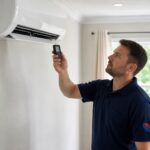
Watch the room temperature for thirty to sixty minutes. If it rises steadily and the system eventually satisfies the thermostat, the gentler air may be normal. If the indoor temperature is flat or falling, compare air at a supply register with the room using a reliable thermometer. Do not put a probe inside the cabinet. A technician will make a more accurate temperature-split measurement at the equipment and account for airflow, outdoor temperature, system stage, and defrost status.
How a Heat Pump Heats in Winter
In heating mode, the outdoor coil absorbs heat and the indoor coil releases it. The compressor moves refrigerant through the circuit, while a reversing valve sends the flow in the heating direction. As outdoor temperature falls, the equipment has less heat available to collect and the home’s heat loss rises. Capacity and efficiency therefore change with weather, though modern cold-climate models can operate at temperatures that would have challenged older designs.
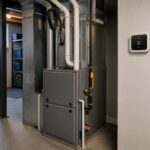
Many ducted systems include electric resistance strips or another backup source. The thermostat may label this Auxiliary Heat or AUX. It can start when the heat pump alone cannot recover quickly, when outdoor temperature reaches a configured balance point, or during defrost. Emergency Heat is different: on many systems it locks out the outdoor unit and runs only the backup source. That mode is a temporary option for a failed outdoor unit, not a daily performance boost.
What a Normal Defrost Cycle Looks Like
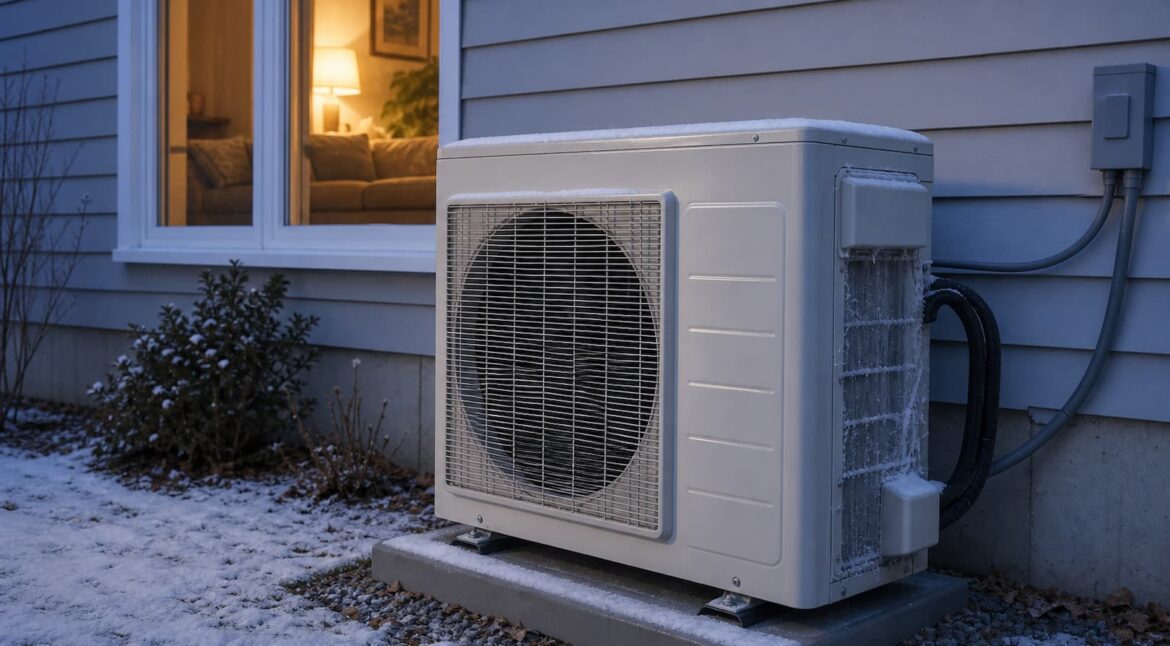
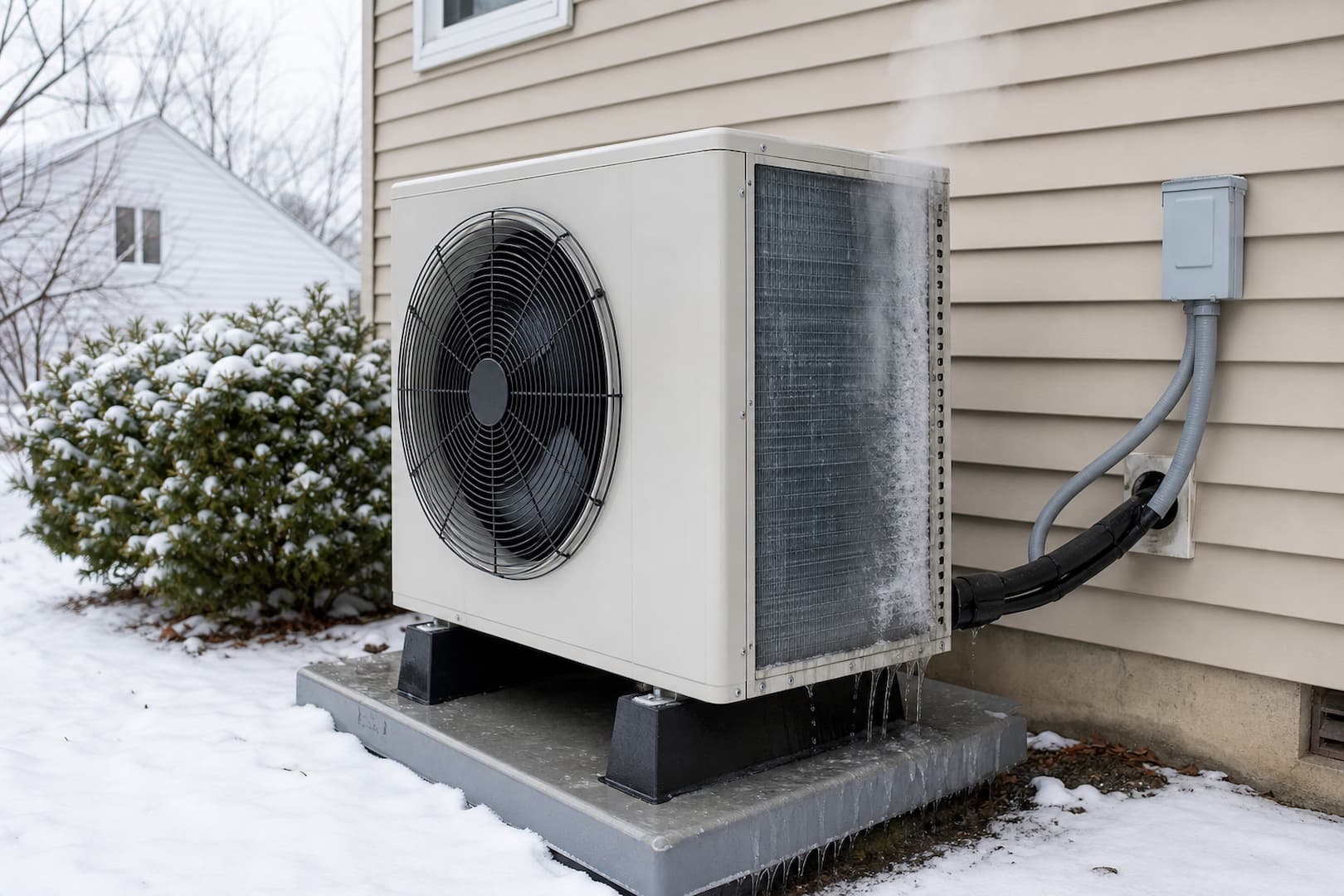
Moist outdoor air can condense and freeze on the cold outdoor coil. A thin, even layer of frost is expected. The heat pump periodically enters defrost, temporarily reversing the refrigeration cycle so hot refrigerant warms the outdoor coil. The outdoor fan may stop, steam can rise, water may drain beneath the unit, and the indoor air can feel cooler for several minutes. Backup heat may run to limit that indoor temperature dip.
Defrost is short. The unit should return to heating and the frost should clear. Service is warranted when thick ice covers the coil, the fan guard, or the cabinet; when defrost repeats excessively; when ice remains after the cycle; or when the unit seems stuck in defrost. Do not chip ice from the coil or pour hot water over the equipment. Aluminum fins, sensors, tubing, fan blades, and electrical parts are easily damaged.
Safe Checks Before You Call
Confirm Heat Mode, Setpoint, and Fan Setting
Select Heat and raise the target two to four degrees above room temperature. Use Auto for the fan. Fan On circulates room-temperature air between heating calls and can make the system appear colder than it is. If the thermostat shows Emergency Heat, return to normal Heat unless a technician or the equipment instructions say otherwise. Review schedules, vacation holds, and smart-home automations that may be changing the setpoint.
Check the Filter, Registers, and Returns
A dirty filter reduces heat transfer at the indoor coil and can lower capacity, raise operating pressure, or trigger protective shutdowns. Replace a dirty disposable filter with the correct size and airflow direction. Open supply registers. Clear furniture, boxes, and curtains from return grilles. If filters clog unusually fast or one return whistles, the system may need an airflow evaluation rather than simply a different filter.
Give the Outdoor Unit Room to Breathe
From a safe position, remove loose leaves and light snow around the unit without reaching through the guard or using tools on the coil. Keep intake and discharge paths clear. Do not wrap or cover an operating heat pump for winter; it needs outdoor airflow. If roof runoff repeatedly freezes across the cabinet, the site may need a properly designed shield or drainage correction that does not obstruct airflow or service access.
Check Both Indoor and Outdoor Breakers
A split heat-pump system may have separate breakers for the outdoor unit and indoor air handler, plus a disconnect near the outdoor equipment. If a labeled breaker is tripped, reset it once. Do not keep resetting a breaker that trips again. The compressor, fan motor, heater kit, wiring, contactor, capacitor, or another electrical component may be at fault.
Look for an Error Message or Pattern
Thermostats may show alerts for auxiliary heat, lockout, sensor problems, communication loss, or service. Some outdoor boards have diagnostic lights, but do not remove high-voltage panels to find them. Write down any message exactly and note whether the outdoor unit is silent, humming, clicking, or trying to restart.
Common Reasons a Heat Pump Is Not Heating
1. The Thermostat Is Misconfigured
Heat pumps require thermostat logic that differs from a furnace-only system. Incorrect equipment type, reversing-valve setting, staging configuration, balance-point setting, or auxiliary-heat control can produce the wrong mode or prevent backup heat. This is especially likely after a thermostat replacement. A technician should compare thermostat configuration with the heat-pump model and wiring rather than changing options by trial and error.
2. Indoor Airflow Is Too Low
Filters are only one part of the air path. A dirty indoor coil, matted blower wheel, weak motor, incorrect blower profile, closed damper, collapsed flex duct, undersized return, or blocked grille can reduce delivered heat. Low airflow may create noisy registers and uneven rooms; in some conditions it can contribute to coil or pressure problems. Static pressure, blower data, and temperature readings tell more than a hand held over one vent.
3. The Outdoor Coil Is Dirty, Blocked, or Iced Over
The outdoor coil must exchange heat with the air. Leaves, lint, shrubs, snow, bent fins, and thick ice reduce that exchange. A failed fan, sensor, board, reversing valve, or low refrigerant charge can make icing worse. Cleaning a coil in freezing weather and diagnosing defrost require care; indiscriminate pressure washing can fold fins or push water into electrical components.
4. The Defrost System Is Not Working Properly
Defrost depends on sensors and control logic, and it relies on the refrigeration system being able to move heat. A faulty coil sensor, outdoor sensor, defrost board, reversing valve, fan control, refrigerant condition, or wiring problem can prevent a complete cycle. The visible ice is a symptom; replacing a sensor without testing the rest of the process may not solve it.
5. Refrigerant Charge or Flow Is Incorrect
A heat pump depends on the correct refrigerant mass and flow in both directions. A leak, restriction, metering problem, contaminated circuit, or incorrect charge can reduce heating, create abnormal frost, increase runtime, and stress the compressor. Refrigerant does not get “used up.” If charge is low, the system needs leak investigation and a repair plan—not routine seasonal topping off.
6. The Reversing Valve Is Not Shifting Correctly
The reversing valve directs refrigerant for heating or cooling. A failed solenoid, wiring problem, control command, internal valve issue, or pressure condition can leave the system in the wrong mode or somewhere between normal operating states. If a unit cools well in summer but cannot heat in winter—or sends distinctly cold supply air during a steady heat call—the reversing circuit is one possibility.
7. The Compressor or Outdoor Fan Is Not Running
A failed capacitor on applicable equipment, contactor, fan motor, compressor, control module, sensor, disconnect, or wiring fault can leave the indoor blower running without useful heat from the outdoor unit. Humming, hard starting, repeated clicks, or a tripped breaker are reasons to turn the system off and call. Do not reach into the cabinet; components may remain energized even when the unit is not running.
8. Auxiliary Heat Is Not Available
On a ducted electric system, backup strips may fail because of a breaker, sequencer, relay, limit, wiring, control, or heater-element problem. The heat pump may still produce some heat but fall behind in colder weather or during defrost. If Emergency Heat also produces no warmth, the backup system needs direct testing. Dual-fuel systems use a furnace as backup and require coordinated thermostat and control operation.
9. The System Is Undersized, the House Load Changed, or Ducts Are Losing Heat
Equipment can operate correctly and still miss the setpoint if it was not sized for the home’s design load, if an addition or renovation increased that load, or if ducts lose air in an attic or crawlspace. Poor insulation, open dampers, disconnected ducts, and large air leaks become more obvious during a cold snap. Diagnosis should compare equipment output with airflow and building conditions instead of assuming every comfort problem is a failed compressor.
What the Symptom Pattern Can Tell You
| Pattern | What it may suggest | Response |
|---|---|---|
| Air feels mild, but room temperature rises | Normal lower supply temperature | Monitor performance, not hand feel |
| Brief cool air, steam outside, then heat resumes | Normal defrost cycle | Allow the short cycle to finish |
| Outdoor coil stays covered in thick ice | Defrost, airflow, fan, or refrigerant problem | Turn off if fan or ice creates risk; call for service |
| Works in Emergency Heat but not normal Heat | Outdoor heat-pump or control problem | Use only as temporary backup and schedule repair |
| Neither normal nor Emergency Heat warms the home | Indoor power, blower, backup heat, thermostat, or airflow | Arrange prompt diagnosis |
When to Turn the Heat Pump Off
Shut the system down and call promptly if:
- The breaker trips again after one reset.
- You smell burning plastic, hot wiring, or a strong chemical odor at the equipment.
- The outdoor unit makes grinding, metal-on-metal, or severe buzzing sounds.
- The fan is striking ice, the cabinet is shaking, or ice threatens the fan or coil.
- Water is entering electrical areas or leaking into a finished part of the home.
- Indoor temperature is approaching an unsafe level for occupants or pipes.
A heat pump itself does not produce carbon monoxide, but a dual-fuel system may include a gas furnace. Treat a gas odor or CO alarm as an evacuation emergency and call the gas utility or 911 from outside. For urgent loss of heat after immediate hazards are addressed, emergency HVAC repair may be appropriate.
What a Heat Pump Technician Will Check
The technician should verify the complaint in the current outdoor conditions and identify which stage is running. That matters because readings taken during startup, defrost, auxiliary heat, or a variable-capacity transition can look very different from steady heating.
- Thermostat equipment setup, reversing-valve command, staging, sensors, balance point, and fault history.
- Filter, indoor coil, blower profile, static pressure, duct condition, return path, and supply temperature.
- Outdoor coil and fan, frost pattern, clearances, drainage, and defrost initiation and termination.
- Line voltage, capacitors where used, contactors, inverters or modules, motors, wiring, and current draw.
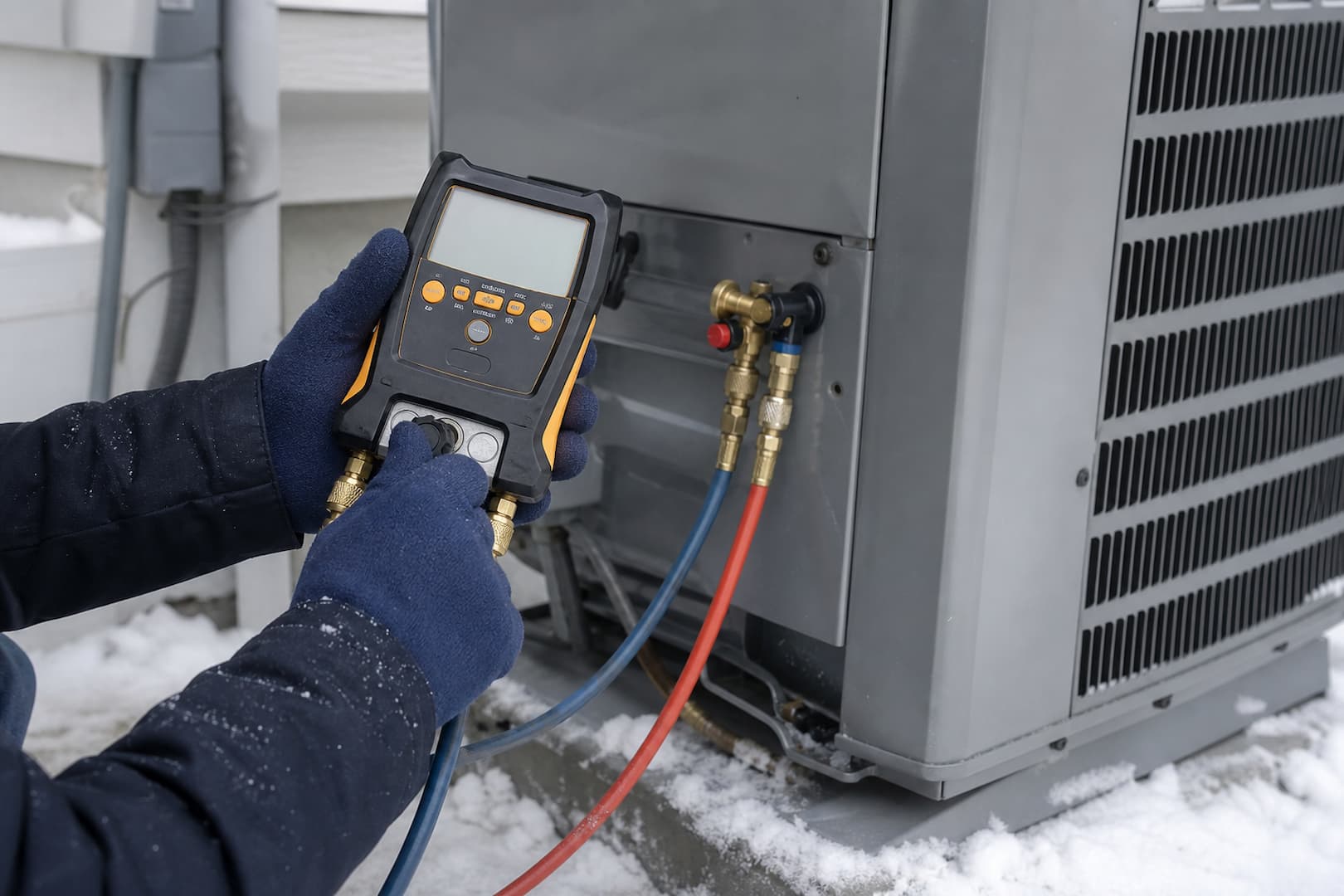
- Refrigerant pressures and line temperatures interpreted with manufacturer data and the current operating mode.
- Leak indicators, metering performance, compressor response, and reversing-valve operation.
- Auxiliary heater stages, breakers, sequencers, limits, relays, and dual-fuel changeover where applicable.
After repair, the system should be tested long enough to establish stable operation. The final check is not simply “the outdoor fan turns.” It is whether the equipment delivers the expected heat, defrosts correctly, stages backup heat as designed, and improves the room temperature without another fault.
Repair or Replace?
Filters, sensors, controls, wiring, capacitors, contactors, fan motors, drain issues, and many defrost faults are repairable. Refrigerant leaks, reversing valves, compressor problems, and proprietary inverter components can be more involved, but they still require a diagnosis before replacement is assumed.
Consider replacement when a major repair is large relative to the equipment’s age and condition, the required part is unavailable, the system uses outdated components, failures are repeating, or the heat pump was never capable of meeting the home’s load. A replacement plan should include load calculation, low-temperature capacity, backup-heat strategy, electrical service, duct airflow, and control compatibility. Changing the outdoor box alone does not correct a poor design.
Preventing Winter Heating Problems
- Check the indoor filter monthly during heavy heating and replace or clean it as specified.
- Keep the outdoor unit clear of leaves, drifting snow, and roof runoff without covering it.
- Use moderate thermostat adjustments. Large setbacks can call expensive auxiliary heat during recovery on some systems.
- Do not ignore recurring frost, frequent AUX indications, breaker trips, or steadily longer runtimes.
- Schedule heat pump maintenance before winter to check airflow, coils, controls, electrical connections, refrigerant performance, defrost, and backup heat.
Frequently Asked Questions
Why does heat-pump air feel cool?
Heat pumps usually deliver lower-temperature air than gas furnaces. Moving air can feel cool against skin even while it is warming the room. Judge the system by measured supply temperature and whether the indoor temperature rises.
Is frost on the outdoor heat pump normal?
A light, even frost can be normal. The unit should enter a short defrost cycle and clear it. Thick ice that remains, blocks the coil, returns immediately, or interferes with the fan is not normal.
Why is my heat pump running constantly?
Long cycles can be normal in cold weather, especially with variable-capacity equipment. Constant operation becomes a concern when the house loses temperature, auxiliary heat runs excessively, ice persists, airflow is weak, or the system’s behavior has changed from previous winters.
Should I switch to Emergency Heat?
Use it only as the equipment instructions or a technician recommends, generally when the outdoor unit has failed and backup heat is available. Emergency Heat can cost substantially more to operate and does not fix the heat pump.
Why does my heat pump blow cool air during defrost?
The refrigeration cycle temporarily reverses to warm the outdoor coil. Some systems energize backup heat to offset the indoor cooling effect. A brief change is normal; prolonged cold air or a system stuck in defrost needs service.
Can low refrigerant cause weak heat?
Yes. Incorrect charge or a refrigerant leak can reduce heating capacity and affect frost and defrost behavior. Because refrigerant circulates in a sealed circuit, low charge calls for leak investigation rather than routine topping off.
Bottom Line
Mild supply air and long winter cycles can be normal. A falling room temperature, a coil sealed in ice, repeated breaker trips, an outdoor unit that never runs, or missing auxiliary heat is not. Check the mode, setpoint, fan, filter, vents, returns, outdoor clearance, and accessible breakers once.
If heat does not recover, the system needs measured diagnosis across controls, airflow, refrigeration, defrost, and backup heat. That whole-system view is important: a heat pump can show the same “not heating” symptom when the problem lives in very different parts of the equipment—or in the ducts and house it serves.