
Why Is My AC Freezing Up?
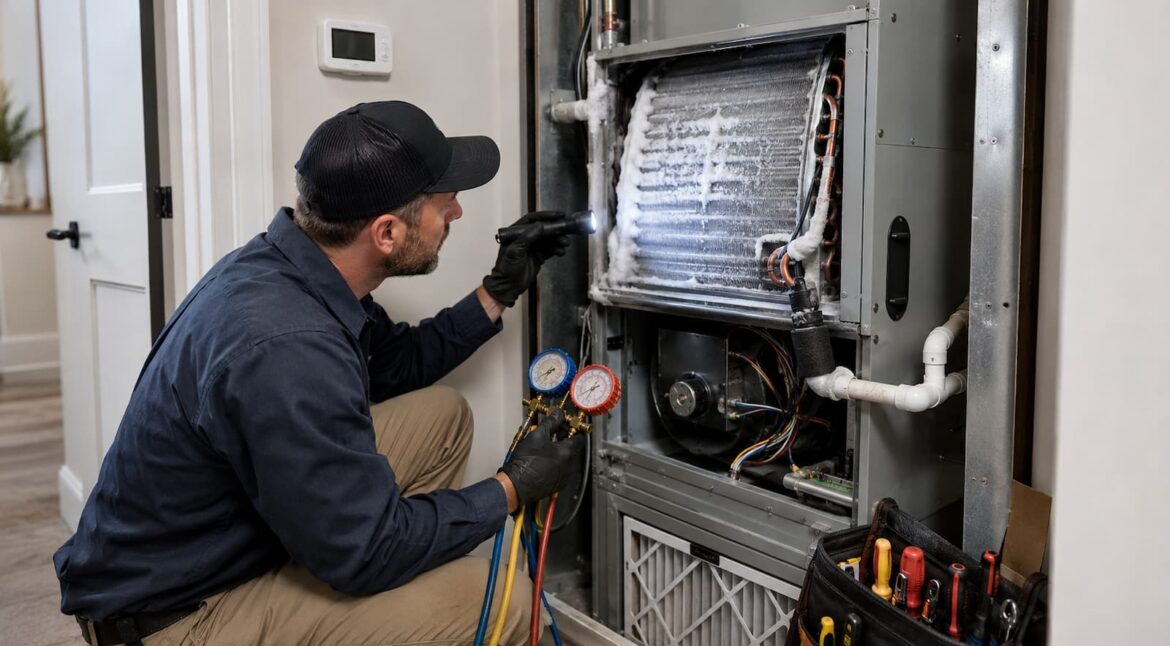
Seeing ice on your air conditioner can feel strange. Air conditioners are supposed to make the house cool, so a little frost may seem like proof that the system is working hard. In reality, an AC that is freezing up is not working properly. Ice on the refrigerant line, evaporator coil, or indoor air handler usually means the system is operating under conditions that can reduce cooling, cause water leaks, strain the compressor, and eventually lead to a bigger repair.
A frozen AC is not a normal part of summer operation. It is a symptom. The most common causes include restricted airflow, a clogged air filter, dirty evaporator coil, low refrigerant, refrigerant leak, weak blower motor, blocked vents, duct restrictions, a dirty blower wheel, incorrect fan operation, or a system running when indoor or outdoor conditions are outside the proper range.
The important question is not only “Why is my AC freezing up?” It is also “What should I do right now?” This guide explains why ice forms, what to turn off, what you can safely check, what not to do, and when to schedule professional air conditioning repair before the problem damages the system.
Quick answer: Your AC is freezing up because the evaporator coil is getting too cold or not receiving enough warm indoor air across it. The most common reasons are low airflow, dirty filters, dirty coils, blower problems, blocked vents, duct restrictions, low refrigerant, or a refrigerant leak. Turn cooling off, set the fan to On if the blower works, let the ice melt completely, and do not restart cooling until you check the filter and airflow. If the ice comes back, call an HVAC technician.
What Does It Mean When an AC Freezes Up?
When an AC freezes up, moisture from the indoor air is freezing on or near the evaporator coil instead of draining away as liquid condensate. Under normal cooling operation, warm indoor air moves across the evaporator coil. The coil absorbs heat from the air, and moisture condenses on the coil surface. That moisture should drip into the condensate drain pan and flow safely away through the drain line.
If the coil temperature drops too low, that moisture freezes. Once ice starts forming, it can grow quickly. Ice blocks airflow, which makes the coil even colder, which creates more ice. This cycle can continue until the AC barely moves air, stops cooling, or shuts down.
Ice is not the cause of the problem by itself. Ice is the result. The real cause may be airflow, refrigerant, controls, fan operation, ductwork, dirt buildup, or equipment failure. That is why simply thawing the system does not always fix it. If the underlying condition remains, the AC will freeze again.
What to Do Immediately If Your AC Is Frozen
If you see ice on your AC, do not keep running the system in cooling mode. Running a frozen AC can make the ice worse, reduce airflow, increase water damage risk when the ice melts, and put stress on the compressor.
Step 1: Turn Cooling Off
Go to the thermostat and switch the system from Cool to Off. This stops the outdoor condenser and compressor from continuing to run while the system is frozen. Do not lower the thermostat to force more cooling. That will only make the problem worse.
Step 2: Set the Fan to On If the Blower Works
If your indoor blower is operating normally, set the fan from Auto to On. This can help move room-temperature air across the frozen coil and speed up thawing. If the blower does not run, or if you hear unusual noises, leave the system off and call for service.
Step 3: Let the Ice Melt Completely
Thawing may take several hours depending on how much ice has formed. Do not rush the process by chipping ice away, using sharp tools, pouring hot water into the equipment, or applying a heat source. Evaporator coils and refrigerant lines can be damaged easily.
Step 4: Watch for Water
As the ice melts, water has to go somewhere. If the drain pan, drain line, or condensate pump cannot handle the water, you may see leaking near the indoor unit. If the air handler is in an attic, closet, finished basement, or above a ceiling, water damage can become a serious concern.
Step 5: Check the Filter Before Restarting
Once the system has thawed, check the air filter. If it is dirty, replace it with the correct size and type. Make sure the airflow arrow points toward the equipment. A clogged filter is one of the most common reasons an AC freezes.
If the filter was extremely dirty, a replacement may help. But if the AC freezes again after the filter is changed and vents are open, the system needs professional diagnosis.
What Not to Do When Your AC Freezes
A frozen AC can tempt homeowners into quick fixes. Some of those quick fixes can damage the system or create safety risks.
- Do not keep running cooling mode. Ice will usually get worse.
- Do not chip ice off the coil. Coils and refrigerant lines are delicate.
- Do not pour hot water into the unit. This can damage components and create water problems.
- Do not use a hair dryer inside the equipment. Moisture and electricity do not mix.
- Do not add refrigerant yourself. Refrigerant work requires proper tools and certification.
- Do not bypass safety switches. A switch may be protecting the system or your home from damage.
- Do not restart the system before it fully thaws. Diagnosis is harder and the problem may return quickly.
The safest first response is simple: turn cooling off, let the ice melt, check airflow basics, and call a technician if the cause is not obvious or the freezing returns.
Why Ice Forms on an AC Coil
The evaporator coil is supposed to get cold, but not so cold that moisture freezes on it. Ice forms when the coil temperature drops below freezing and moisture in the air sticks to the coil surface. This usually happens because the coil is not receiving enough heat from indoor air, or because refrigerant conditions are causing the coil to operate too cold.
Think of the coil as a heat absorber. Warm indoor air must flow across it. If airflow is reduced, the coil has less heat to absorb. It gets colder and may freeze. If refrigerant is low or not metering correctly, pressure and temperature conditions inside the coil can also drop too low. That can create freezing even if the filter looks acceptable.
This is why frozen AC problems are often grouped into two big categories: airflow problems and refrigerant or system performance problems. A technician’s job is to determine which one is happening and why.
Common Reasons Your AC Is Freezing Up
Several problems can lead to a frozen AC. Some are simple. Others require tools and professional diagnosis. Below are the most common causes.
1. Dirty Air Filter
A dirty air filter is one of the most common causes of AC freezing. When the filter is clogged with dust, pet hair, lint, pollen, or debris, it restricts airflow into the system. Less air moves across the evaporator coil. The coil gets too cold. Moisture freezes. The ice then blocks airflow even more.
A dirty filter can also make the blower work harder and reduce cooling performance throughout the home. If your AC is frozen and the filter is dirty, replace it after turning the cooling off. But do not assume the filter is the only problem if the ice returns.
Homes with pets, renovation dust, high occupancy, frequent cooking, or continuous fan operation may need filter changes more often than the package suggests. The best schedule is based on how the filter actually looks and how the system performs.
2. Blocked Return Airflow
Return air grilles pull warm indoor air back to the HVAC system. If returns are blocked by furniture, storage boxes, rugs, curtains, or closed doors, the system may not receive enough airflow. Low return airflow can contribute to freezing.
Make sure return grilles are open and clear. If your home has only one central return, blocking it can affect the entire system. If certain rooms feel stuffy or pressure changes when doors close, return airflow may be part of the comfort problem.
3. Closed or Blocked Supply Vents
Closing a few supply vents may seem like a good way to redirect cooling, but closing too many can reduce total system airflow and increase duct pressure. That can contribute to coil freezing, especially if the system already has airflow problems.
Keep most supply vents open and make sure they are not blocked by furniture or rugs. If some rooms are too cold and others are too warm, the solution may be duct balancing, airflow correction, insulation improvements, or zoning — not simply closing vents.
4. Dirty Evaporator Coil
The evaporator coil sits inside the indoor unit and absorbs heat from the air. If dirt builds up on the coil, it acts like insulation. Heat transfer drops, airflow may be restricted, and the coil surface can become too cold. This can lead to ice formation.
Dirty coils often develop over time because of poor filtration, filter bypass, gaps in the filter rack, infrequent maintenance, or dust entering the return system. Coil cleaning is usually a professional service because the coil can be hard to access and easily damaged.
5. Weak or Failing Blower Motor
The blower motor moves air across the evaporator coil and through the ductwork. If the blower runs too slowly, overheats, starts intermittently, or fails completely, airflow drops. Without enough airflow, the coil can freeze quickly.
Blower problems may show up as weak airflow from vents, unusual humming, intermittent fan operation, hot electrical smells, or an indoor unit that runs differently than normal. A blower issue can involve the motor, capacitor, relay, control board, blower wheel, or wiring.
6. Dirty Blower Wheel
Even if the blower motor runs, a dirty blower wheel can move less air. Dust and debris on the wheel blades reduce the blower’s ability to push air through the system. This can create low airflow, poor comfort, longer run times, and freezing risk.
A dirty blower wheel is not always obvious to a homeowner because it is inside the air handler or furnace cabinet. It is often found during service when airflow problems are being investigated.
7. Duct Restrictions or Duct Leakage
Ductwork problems can reduce airflow and contribute to freezing. Collapsed flexible duct, closed dampers, crushed duct sections, disconnected ducts, blocked returns, undersized ducts, or poorly designed duct systems can all limit airflow through the evaporator coil.
Duct leakage can also create comfort problems and reduce system performance. If cooled air is lost into an attic or crawl space, the system may run longer. If return ducts pull in hot, humid, dusty air, the system may work harder and get dirty faster.
8. Low Refrigerant
Low refrigerant is another common reason an AC freezes. Many people assume low refrigerant means the system needs a simple “top-off.” That is not how a healthy AC should work. Refrigerant circulates in a sealed system. It should not be used up during normal operation. If refrigerant is low, there is usually a leak or another issue.
Low refrigerant can reduce pressure and temperature in the evaporator coil, causing it to get too cold. The system may run constantly, cool poorly, develop ice, and eventually stress the compressor. Adding refrigerant without finding the cause may only create a temporary fix.
9. Refrigerant Leak
A refrigerant leak may occur at the evaporator coil, condenser coil, line set, service valves, joints, or fittings. Some leaks are small and slow. Others cause noticeable performance problems quickly. A frozen coil can be one of the first signs of a refrigerant leak.
Leak diagnosis requires specialized tools and proper handling. If a system repeatedly freezes and refrigerant is low, the leak should be located and repair options should be discussed. On older systems, a major coil leak may lead to a repair-versus-replacement conversation.
10. Faulty Metering Device
The metering device controls how refrigerant enters the evaporator coil. If it is restricted, stuck, or not feeding refrigerant properly, the coil may not operate correctly. This can cause poor cooling, abnormal pressures, freezing, or compressor stress.
Metering device problems are not homeowner-level repairs. They require pressure and temperature readings, system knowledge, and sometimes refrigerant circuit work.
11. Running the AC When It Is Too Cool Outside
Air conditioners are designed to operate within a certain range of outdoor and indoor conditions. Running cooling when outdoor temperatures are too low can cause refrigerant pressures and coil temperatures to fall outside normal operating conditions. This can contribute to freezing.
This can happen in server rooms, commercial spaces, or homes where cooling is used during cool nights or shoulder seasons. Some systems need low-ambient controls for specialized applications. Standard residential AC systems are not always designed for cooling during cool outdoor weather.
12. Thermostat or Control Problems
A thermostat that runs cooling too long, misreads temperature, fails to cycle properly, or controls the fan incorrectly can contribute to freezing. A control board or relay problem may also cause the blower and outdoor unit to operate out of sequence.
For example, if the outdoor unit runs but the indoor blower does not, the evaporator coil can freeze quickly. If cooling runs continuously because of thermostat or control issues, freezing may become more likely under poor airflow or refrigerant conditions.
Where Ice Usually Appears on an AC System
Ice can appear in several places. Where you see it can help a technician understand what is happening, but the location alone does not prove the cause.
Ice on the Refrigerant Line
Ice or frost on the larger copper refrigerant line near the outdoor unit or indoor unit often means the evaporator coil is freezing. The line may look frosted, white, wet, or covered in thick ice. This is a sign to turn cooling off.
Ice on the Indoor Coil Cabinet
Ice may form around the indoor coil cabinet or air handler. You may notice water dripping later as the ice melts. If the coil is heavily frozen, the system may need hours to thaw before diagnosis can be completed.
Ice Inside the Air Handler
Sometimes ice is not visible from outside the cabinet, but airflow is weak and the system is not cooling. A technician may find that the evaporator coil is iced over inside the unit. Do not remove panels unless you can do so safely and the equipment design allows it. Many panels include switches or expose electrical components.
Ice on the Outdoor Unit
Ice on an outdoor unit can mean different things depending on system type and season. A heat pump may develop some frost in heating mode and use a defrost cycle to clear it. But ice on a standard central AC during cooling season usually points back to a freezing indoor coil or refrigerant issue.
How to Tell If the Problem Is Airflow or Refrigerant
Homeowners often want to know whether a frozen AC is caused by low refrigerant or airflow. The truth is that both can look similar from the outside. Both can cause ice. Both can reduce cooling. Both can make the system run longer than normal.
Airflow problems are more likely if the filter is clogged, vents are blocked, return grilles are covered, airflow from vents is weak, the blower is not running normally, or the coil has not been cleaned in a long time. Refrigerant problems are more likely if the system has a history of low charge, repeated freezing after airflow problems were corrected, hissing sounds, oil stains near refrigerant fittings, or declining cooling performance over time.
But guessing is not enough. A technician will check airflow, temperature split, coil condition, blower operation, refrigerant pressures, line temperatures, superheat, subcooling where appropriate, and signs of leakage. That is how the root cause is separated from the symptom.
Can You Keep Running an AC After It Freezes?
No. If the AC is frozen, do not keep running cooling mode. A frozen system cannot cool properly because ice blocks airflow and prevents heat transfer. Running it longer usually makes the ice worse and can stress the compressor.
After the system thaws, you may restart it only if the cause appears to be simple and corrected, such as a very dirty filter that was replaced and vents that were reopened. Even then, monitor it closely. If ice returns, turn cooling off and schedule service.
If the system freezes repeatedly, there is a real problem that needs diagnosis. Repeated freeze-ups can lead to water damage, poor comfort, high utility bills, and expensive repairs.
Why a Frozen AC Can Lead to Water Damage
Ice does not stay frozen forever. When it melts, it can release more water than the drain pan and condensate line are prepared to handle at one time. If the drain is clogged or the pan is damaged, water can leak into the surrounding area.
This is especially concerning if the air handler is located in an attic, closet, finished basement, crawl space, or ceiling area. Water from a thawing coil can stain ceilings, damage drywall, affect flooring, create odors, or trigger mold concerns if it is not addressed quickly.
If you see water around the indoor unit after a freeze-up, do not assume it is harmless. It may be meltwater from the coil, a clogged condensate drain, a cracked drain pan, or a pump problem. The drainage system should be checked before normal cooling operation resumes.
Why a Frozen AC Can Damage the Compressor
The compressor is one of the most expensive parts of the AC system. It is designed to move refrigerant vapor through the system under proper operating conditions. When airflow is too low, refrigerant charge is incorrect, coils are frozen, or the system runs with abnormal pressures and temperatures, the compressor can be placed under stress.
A single freeze-up does not automatically mean the compressor is damaged. But repeated freeze-ups or continued operation while frozen can increase the risk of costly failure. That is why it is important to turn the system off and diagnose the cause rather than repeatedly thawing and restarting the AC.
What an HVAC Technician Will Check
A frozen AC should be diagnosed after the ice has melted. If the coil is still frozen, many readings will not be accurate and access may be limited. Once thawed, a technician can check the full system.
A diagnostic visit may include:
- Air filter size, condition, and fit.
- Return airflow and blocked return grilles.
- Supply vent condition and airflow from rooms.
- Evaporator coil cleanliness.
- Blower motor operation and speed.
- Blower wheel cleanliness.
- Duct restrictions, collapsed duct, or closed dampers.
- Thermostat settings and fan control operation.
- Temperature split across the indoor coil.
- Refrigerant pressures and line temperatures.
- Superheat and subcooling where appropriate.
- Signs of refrigerant leaks.
- Outdoor condenser coil condition.
- Condensate drain, pan, pump, and float switch operation.
- Compressor operating conditions.
The purpose is to identify the cause, not just melt the ice. If the cause is airflow, the repair plan may focus on filters, coils, blower, ducts, or vents. If the cause is refrigerant-related, the system may need leak detection, repair, and proper charging. If the cause is controls, the thermostat, relays, or board may need attention.
Does a Frozen AC Always Mean Low Refrigerant?
No. Low refrigerant is one possible cause, but it is not the only one. Many frozen AC systems freeze because of poor airflow, not low refrigerant. A clogged filter, dirty coil, weak blower motor, closed vents, or duct restriction can all create freezing even if the refrigerant charge is correct.
This matters because adding refrigerant to a system with an airflow problem does not fix the issue. It may even create new problems if the system is overcharged. Refrigerant should be added only after proper testing confirms it is needed.
If refrigerant is low, the cause should be investigated. Since refrigerant circulates in a sealed system, low refrigerant usually means there is a leak or another service issue. Repeated “top-offs” without leak diagnosis are rarely a good long-term solution.
Can Maintenance Prevent AC Freezing?
Maintenance can prevent many freeze-up problems, especially those related to airflow, dirt, drains, electrical components, and early system performance issues. It cannot prevent every refrigerant leak or component failure, but it can reduce the chance that a preventable problem goes unnoticed.
During seasonal AC maintenance, a technician can inspect filters, coils, drains, blower operation, electrical components, refrigerant performance, and airflow. These checks are especially important before peak cooling season, when the AC will run longer and small problems can quickly become breakdowns.
Maintenance helps reduce freezing risk by:
- Keeping filters and coils from becoming restrictive.
- Checking blower operation before airflow drops.
- Identifying duct or vent airflow concerns.
- Checking condensate drainage before water problems develop.
- Catching early refrigerant performance issues.
- Finding weak electrical components that affect fan operation.
- Reducing long runtime caused by poor heat transfer.
When Is a Frozen AC an Emergency?
A frozen AC is not always an emergency, but it should not be ignored. The urgency depends on the situation.
Call for urgent service if:
- The home is becoming unsafe because of heat.
- Vulnerable occupants are affected.
- Water is leaking into finished areas.
- The breaker trips when the system runs.
- You smell burning or electrical odors.
- The outdoor unit hums or struggles to start.
- The indoor blower does not run.
- The system freezes repeatedly after thawing.
- You cannot restore airflow after replacing the filter.
For urgent no-cooling situations, especially when there is water, electrical trouble, or unsafe indoor heat, emergency HVAC repair may be appropriate.
Repair or Replace: What If Your AC Keeps Freezing?
Many freeze-up problems are repairable. If the cause is a clogged filter, dirty coil, blower capacitor, drain issue, or airflow restriction, the system may return to normal after proper service. But repeated freezing on an older system can point to more serious issues.
Repair often makes sense when:
- The system is relatively young.
- The cause is a clear airflow or maintenance issue.
- The refrigerant circuit is intact.
- The blower and compressor are in good condition.
- The AC cools well after the cause is corrected.
- Repair cost is reasonable compared with system age.
Replacement may be worth discussing when:
- The system is older and freezes repeatedly.
- There is a major refrigerant leak.
- The evaporator coil is leaking or severely corroded.
- The compressor is stressed or failing.
- The system has needed repeated repairs.
- Cooling performance has been poor for several seasons.
- The repair cost is high compared with replacement value.
The best decision depends on the diagnosis, equipment age, repair history, refrigerant type, comfort performance, and long-term reliability. A frozen AC does not automatically mean replacement, but repeated freezing should not be ignored.
How to Prevent Your AC From Freezing Again
Once your AC has frozen, preventing a repeat matters. The ice may melt, but the underlying problem can return the next time the system runs long enough.
Change Filters Regularly
Check your filter monthly during heavy cooling season. Replace it when it is dirty, even if it has not reached the suggested calendar interval. Use the correct size and avoid filters that are too restrictive for your system unless the ductwork and blower can handle them.
Keep Vents and Returns Open
Do not block return grilles or close too many supply vents. The AC needs steady airflow. If rooms are uneven, solve the airflow issue rather than starving the system.
Schedule Coil and Blower Inspection
A clean filter does not guarantee a clean evaporator coil or blower wheel. If the system has gone years without service, dust may already be inside the equipment. A technician can inspect and clean components as needed.
Do Not Ignore Weak Airflow
Weak airflow is often the first warning sign before freezing. If vents feel weaker than normal, the blower sounds different, or certain rooms receive little air, address the issue before the coil freezes.
Watch for Refrigerant Leak Symptoms
If the system cools less each season, runs constantly, freezes repeatedly, or needs refrigerant added more than once, ask about leak detection. A sealed system should not need regular refrigerant top-offs.
Use Reasonable Thermostat Settings
Setting the thermostat extremely low does not make the AC cool faster. It simply makes the system run longer. If the AC is already struggling, long runtime can make freezing more likely when airflow or refrigerant conditions are poor.
Frequently Asked Questions
Why is my AC freezing up?
Your AC is freezing because the evaporator coil is getting too cold. Common causes include restricted airflow, dirty filters, blocked vents, dirty coils, blower problems, duct restrictions, low refrigerant, refrigerant leaks, or control issues.
What should I do if my AC freezes up?
Turn cooling off at the thermostat. Set the fan to On if the blower works. Let the ice melt completely. Check the filter and vents. If the system freezes again, call an HVAC technician.
Can I run my AC while it is frozen?
No. Running cooling mode while the AC is frozen usually makes the ice worse and can stress the compressor. Turn cooling off and let the system thaw.
How long does it take a frozen AC to thaw?
It can take several hours, depending on how much ice has formed and whether the fan is running. Heavy ice buildup may take longer. Do not chip away the ice or use heat tools inside the equipment.
Does a frozen AC mean low refrigerant?
Not always. Low refrigerant can cause freezing, but airflow problems are also very common. A dirty filter, blocked return, dirty evaporator coil, blower issue, or duct restriction can freeze the system even if refrigerant charge is correct.
Can a dirty filter cause my AC to freeze?
Yes. A clogged filter restricts airflow across the evaporator coil. Without enough warm air moving across the coil, the coil can get too cold and ice can form.
Why is there ice on the copper line outside?
Ice on the larger copper refrigerant line usually means the indoor evaporator coil is freezing. Turn cooling off and let the system thaw. The cause may be airflow restriction, low refrigerant, blower issues, or another system problem.
Can a frozen AC cause water leaks?
Yes. When the ice melts, water may overwhelm the drain pan or reveal a clogged condensate drain. This can cause leaks around the indoor unit, ceiling stains, or water damage.
Will my AC freeze again after it thaws?
It may freeze again if the underlying problem remains. Replacing a dirty filter may solve a simple airflow issue, but repeated freezing usually means a technician should check airflow, blower operation, coil condition, refrigerant performance, and controls.
When should I call a technician for a frozen AC?
Call a technician if the AC freezes more than once, airflow is weak, the filter is clean but ice returns, there is water leaking, the breaker trips, the blower does not run, or you suspect low refrigerant or a refrigerant leak.
Bottom Line: Ice on Your AC Is a Warning Sign
An AC that freezes up is not cooling better. It is struggling. Ice usually means the evaporator coil is too cold because of poor airflow, refrigerant issues, blower problems, dirty coils, blocked vents, duct restrictions, or control problems.
The right first step is to turn cooling off, let the system thaw, check the filter, open vents and returns, and watch for water. Do not keep running the AC while it is frozen, and do not try to remove the ice manually.
If the AC freezes again, the system needs proper diagnosis. A technician can determine whether the problem is airflow, refrigerant, blower operation, coil condition, ductwork, controls, or a combination of issues. Fixing the cause helps restore cooling, protect the compressor, reduce water damage risk, and prevent the same freeze-up from returning during the next hot day.