What Is a Rooftop Unit and How Does It Work?
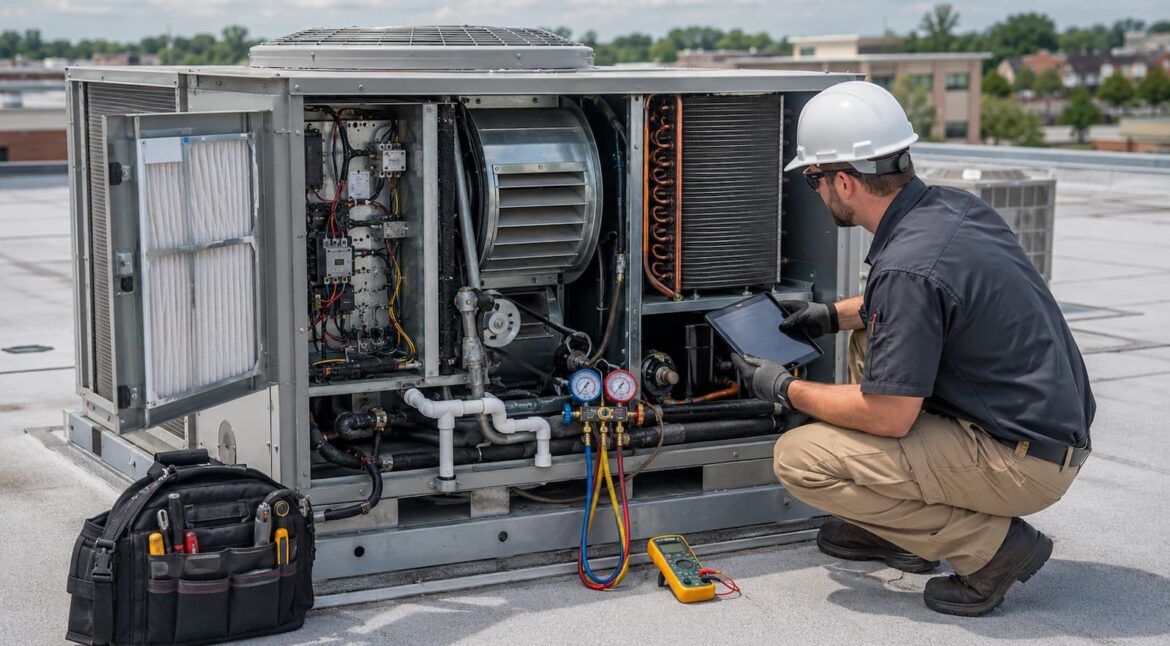
If you have ever looked at the roof of a retail store, office building, restaurant, warehouse, medical office, or light industrial property, you have probably seen large metal HVAC cabinets sitting on the roof. Those units are often called rooftop units, or RTUs. They are one of the most common HVAC solutions for commercial buildings because they combine heating, cooling, air movement, filtration, ventilation, and controls in a single packaged system.
A rooftop unit is different from a typical residential split air conditioner. In a split system, the indoor coil and blower are inside the building, while the condenser is outside. In a packaged rooftop unit, many of the major components are inside one outdoor cabinet on the roof. The unit conditions air and sends it into the building through ductwork, then receives return air back from the occupied space.
This guide explains what a rooftop unit is, how it works, what components it includes, why commercial buildings use RTUs, what can go wrong, how maintenance protects the equipment, and when repair or replacement should be considered.
Quick answer: A rooftop unit is a packaged HVAC system installed on the roof of a commercial building. It typically uses ductwork to pull return air from the building, mix in outside air when needed, filter and condition the air, then supply heated or cooled air back to the occupied space. Many RTUs include compressors, coils, fans, filters, controls, dampers, heating components, and sometimes an economizer.
What Is a Rooftop Unit?
A rooftop unit is a self-contained HVAC system designed to sit on the roof of a building. It is commonly used in commercial and light commercial applications, although packaged units can also appear in some residential or mixed-use settings. The main idea is simple: instead of placing large HVAC equipment inside the building, the system is packaged into one cabinet and installed outside on the roof.
RTUs are usually connected to the building through a roof curb and duct openings. One duct path carries supply air from the unit into the building. Another duct path brings return air back from the building to the unit. Depending on the design, the RTU may also bring in outside air for ventilation and exhaust or relieve air from the building.
In many commercial buildings, rooftop units are used because they save interior mechanical space, simplify equipment access, support multiple zones, and allow each tenant or area to have its own HVAC equipment. You may see several RTUs on one roof, with each unit serving a different store, office suite, dining area, warehouse zone, or floor.
A rooftop unit may provide cooling only, cooling with gas heat, cooling with electric heat, heat pump operation, or ventilation with more advanced controls. The exact configuration depends on the building, climate, utility availability, load requirements, and equipment design.
Why Are Rooftop Units So Common in Commercial Buildings?
Rooftop units are popular because they solve several practical problems for commercial buildings. They keep bulky equipment out of occupied areas, use roof space that might otherwise be unused, and make it possible to serve different areas with separate units. This is useful in shopping centers, office buildings, restaurants, warehouses, and multi-tenant properties.
In a commercial building, mechanical rooms may be limited, expensive, or better used for storage, operations, or tenant space. Placing the HVAC unit on the roof frees up interior square footage. It can also reduce indoor noise compared with placing large equipment near occupied areas.
Rooftop units are also modular. If one tenant space needs a 7.5-ton unit and another needs a 15-ton unit, the building can use different RTUs for different loads. If one unit fails, it may affect only part of the building rather than the entire property. This can make maintenance, repairs, and replacement planning more manageable.
RTUs are especially practical for flat-roof commercial buildings because ductwork can pass through the roof curb directly into the conditioned space. For many retail and light commercial buildings, this arrangement is simpler than building a large interior mechanical room.
How Does a Rooftop Unit Work?
A rooftop unit works by moving air through a packaged HVAC cabinet, conditioning that air, and delivering it into the building through ductwork. The exact sequence depends on whether the building needs cooling, heating, ventilation, or economizer operation.
The basic process looks like this:
- Return air comes back from the building. Air from the occupied space returns to the rooftop unit through return ductwork.
- Outside air may be mixed in. Depending on ventilation requirements and economizer operation, the unit may bring in outdoor air through dampers.
- The air passes through filters. Filters help protect the equipment and reduce airborne particles in the air stream.
- The air is cooled or heated. In cooling mode, refrigerant absorbs heat from the air at the evaporator coil. In heating mode, gas heat, electric heat, or heat pump operation may warm the air.
- The supply fan moves air into the building. The blower or supply fan pushes conditioned air through supply ducts and into the occupied zones.
- Controls manage the sequence. Thermostats, sensors, relays, boards, dampers, and safety devices tell the unit when to run and how to operate.
In simple terms, an RTU is an air-moving and air-conditioning machine. It pulls air from the building, mixes or conditions that air, and supplies it back at the right temperature and airflow. When working correctly, occupants do not think much about the equipment. They simply feel comfortable.
Main Components of a Rooftop Unit
Rooftop units look like simple metal boxes from a distance, but inside they include many components. Understanding the major parts helps explain why maintenance and diagnosis matter.
Cabinet and Access Panels
The cabinet protects the equipment from weather and organizes the unit into sections. Access panels allow technicians to inspect filters, coils, electrical controls, belts, motors, compressors, heating components, and drain areas. Panel condition matters because loose or missing panels can allow water intrusion, air leakage, noise, and safety risks.
Filters
Filters protect the unit and the building’s air stream. Dirty filters restrict airflow, which can reduce comfort, increase energy use, strain the blower, freeze coils, and shorten equipment life. In commercial buildings, filters may need frequent inspection because occupancy, dust, outdoor air intake, kitchen activity, nearby traffic, and construction can load filters quickly.
Supply Fan or Blower
The supply fan moves air through the RTU and into the duct system. Some units use belt-driven blowers, while others use direct-drive motors. If the fan is weak, belts are loose, bearings are failing, or the blower wheel is dirty, airflow drops. Low airflow can cause poor comfort, frozen coils, overheating, and tenant complaints.
Evaporator Coil
In cooling mode, the evaporator coil is where indoor heat is absorbed into the refrigerant. Air passes across the coil, gives up heat, and leaves cooler. If the evaporator coil is dirty, iced over, or starved for airflow, the unit will struggle to cool properly.
Condenser Coil
The condenser coil releases heat outdoors. Since the RTU sits on the roof, the condenser coil is exposed to pollen, leaves, dust, grease, weather, and rooftop debris. A dirty condenser coil makes it harder for the unit to reject heat, which can reduce cooling capacity and increase compressor stress.
Compressors
The compressor circulates refrigerant through the cooling system. It is one of the most important and expensive components in the RTU. Compressor problems can come from electrical issues, refrigerant problems, dirty coils, poor airflow, overheating, lack of maintenance, or normal age-related wear.
Refrigerant Circuit
The refrigerant circuit includes refrigerant lines, coils, metering devices, compressors, and related components. In cooling mode, refrigerant absorbs heat inside and releases it outside. Refrigerant does not get used up during normal operation. If a unit is low on refrigerant, there may be a leak or another problem that needs diagnosis.
Heating Section
Many rooftop units provide heating. Depending on the unit, heating may come from gas burners, electric heat elements, or heat pump operation. Gas heat RTUs include components such as burners, ignition systems, flame sensors, gas valves, heat exchangers, pressure switches, rollout switches, and limit controls. Heat pump RTUs use the refrigeration cycle in reverse to provide heating.
Economizer
An economizer is a set of dampers, sensors, actuators, and controls that can bring in outdoor air for cooling when outdoor conditions are favorable. This is sometimes called “free cooling” because the unit can reduce mechanical cooling when outdoor air is cool enough and appropriate for the building’s needs.
Economizers can save energy, but only when they work correctly. If dampers are stuck, sensors are inaccurate, or controls are misconfigured, an economizer can waste energy or create comfort problems by bringing in too much hot, cold, or humid air.
Dampers and Outside Air Intake
Dampers control how much return air, outside air, and relief air moves through the unit. Proper damper operation is important for ventilation, building pressure, comfort, and energy use. A stuck damper can cause poor indoor air quality, drafts, humidity problems, excessive heating or cooling load, or pressure issues at doors.
Electrical Controls
Contactors, capacitors, relays, control boards, transformers, wiring, disconnects, and safety devices all help the RTU start, run, stage, and shut down safely. Electrical failures are a common reason rooftop units stop heating or cooling. Regular inspection can identify loose wires, burned contacts, weak capacitors, damaged insulation, and overheating components.
Condensate Drain and Pan
In cooling mode, moisture from the air condenses on the evaporator coil and drains away. The drain pan and condensate line must remain clear. If the drain clogs, water can back up, leak into the unit, damage the roof or ceiling, trigger safety switches, or create odors.
Thermostats, Sensors, and Building Controls
Rooftop units may be controlled by a simple thermostat, programmable thermostat, zone controller, or building automation system. Controls tell the unit when to cool, heat, ventilate, use an economizer, stage compressors, run fans, or switch between occupied and unoccupied schedules.
How Rooftop Units Cool a Building
Cooling mode is similar in principle to other direct-expansion air conditioning systems. The thermostat or building control calls for cooling. The RTU starts the supply fan and cooling circuit. Return air from the building passes through filters and across the evaporator coil. Refrigerant inside the coil absorbs heat from the air. The cooled air is then delivered back into the building through supply ducts.
The absorbed heat is carried through the refrigerant circuit to the condenser section, where the outdoor coil and condenser fan release it into the outdoor air. This heat rejection process is why condenser coil cleanliness and outdoor airflow matter so much. If the roof environment is hot, dirty, or blocked by debris, the unit has to work harder.
Many commercial RTUs use staged cooling. A smaller call for cooling may run one compressor or one stage. A larger load may bring on additional stages. More advanced units may use modulating compressors or variable-speed fans. The goal is to match cooling output to the building’s need without wasting energy or short cycling.
How Rooftop Units Heat a Building
Rooftop units can provide heat in several ways. The most common options are gas heat, electric heat, and heat pump operation. The right type depends on the building, local utility availability, climate, operating cost, and equipment design.
Gas Heat RTUs
Gas heat rooftop units burn natural gas or propane to heat air. When there is a call for heat, the unit starts a safety sequence involving inducer operation, pressure switches, ignition, gas valve operation, flame sensing, and blower operation. Air passes across the heat exchanger and is delivered to the building.
Gas heating components require careful maintenance because they involve combustion and safety controls. Burners, flame sensors, heat exchangers, gas pressure, venting, rollout switches, and limit controls should be inspected by qualified technicians.
Electric Heat RTUs
Electric heat rooftop units use electric resistance elements to warm air. They may be simpler in some ways because they do not involve gas combustion, but they can require significant electrical capacity and may have higher operating costs depending on utility rates and usage.
Heat Pump RTUs
Heat pump rooftop units use the refrigeration cycle for both cooling and heating. In heating mode, the system moves heat from outdoor air into the building. Heat pump RTUs may also include auxiliary heat for colder conditions or backup operation. Their maintenance includes checking defrost operation, reversing valves, outdoor coil condition, refrigerant performance, and controls.
How Ventilation Works in a Rooftop Unit
Commercial buildings need ventilation to dilute indoor contaminants and bring in outdoor air. Rooftop units often include outside air dampers that allow a controlled amount of fresh air into the return air stream. This air is mixed with return air, filtered, conditioned, and supplied to the occupied space.
Ventilation must be balanced carefully. Too little outside air can create indoor air quality complaints. Too much outside air can increase energy use, humidity, drafts, and equipment load. A stuck or misadjusted damper can cause major comfort and efficiency problems.
Some buildings use demand-controlled ventilation, which adjusts outdoor air based on occupancy indicators such as carbon dioxide sensors. Some units use economizers, which bring in more outside air for cooling when conditions are favorable. Both strategies depend on sensors, dampers, actuators, and controls working correctly.
What Is an Economizer on a Rooftop Unit?
An economizer is an energy-saving feature found on many commercial rooftop units. It uses outdoor air for cooling when outdoor conditions are suitable. Instead of running compressors to provide all cooling, the unit opens dampers and brings in cooler outside air. This can reduce mechanical cooling runtime and lower energy use.
For example, on a mild spring or fall day, the building may need cooling because of people, lighting, equipment, or solar heat gain. If outdoor air is cool and dry enough, the economizer can bring in that outside air to cool the building without relying fully on the refrigerant circuit.
Economizers are useful, but they are also a common source of problems. A stuck-open economizer can bring in humid summer air or cold winter air. A stuck-closed economizer prevents energy savings and may reduce ventilation. Bad sensors can make the unit choose the wrong mode. Broken linkages or actuators can stop dampers from moving properly.
That is why economizer inspection should be part of rooftop unit maintenance. The technician should verify damper movement, actuator operation, sensor readings, seals, linkages, and control logic.
Rooftop Unit Airflow: Supply, Return, Outside Air, and Relief Air
Airflow is one of the most important parts of RTU performance. The unit must move the correct amount of air through filters, coils, dampers, and ductwork. If airflow is too low, the building may not cool or heat properly. If airflow is too high or poorly distributed, occupants may feel drafts, noise, or uneven temperatures.
A rooftop unit may manage several air streams:
- Return air: Air pulled back from the building into the unit.
- Outside air: Fresh air brought into the unit for ventilation or economizer operation.
- Mixed air: The combination of return air and outside air.
- Supply air: Conditioned air delivered from the unit to the building.
- Relief or exhaust air: Air released from the building to help control pressure when outside air is brought in.
Poor airflow can be caused by dirty filters, dirty coils, loose belts, failing motors, blocked ducts, closed dampers, collapsed duct liner, improper fan speed, or bad balancing. Because RTUs serve commercial spaces, airflow problems can create tenant complaints quickly.
Common Types of Rooftop Units
Rooftop units come in several configurations. The right type depends on the building’s heating and cooling needs.
Cooling-Only Rooftop Units
Cooling-only RTUs provide air conditioning but do not include a heating section. These may be used in buildings with separate heat sources or in applications where cooling is the main requirement. In New Jersey, most commercial buildings still need a reliable heating strategy, so cooling-only units are less common than units with heat.
Gas/Electric Rooftop Units
Gas/electric RTUs use electric cooling and gas heating. This is a common commercial configuration. The cooling side uses the refrigeration cycle, while the heating side uses gas burners and a heat exchanger. These units require both cooling maintenance and combustion safety checks.
Heat Pump Rooftop Units
Heat pump RTUs provide cooling and heating through the refrigeration cycle. They can be efficient in many applications, but proper sizing, defrost operation, auxiliary heat strategy, and controls matter. In colder weather, heat pump performance should be evaluated carefully for the building’s needs.
Makeup Air and Dedicated Outdoor Air Units
Some rooftop equipment is designed primarily to provide outdoor air or makeup air. Restaurants, kitchens, labs, and certain commercial spaces may require dedicated ventilation strategies. These units are not always the same as standard comfort-cooling RTUs, but they may be part of the rooftop HVAC system.
Single-Zone and Multi-Zone Applications
Many RTUs serve a single zone, such as one store, office area, or dining room. Larger or more advanced systems may serve multiple zones with dampers, VAV boxes, or building automation controls. More complex zoning requires more careful control and maintenance.
What Buildings Commonly Use Rooftop Units?
Rooftop units are common in many commercial and light commercial properties. They are especially useful when the building has a flat roof, open ceiling structure, or multiple tenant spaces.
Common RTU applications include:
- Retail stores and shopping centers.
- Restaurants and food service spaces.
- Office buildings.
- Medical and dental offices.
- Warehouses and light industrial buildings.
- Schools and training centers.
- Fitness centers.
- Grocery and convenience stores.
- Multi-tenant commercial buildings.
- Municipal and institutional facilities.
In multi-tenant buildings, separate RTUs can make it easier to divide utility use, schedule service, and manage comfort by tenant area. However, this also means the property may have many units to maintain, each with its own age, condition, repair history, and risk level.
Advantages of Rooftop Units
RTUs are common for a reason. They offer several practical advantages for commercial buildings.
They Save Interior Space
Placing equipment on the roof keeps large HVAC components out of occupied or rentable space. This can be valuable in retail, office, restaurant, and warehouse buildings where interior square footage matters.
They Combine Multiple Functions
A packaged RTU can provide cooling, heating, ventilation, air filtration, and controls in one unit. This simplifies equipment layout and can reduce the amount of separate indoor mechanical equipment needed.
They Are Modular
A building can use multiple RTUs for different areas. If one tenant has different needs than another, the equipment can be sized and controlled separately. If one unit needs replacement, the whole building may not need to be shut down.
They Can Be Easier to Service Without Disturbing Occupants
Because the unit is on the roof, technicians can often perform maintenance without entering occupied areas, aside from thermostat checks or indoor airflow verification. This can reduce disruption for tenants, customers, and employees.
They Can Support Ventilation and Economizer Operation
Many RTUs are designed to manage outside air and economizer functions. When properly set up and maintained, this can improve ventilation and reduce mechanical cooling demand during favorable outdoor conditions.
Disadvantages and Limitations of Rooftop Units
Rooftop units are practical, but they are not perfect. Their limitations should be understood during design, maintenance, and replacement planning.
They Are Exposed to Weather
Roof exposure means RTUs deal with heat, cold, rain, snow, wind, sun, debris, and freeze-thaw cycles. Weather affects cabinet seals, coils, wiring, panels, drains, motors, and rooftop access. Units in harsh rooftop environments may age faster without regular service.
Roof Access Can Make Service More Complicated
Technicians need safe access to the unit. Roof hatches, ladders, weather, snow, ice, and building access rules can all affect service. A rooftop unit may be simple to service on a clear day and difficult to access during winter storms.
Ductwork Still Matters
Even though the unit is packaged, it still depends on ductwork. Poor duct design, leaks, undersized returns, bad balancing, or blocked diffusers can make a good RTU perform poorly. Replacing the rooftop unit alone may not solve comfort complaints if the air distribution system is the real issue.
Economizers Can Waste Energy When Neglected
An economizer is valuable only if it works correctly. Stuck dampers, failed actuators, bad sensors, and poor control settings can bring in the wrong amount of outside air. This may increase energy use, humidity, drafts, and comfort complaints.
Multiple Units Mean Multiple Maintenance Needs
A building with several RTUs needs careful tracking. Each unit has filters, belts, coils, drains, motors, electrical components, and repair history. Without documentation, it is easy to miss one unit until it fails.
Common Rooftop Unit Problems
Rooftop units can fail in many ways because they combine several systems in one cabinet. Some problems are minor if caught early. Others can lead to major repairs or equipment replacement.
Dirty Filters
Dirty filters restrict airflow, reduce comfort, increase energy use, and strain the blower. They can also contribute to frozen coils in cooling mode or overheating in heating mode. Filter neglect is one of the most preventable RTU problems.
Dirty Coils
Dirty condenser coils reduce heat rejection. Dirty evaporator coils reduce heat absorption and airflow. Both problems make the unit work harder and can increase operating costs.
Belt and Blower Problems
Belt-driven rooftop units need belt inspection and adjustment. Worn, loose, or misaligned belts reduce airflow and may create squealing noises. Blower bearings, pulleys, and wheels should also be inspected.
Electrical Failures
Capacitors, contactors, relays, transformers, control boards, and wiring can fail from age, heat, vibration, weather exposure, or electrical stress. Electrical failures are a common cause of no-cooling and no-heating calls.
Refrigerant Leaks
A rooftop unit that is low on refrigerant may cool poorly, run constantly, freeze the evaporator coil, or stress the compressor. Refrigerant leaks should be diagnosed, not ignored or repeatedly topped off without finding the cause.
Condensate Drain Issues
Clogged drains and damaged pans can create water leaks, odors, and shutdowns. During humid New Jersey summers, condensate problems can appear quickly because cooling systems remove more moisture from the air.
Economizer Failure
Stuck dampers, failed actuators, and bad sensors can cause energy waste and comfort problems. Economizer issues are common because dampers and linkages are exposed to weather and may not move regularly if neglected.
Heating Failures
Gas heat RTUs may have ignition failures, flame sensor problems, gas valve issues, pressure switch faults, blocked vents, heat exchanger concerns, or safety lockouts. Heat pump RTUs may have defrost, reversing valve, refrigerant, or auxiliary heat issues.
If your RTU is not heating, not cooling, making unusual noises, freezing, leaking, or repeatedly tripping controls, professional rooftop unit repair can identify the root cause before a minor issue becomes a major failure.
How Rooftop Unit Maintenance Works
Rooftop unit maintenance should be scheduled before major heating and cooling seasons. Many commercial buildings benefit from quarterly service, especially if they have multiple RTUs, older equipment, restaurant use, high occupancy, or comfort-sensitive tenants.
A rooftop unit maintenance visit may include:
- Inspecting and replacing filters.
- Checking belts, pulleys, bearings, and blower assemblies.
- Inspecting condenser and evaporator coils.
- Cleaning coils as needed.
- Testing capacitors, contactors, relays, and electrical components.
- Checking motor amp draw.
- Inspecting compressor operation.
- Checking refrigerant performance.
- Inspecting condensate drains and pans.
- Testing economizer operation.
- Checking gas heating components where applicable.
- Verifying thermostat or building automation communication.
- Inspecting access panels, seals, and cabinet condition.
- Documenting repair recommendations and equipment condition.
Preventive maintenance is especially important because RTUs often fail under peak demand. Cooling failures happen during heat waves. Heating failures happen during cold snaps. Planned service reduces the chance of emergency downtime.
For buildings that rely on packaged rooftop equipment, scheduled rooftop unit maintenance helps protect comfort, improve reliability, and keep repair history documented.
How Long Does a Rooftop Unit Last?
Rooftop unit lifespan depends on maintenance, installation quality, runtime, equipment type, roof conditions, corrosion, repair history, and operating load. Many commercial rooftop units can provide years of reliable service when maintained properly, but they often face harsher conditions than indoor equipment because they sit outdoors year-round.
A unit that is clean, properly serviced, and not overloaded may last significantly longer than a neglected unit with dirty coils, failing belts, poor airflow, refrigerant leaks, and repeated electrical problems. Age alone does not tell the whole story. Repair frequency, comfort performance, energy use, and major component condition matter more.
Replacement should be considered when:
- The unit needs frequent repairs.
- Major components are failing.
- The unit no longer maintains comfort.
- Energy use is high despite maintenance.
- Parts are difficult or expensive to source.
- The equipment is poorly sized for the current space.
- The building use has changed since installation.
- Repair cost is high compared with replacement value.
Repair or Replace a Rooftop Unit?
The repair-versus-replacement decision depends on age, condition, repair cost, energy use, tenant comfort, equipment availability, and business risk. A minor electrical repair on a newer RTU usually makes sense. A major compressor or coil repair on an older unit with repeated breakdowns may not.
Repair is often reasonable when the unit is relatively young, parts are available, the issue is isolated, and the unit has otherwise been reliable. Replacement becomes more attractive when the unit is old, inefficient, frequently down, poorly matched to the building, or facing a major repair.
Commercial buildings should also consider downtime. A unit serving a low-use storage area may not be as critical as a unit serving a restaurant dining room, medical office, retail floor, or tenant space. The cost of poor comfort can be larger than the repair invoice.
If replacement is being considered, the contractor should review the existing unit size, curb, duct connections, electrical, gas, controls, drainage, roof access, ventilation needs, and code requirements. Replacing an RTU is not just dropping a new box on the roof. It should be planned around the building’s actual load and operating needs.
What Facility Managers Should Know About RTUs
Facility managers do not need to perform technical repairs, but they should understand how rooftop units affect building operations. Good building management can reduce emergency calls and help technicians diagnose problems faster.
Facility managers should track:
- Which unit serves which space.
- Unit model, serial number, age, and capacity.
- Filter sizes and replacement schedule.
- Repair history by unit.
- Comfort complaints by zone.
- Thermostat and building automation schedules.
- Roof access requirements.
- Known units approaching end of life.
- Emergency service history.
- Planned replacement priorities.
Documentation is especially important in buildings with multiple rooftop units. Without records, it is easy to spend money repeatedly on the same declining unit without seeing the pattern.
Signs a Rooftop Unit Is Not Working Properly
Rooftop unit problems are not always obvious from inside the building. Occupants may only notice that a room is hot, cold, humid, noisy, or uncomfortable. Facility teams should watch for patterns.
Warning signs include:
- The unit runs but the space does not cool.
- The unit runs but the space does not heat.
- Airflow from vents is weak.
- The same zone has recurring complaints.
- The rooftop unit is unusually loud.
- There are burning or electrical odors.
- Breakers trip or controls require resets.
- The unit short cycles.
- The unit runs constantly.
- Ice appears on coils or refrigerant lines.
- Water leaks appear near ducts or ceiling areas.
- Indoor humidity is high.
- Energy bills rise without a clear reason.
If any of these problems appear, it is better to schedule service early. Rooftop units often become more expensive to repair when small problems are allowed to continue under heavy load.
Frequently Asked Questions About Rooftop Units
What does RTU mean in HVAC?
RTU stands for rooftop unit. It is a packaged HVAC system installed on the roof of a building. It typically provides heating, cooling, ventilation, filtration, and air distribution through ductwork.
Is a rooftop unit the same as an air conditioner?
Not exactly. A rooftop unit can include air conditioning, but many RTUs also include heating, ventilation, filters, fans, controls, dampers, and economizers. It is more accurate to call it a packaged HVAC system.
How does a rooftop unit cool a building?
The unit pulls return air from the building, passes it through filters and the evaporator coil, removes heat using the refrigerant circuit, and sends cooled air back through supply ducts. The heat is released outdoors through the condenser coil.
Do rooftop units provide heat?
Many rooftop units provide heat. They may use gas heat, electric heat, or heat pump operation depending on the model and building design. Some units are cooling-only, but many commercial RTUs are heating and cooling systems.
Why are HVAC units placed on roofs?
Roof placement saves interior space, reduces equipment disruption inside the building, supports packaged HVAC design, and makes it easier to serve different tenant zones with separate units. Flat commercial roofs are often practical locations for packaged HVAC equipment.
What is an economizer on a rooftop unit?
An economizer uses outdoor air for cooling when conditions are favorable. It includes dampers, actuators, sensors, and controls. When working correctly, it can reduce mechanical cooling. When neglected, it can waste energy or create comfort problems.
How often should a rooftop unit be serviced?
At minimum, rooftop units should usually be serviced before cooling season and before heating season. Many commercial buildings benefit from quarterly RTU maintenance, especially if the units are older, heavily used, exposed to debris, or serve critical spaces.
What causes a rooftop unit to stop cooling?
Common causes include dirty filters, dirty condenser coils, low refrigerant, failed capacitors, bad contactors, compressor problems, condenser fan failure, blower problems, control issues, economizer problems, or poor airflow.
Can a rooftop unit serve multiple rooms?
Yes. A rooftop unit can serve multiple rooms through ductwork. Some units serve one open area, while others serve a zone made up of several rooms. Larger buildings may use multiple RTUs or additional zoning controls.
When should a rooftop unit be replaced?
Replacement should be considered when the unit is old, unreliable, inefficient, expensive to repair, difficult to get parts for, no longer maintains comfort, or needs major repairs such as compressor or coil replacement. The decision should consider equipment age, repair history, building needs, and downtime risk.
Bottom Line: A Rooftop Unit Is a Complete Commercial HVAC System in One Package
A rooftop unit is a packaged HVAC system installed on the roof of a commercial building. It can cool, heat, ventilate, filter, and move air through ductwork. Inside the cabinet, an RTU may include compressors, coils, fans, filters, dampers, economizers, electrical controls, heating components, drains, sensors, and safety devices.
Rooftop units are popular because they save interior space, support modular commercial design, and can serve different building zones. But they also need regular maintenance because they are exposed to weather and combine many critical components in one cabinet.
The best way to keep an RTU reliable is to understand that it is not just a metal box on the roof. It is the system that keeps the building comfortable, ventilated, and operational. Regular inspection, filter service, coil cleaning, electrical testing, drain maintenance, economizer checks, and clear repair documentation help protect both the equipment and the people inside the building.