
Commercial HVAC Maintenance Checklist for New Jersey Buildings
Commercial HVAC systems work harder than most people realize. They do not just keep a building comfortable. They protect employee productivity, tenant satisfaction, customer experience, indoor air quality, product storage conditions, humidity control, equipment rooms, and operating costs. When a commercial HVAC system fails during a New Jersey heat wave or a cold winter morning, the problem can quickly become more than an inconvenience.
A good commercial HVAC maintenance checklist helps prevent that. It gives property owners, facility managers, business operators, and maintenance teams a practical way to inspect, clean, test, document, and prepare HVAC equipment before small issues become emergency repairs. It also helps create a predictable maintenance rhythm instead of waiting for a rooftop unit, air handler, boiler, heat pump, or exhaust system to fail at the worst possible time.
This guide covers what commercial HVAC maintenance should include for New Jersey buildings, how often different tasks should be performed, what building staff can safely monitor, what should be handled by a qualified technician, and how to adapt the checklist for rooftop units, office buildings, retail spaces, restaurants, warehouses, medical offices, multi-tenant properties, and light industrial facilities.
Quick answer: Commercial HVAC maintenance should include filter service, coil inspection, belt and motor checks, electrical testing, thermostat and control verification, refrigerant performance checks, condensate drain cleaning, economizer inspection, airflow review, rooftop unit inspection, heating preparation before winter, cooling preparation before summer, and clear maintenance documentation. New Jersey buildings should be prepared for humid summers, cold winters, pollen, storms, freeze-thaw conditions, and heavy seasonal equipment demand.
Why Commercial HVAC Maintenance Matters
Commercial HVAC maintenance is not only about keeping equipment clean. It is about reducing risk. In a commercial building, HVAC problems can affect many people at once: employees, customers, tenants, patients, students, residents, vendors, and building staff. A poorly maintained system can lead to hot or cold zones, weak airflow, odors, high humidity, noise complaints, water leaks, rising utility bills, repeated service calls, and shortened equipment life.
In New Jersey, HVAC systems have to deal with both sides of the weather cycle. Summers can be humid and demanding on cooling equipment. Winters require reliable heating and freeze protection. Spring can bring pollen and debris that affect filters and outdoor coils. Fall is the time to prepare heating systems before the first cold snap. For buildings near coastal areas or exposed rooftops, weathering and corrosion can also become maintenance concerns.
The value of maintenance is that it catches problems while they are still manageable. A weak capacitor can be replaced before it prevents a rooftop unit from starting. A clogged condensate drain can be cleared before it leaks into a ceiling. Dirty coils can be cleaned before they drive up energy use. A worn belt can be changed before airflow drops. A control issue can be corrected before tenants start calling about comfort problems.
If your building needs a structured service plan, professional commercial HVAC maintenance can help create a seasonal checklist based on the actual equipment, building use, and operating schedule.
Commercial HVAC Maintenance Is Not One Checklist for Every Building
A small retail storefront does not have the same needs as a medical office, restaurant, warehouse, school, office building, or multi-tenant commercial property. The right checklist depends on equipment type, operating hours, occupancy, indoor air quality requirements, ventilation needs, roof access, tenant expectations, and how critical the building environment is to daily operations.
A maintenance plan should consider:
- Type and number of HVAC units in the building.
- Whether equipment is rooftop, split system, packaged, boiler-based, heat pump-based, or ductless.
- Operating hours and occupancy patterns.
- Tenant comfort expectations.
- Filter type and replacement frequency.
- Ventilation and outside air requirements.
- Humidity-sensitive spaces.
- Kitchen, restaurant, medical, or specialty use areas.
- Roof access and weather exposure.
- Age and repair history of the equipment.
- Budget priorities and risk tolerance.
A checklist should be detailed enough to prevent missed tasks, but flexible enough to match the building. The goal is not to copy a generic form. The goal is to maintain the actual equipment that keeps the building operating.
Monthly Commercial HVAC Maintenance Checklist
Monthly checks are the first line of defense. Some can be performed by trained building staff, while others may be included in a professional maintenance agreement depending on the property. Monthly tasks focus on visible issues, airflow, filters, thermostat behavior, drainage, and early warning signs.
1. Inspect or Replace Air Filters
Filters are one of the most important maintenance items in a commercial HVAC system. Dirty filters restrict airflow, reduce comfort, increase energy use, strain motors, and can contribute to frozen coils or overheating equipment. In commercial buildings, filters may load faster because of higher occupancy, longer operating hours, dust, outdoor air intake, construction activity, nearby traffic, or tenant use.
During filter inspection, check:
- Filter size and fit.
- Correct airflow direction.
- Visible dust loading.
- Filter rack gaps or bypass air.
- Whether filters are collapsing or pulling out of place.
- Whether the filter type matches the system’s airflow capacity.
Many buildings need monthly filter checks even if the filters are not replaced every month. A medical office, restaurant, warehouse, or high-traffic retail space may need more frequent service than a lightly occupied office.
2. Check Thermostat and Zone Temperatures
Thermostat problems can create comfort complaints even when the equipment is working. Check that thermostats are set to the correct mode, schedules are accurate, occupied and unoccupied settings make sense, and tenants are not overriding controls in a way that causes equipment to fight itself.
Compare thermostat readings with actual room conditions. A thermostat near sunlight, kitchen heat, electronics, drafts, or supply air can misread the space. In multi-tenant buildings, document recurring hot and cold spots. Those complaints may point to airflow balancing, duct, sensor, control, or zoning issues.
3. Listen for Unusual Noises
Building staff should pay attention to sound changes. Rattling, buzzing, squealing, grinding, thumping, clicking, or loud vibration can indicate loose panels, worn belts, motor problems, failing bearings, electrical issues, compressor trouble, fan blade problems, or duct movement.
Sound changes are especially important for rooftop units because tenants may not hear the unit directly until the problem becomes severe. A quick roof check or scheduled maintenance visit can catch noise issues before a full shutdown.
4. Look for Water, Leaks, or Drain Problems
Cooling systems remove moisture from indoor air. That water must drain correctly. Clogged condensate drains, cracked pans, failed condensate pumps, poor slope, algae buildup, and overflowing pans can cause ceiling stains, tenant complaints, odor issues, and equipment shutdowns.
Monthly visual checks should look for:
- Water around indoor units.
- Stains on ceiling tiles.
- Musty odors near supply vents or mechanical rooms.
- Standing water in drain pans.
- Condensate pump alarms or failures.
- Drain lines that appear disconnected or poorly supported.
5. Keep Outdoor and Rooftop Units Clear
Outdoor and rooftop units need airflow. Debris, leaves, trash, stored materials, snow, vegetation, and construction dust can block coils or airflow openings. For rooftop units, check that access paths are safe and clear, panels are secure, and nothing has blown against the equipment after storms.
This is especially important in New Jersey during fall leaf season, spring pollen buildup, and after storms. A blocked condenser coil can reduce cooling capacity and increase compressor stress.
Spring Commercial HVAC Checklist: Prepare for Cooling Season
Spring maintenance prepares commercial cooling equipment before the first major heat wave. Waiting until the building is already hot can lead to emergency calls, tenant complaints, and rushed repairs.
1. Inspect and Clean Condenser Coils
Condenser coils reject heat outside. If they are dirty, the system has to work harder to release heat. This can reduce cooling capacity, raise energy use, increase head pressure, and stress the compressor. Rooftop units and outdoor condensers can collect pollen, leaves, dirt, cottonwood-like debris, grease, road dust, and construction debris.
Coil cleaning should be done carefully. High-pressure water or aggressive cleaning can damage coil fins. A technician should inspect coil condition, clean as needed, and check that airflow across the condenser is not restricted.
2. Check Evaporator Coil Condition
The evaporator coil absorbs heat from indoor air. A dirty evaporator coil can reduce heat transfer, restrict airflow, contribute to freezing, and worsen humidity control. In commercial spaces, coil dirt can build from poor filtration, air bypass, high occupancy, dust, kitchen activity, or outdoor air intake.
The technician should inspect the coil, look for signs of restriction, check drain pan condition, and determine whether cleaning is needed. A clean coil helps the system cool more efficiently and maintain better indoor comfort.
3. Test Refrigerant Performance
Refrigerant is not consumed during normal operation. If a system is low, there may be a leak or another problem. Commercial cooling systems should be checked for proper refrigerant performance, not simply “topped off” as a guess.
Refrigerant-related checks may include pressure and temperature readings, superheat and subcooling where appropriate, line temperature, coil performance, compressor operation, and signs of leaks. Poor refrigerant performance can cause weak cooling, high energy use, frozen coils, and compressor damage.
4. Test Capacitors, Contactors, Motors, and Electrical Components
Many summer breakdowns are electrical. Capacitors weaken, contactors pit or burn, wires loosen, motors overheat, and relays fail. These issues are often easier to address during planned maintenance than during an emergency no-cooling call.
A spring electrical inspection should include:
- Capacitor testing.
- Contactor inspection.
- Motor amp draw checks.
- Loose wire inspection.
- Control board review.
- Disconnect and breaker condition.
- Signs of heat, arcing, corrosion, or damaged insulation.
5. Confirm Cooling Operation Before Tenants Need It
A cooling startup test should verify that each unit starts, runs, cools, drains, and responds to controls. The technician should confirm supply air temperature, return air temperature, unit staging, fan operation, thermostat communication, and safe operation.
This is also the time to identify weak units. If one rooftop unit serves a sunny office zone and is already struggling in mild spring weather, it may fail during July demand. Planned repair is usually better than emergency repair.
Summer Commercial HVAC Checklist: Keep Cooling Reliable
During New Jersey’s humid summer weather, commercial HVAC systems may run for long hours. Summer maintenance focuses on airflow, cooling capacity, drainage, humidity, and tenant comfort.
1. Monitor Runtime and Comfort Complaints
A system that runs longer during hot weather is not automatically failing. But if it runs constantly and the space remains warm, the unit may have low refrigerant, dirty coils, weak airflow, duct leakage, poor controls, or compressor trouble.
Track patterns. Does the same zone overheat every afternoon? Does the building recover at night? Are top-floor offices worse than lower floors? Does humidity remain high even when temperature is acceptable? Patterns help technicians diagnose the real problem faster.
2. Check Condensate Drains More Often
Humid weather means more condensate. A drain line that handled spring operation may clog during heavy summer runtime. Drain issues can cause water leaks, ceiling damage, float switch shutdowns, odors, and tenant complaints.
Commercial systems should have drain pans and lines inspected, cleared as needed, and tested for proper flow. Condensate pumps should be tested where installed. Drain maintenance is especially important for units above finished ceilings or tenant spaces.
3. Watch for Ice or Frost
Ice on refrigerant lines, coils, or indoor equipment is not normal in cooling mode. It can indicate airflow restriction, low refrigerant, dirty coils, blower problems, duct restrictions, or control issues. If a unit is frozen, continuing to run it can make the problem worse and may damage equipment.
Building staff should report ice immediately and avoid restarting the unit repeatedly. A technician should diagnose the cause after the system has thawed.
4. Confirm Economizer Operation Where Applicable
Many commercial rooftop units use economizers to bring in outside air when conditions are favorable. Economizers can reduce mechanical cooling demand when working correctly, but they can also waste energy or create comfort problems when dampers, actuators, sensors, or controls fail.
A stuck-open economizer can bring in too much hot or humid outdoor air. A stuck-closed economizer may miss opportunities for free cooling. The technician should inspect damper movement, actuator response, sensors, linkages, seals, and control logic.
Fall Commercial HVAC Checklist: Prepare for Heating Season
Fall is the time to switch attention from cooling reliability to heating readiness. New Jersey buildings should not wait until the first cold morning to find out a heat exchanger, ignition system, boiler component, heat pump, or control sequence is not working.
1. Test Heating Operation Early
Heating systems should be started and tested before the building depends on them. A technician should confirm that each unit starts safely, responds to controls, delivers heat, and shuts down properly. For rooftop gas units, this includes checking ignition, burners, flame sensing, safety controls, combustion air, venting, and heat exchanger condition where accessible.
For heat pumps, the technician should verify heating mode operation, defrost behavior, reversing valve function, outdoor fan operation, auxiliary heat where present, and control settings.
2. Inspect Belts, Bearings, Pulleys, and Blower Assemblies
Many commercial systems rely on belts and blower assemblies to move air. Worn belts can slip, squeal, reduce airflow, or break. Loose belts waste energy and reduce performance. Over-tightened belts can damage bearings. Pulleys should be aligned, and blower wheels should be checked for dirt and vibration.
Airflow problems affect both heating and cooling. If a building had cooling complaints in summer, fall maintenance should include a closer look at airflow before heating season begins.
3. Check Gas Heating Components Where Applicable
Gas-fired commercial equipment should be inspected carefully. Burners, ignition systems, flame sensors, gas valves, pressure switches, rollout switches, limit controls, venting, and heat exchangers all affect safe operation. Any unusual flame pattern, delayed ignition, soot, odor, or safety lockout should be addressed before regular heating use.
Building staff should never bypass safety controls. If a unit locks out, the cause should be diagnosed by a technician.
4. Prepare Boilers and Hydronic Systems
Buildings with commercial boilers need dedicated heating maintenance. Boiler service may include checking pumps, valves, expansion tanks, pressure, combustion, controls, low-water cutoffs, safety devices, venting, leaks, and system water conditions. Boiler maintenance should be performed before the heating season, not after comfort complaints begin.
For buildings that rely on boiler heat, scheduled commercial boiler maintenance can help reduce heating interruptions, improve safety, and catch early issues before winter demand.
Winter Commercial HVAC Checklist: Protect Heating Reliability
Winter maintenance focuses on heating reliability, freeze protection, ventilation, airflow, and storm-related issues. Rooftop units and outdoor equipment face wind, ice, snow, and freeze-thaw cycles.
1. Keep Rooftop Units Accessible
Service access matters in winter. If rooftop units cannot be reached safely, repairs take longer. Keep roof hatches, ladders, access paths, and service clearances in mind before storms arrive. Building managers should understand how technicians will safely reach equipment when heating service is needed.
2. Watch for Freeze Protection Problems
Buildings with hydronic piping, rooftop units, makeup air units, or outdoor piping need attention to freeze risk. Failed controls, low flow, poor insulation, open dampers, or heating interruptions can lead to frozen coils or piping. Freeze damage can be expensive and disruptive.
Maintenance should include checking dampers, freeze stats, pumps, valves, insulation, and control sequences where applicable.
3. Check Airflow During Heating Operation
Weak airflow can cause heating comfort issues and equipment problems. Dirty filters, worn belts, blower issues, closed dampers, blocked returns, and duct restrictions can all reduce heating performance. If occupants complain about cold zones, the issue may not be the heating source itself; it may be air delivery.
4. Monitor Carbon Monoxide and Combustion Safety Concerns
Any building with combustion equipment should take safety seriously. Commercial heating systems should have proper venting, combustion air, safety controls, and routine inspection. Carbon monoxide detectors should be installed and maintained according to applicable requirements and manufacturer instructions. If occupants report headaches, dizziness, unusual odors, or detector alarms, treat it as urgent and follow emergency safety procedures.
Rooftop Unit Maintenance Checklist
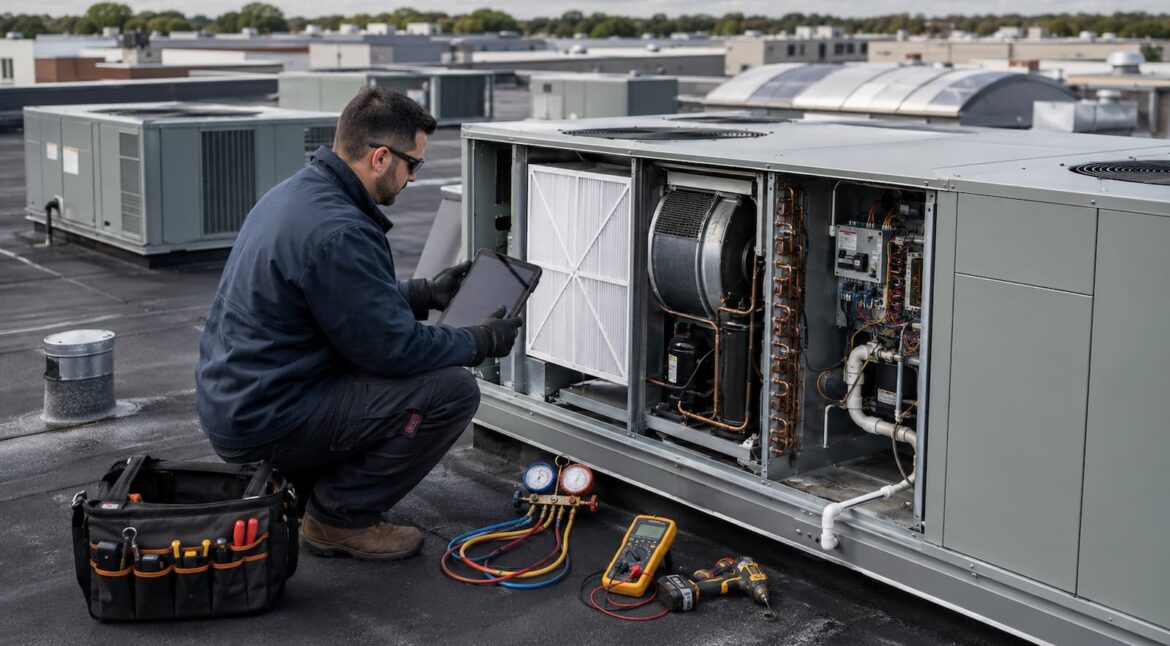
Rooftop units are common in commercial buildings because they combine heating, cooling, ventilation, and controls in a packaged unit. They are exposed to weather, roof debris, sun, wind, and seasonal changes. RTU maintenance should be detailed and consistent.
A rooftop unit checklist should include:
- Inspect access panels, hinges, screws, and seals.
- Replace or clean filters.
- Inspect condenser and evaporator coils.
- Check belts, pulleys, bearings, and blower wheels.
- Test capacitors, contactors, relays, and electrical connections.
- Measure motor amp draw.
- Check compressor operation.
- Inspect refrigerant performance.
- Check economizer dampers, actuators, and sensors.
- Inspect gas heating components where applicable.
- Check condensate pans and drains.
- Inspect insulation inside the cabinet.
- Verify thermostat or building automation communication.
- Check curb, roof penetration, and water intrusion concerns.
- Document unit condition and recommended repairs.
If your building relies heavily on RTUs, scheduled rooftop unit maintenance can help reduce surprise failures and extend equipment life.
Annual Commercial HVAC Maintenance Checklist
Annual maintenance should go beyond seasonal startup. It should evaluate long-term equipment condition, repair history, efficiency, controls, safety, and capital planning.
1. Review Repair History
Look at which units required service during the year. Repeated failures on the same unit may indicate deeper issues: poor airflow, aging equipment, refrigerant leaks, electrical wear, control problems, or sizing mismatch. Repair history helps prioritize replacement planning and budget forecasting.
2. Evaluate Equipment Age and Condition
Older units can still be useful, but they should be evaluated carefully. Document equipment age, major repairs, efficiency concerns, refrigerant type, parts availability, corrosion, coil condition, compressor health, and tenant complaints. This helps avoid emergency replacement decisions.
3. Check Controls and Building Automation
Controls can waste energy when schedules, sensors, setpoints, dampers, or overrides are wrong. Review occupied and unoccupied schedules, holiday settings, tenant overrides, sensor calibration, economizer logic, and simultaneous heating/cooling problems. A building can have good equipment and still waste energy because of poor controls.
4. Inspect Ductwork and Air Distribution
Duct issues can create comfort complaints even when equipment is functional. Annual review should consider duct leakage, damaged insulation, loose connections, closed dampers, blocked diffusers, poor return paths, and balancing issues. In multi-tenant spaces, buildouts and renovations can change airflow needs.
5. Build a Capital Replacement Plan
Commercial HVAC replacement is easier to manage when planned in advance. If several units are aging, create a priority list based on age, condition, repair frequency, comfort impact, and business risk. Planned replacement can reduce emergency costs and give building owners more time to compare options.
Maintenance Checklist by Building Type
Office Buildings
Office buildings often have comfort complaints tied to zones, conference rooms, solar exposure, occupancy changes, and thermostat disputes. Maintenance should focus on filters, airflow balancing, controls, VAV boxes where present, rooftop units, tenant schedules, and after-hours operation.
Retail Stores
Retail HVAC affects customers, staff, and product comfort. Doors opening frequently can increase load. Maintenance should focus on rooftop units, filters, economizers, thermostat protection, humidity, and fast response to no-cooling complaints during business hours.
Restaurants and Food Service Spaces
Restaurants have unique HVAC demands because cooking equipment adds heat, grease, ventilation load, and makeup air requirements. Comfort problems may be tied to exhaust systems, makeup air, kitchen heat, dining room balance, and rooftop unit performance. Filters and coils may need closer attention depending on use.
Warehouses and Light Industrial Buildings
Warehouses may have large open areas, loading doors, dust, high ceilings, equipment heat, and spot-conditioning needs. Maintenance should account for dustier filters, ventilation, unit heaters, rooftop equipment, exhaust systems, and employee comfort zones.
Medical Offices and Specialty Spaces
Medical and specialty offices may have higher expectations for comfort, humidity, filtration, and reliability. Maintenance should be documented clearly, filters should be managed carefully, and comfort complaints should be addressed quickly. Any special ventilation or filtration requirements should be reviewed with qualified professionals.
What Building Staff Can Safely Do
Building staff can play a major role in maintenance, but they should stay within safe limits. Staff should not open high-voltage compartments, handle refrigerant, bypass safeties, adjust gas components, or perform repairs they are not trained to do.
Safe staff-level tasks may include:
- Checking thermostat settings and schedules.
- Replacing accessible filters if trained to do so.
- Keeping vents and returns clear.
- Reporting unusual noises or odors.
- Documenting hot and cold complaints by location and time.
- Looking for water stains or leaks.
- Keeping outdoor units clear of debris.
- Checking that roof access paths are safe and available.
What Should Be Handled by a Commercial HVAC Technician
A qualified technician should handle diagnostic and repair tasks involving electrical components, refrigerant, gas heating, boilers, controls, motors, belts, coil cleaning, rooftop units, and safety systems.
Technician-level tasks include:
- Testing capacitors, contactors, motors, compressors, and electrical controls.
- Checking refrigerant performance and leak concerns.
- Cleaning coils safely and properly.
- Inspecting gas heating operation and safety controls.
- Servicing commercial boilers and hydronic systems.
- Inspecting economizers and dampers.
- Testing airflow and static pressure where needed.
- Clearing difficult condensate clogs.
- Diagnosing rooftop unit failures.
- Repairing control sequences and sensor issues.
Warning Signs Your Commercial HVAC System Needs Service
Maintenance reduces breakdown risk, but building managers should still watch for warning signs between visits.
- Repeated hot or cold complaints from the same area.
- Weak airflow from multiple vents.
- Unusual noises from rooftop or indoor equipment.
- Water stains, leaks, or musty odors.
- Short cycling or constant operation.
- Ice on coils or refrigerant lines.
- Rising utility bills without a clear reason.
- Thermostats that do not match actual room conditions.
- Units that require frequent resets.
- Burning smells, electrical odors, or breaker trips.
- Heating startup problems before winter.
- Cooling startup problems before summer.
Electrical odors, breaker trips, gas odors, combustion concerns, active water leaks, and loss of heating or cooling in critical spaces should be treated as urgent.
How Often Should Commercial HVAC Be Serviced?
Many commercial buildings benefit from at least two professional maintenance visits per year: one before cooling season and one before heating season. Buildings with heavier use, rooftop units, restaurants, medical spaces, older systems, or high comfort demands may need more frequent service.
A practical schedule often looks like this:
- Monthly: Filters, thermostat checks, visible leaks, unusual noises, tenant complaints, outdoor clearance.
- Quarterly: More detailed equipment checks, belts, drains, coils, electrical review, rooftop inspection.
- Spring: Cooling startup, coils, refrigerant performance, drains, electrical components, economizers.
- Fall: Heating startup, burners, heat exchangers where applicable, boilers, heat pumps, belts, safety controls.
- Annually: Equipment condition review, repair history, efficiency concerns, capital planning, control strategy review.
The right frequency depends on risk. A low-occupancy storage building has different needs than a busy retail store or medical office. The maintenance schedule should match how important HVAC reliability is to the operation.
Documentation: The Part of Maintenance Many Buildings Miss
Maintenance that is not documented is harder to manage. Good records help track recurring issues, justify repairs, plan replacements, and reduce confusion between property managers, tenants, and service providers.
A maintenance report should document:
- Date of service.
- Unit identification and location.
- Filters replaced or inspected.
- Cooling or heating performance readings.
- Electrical readings and component condition.
- Drain and condensate findings.
- Coil condition.
- Belts, motors, and blower observations.
- Repairs completed.
- Recommended repairs or follow-up.
- Equipment age and replacement concerns.
Documentation is especially valuable for multi-unit buildings. If one rooftop unit has needed three repairs in two years while others are stable, that unit should be on the capital planning list.
Frequently Asked Questions
What should be included in commercial HVAC maintenance?
Commercial HVAC maintenance should include filters, coils, belts, motors, electrical components, refrigerant performance, condensate drains, thermostats, controls, economizers, airflow, safety devices, heating components, cooling components, rooftop unit condition, and clear documentation.
How often should commercial HVAC filters be changed?
Filters should be inspected regularly, often monthly in commercial settings. Replacement frequency depends on building use, occupancy, filter type, dust levels, outdoor air intake, tenant activity, and operating hours. Some buildings need monthly replacement; others may be able to go longer with proper monitoring.
How often should a commercial HVAC system be serviced?
Many commercial buildings should have professional service at least twice per year: once before cooling season and once before heating season. Heavily used buildings, rooftop units, restaurants, medical offices, and older equipment may need quarterly or more frequent maintenance.
What is the most commonly missed commercial HVAC maintenance task?
Filters and coils are often neglected, but documentation is also commonly missed. Without records, it is harder to identify repeat failures, compare unit performance, plan replacements, and prove that maintenance has been performed consistently.
Do rooftop units need different maintenance than indoor HVAC equipment?
Yes. Rooftop units are exposed to weather, debris, roof conditions, wind, snow, sun, and access limitations. They often include cooling, heating, ventilation, economizers, filters, belts, motors, and controls in one packaged system. They need detailed seasonal inspection.
Can poor maintenance increase energy bills?
Yes. Dirty filters, dirty coils, weak airflow, bad controls, stuck dampers, refrigerant issues, and worn components can all make equipment run longer or less efficiently. Maintenance helps the system operate closer to intended performance.
What HVAC maintenance should be done before summer?
Before summer, check cooling operation, filters, condenser coils, evaporator coils, refrigerant performance, capacitors, contactors, motors, condensate drains, economizers, controls, and rooftop unit condition. Cooling startup should happen before the first major heat wave.
What HVAC maintenance should be done before winter?
Before winter, test heating operation, gas burners, ignition systems, heat exchangers where applicable, safety controls, boilers, pumps, belts, blowers, dampers, freeze protection, thermostats, and control sequences. Heating problems are easier to fix before the first cold snap.
Who should maintain a commercial HVAC system?
Building staff can safely handle basic visual checks, filter replacement where trained, thermostat review, and complaint documentation. Electrical testing, refrigerant work, gas heating service, boiler maintenance, rooftop unit service, coil cleaning, and safety control diagnostics should be handled by qualified HVAC technicians.
Is a maintenance agreement worth it for a commercial building?
For many commercial buildings, yes. A maintenance agreement creates a predictable schedule, reduces missed service, improves documentation, and helps identify problems before they become emergency repairs. It is especially valuable for buildings with rooftop units, multiple tenants, older equipment, or critical comfort needs.
Bottom Line: A Commercial HVAC Checklist Should Prevent Surprises
Commercial HVAC maintenance is not just a seasonal formality. It is a risk management tool for New Jersey buildings. A strong checklist helps protect comfort, reduce emergency calls, improve efficiency, support indoor air quality, and extend equipment life.
The best checklist covers the basics every month, prepares cooling equipment in spring, protects performance through summer, prepares heating systems in fall, and keeps equipment reliable through winter. It should also include rooftop units, controls, drains, filters, coils, belts, motors, boilers, safety devices, airflow, documentation, and capital planning.
Most importantly, the checklist should match the building. A retail store, restaurant, office, warehouse, and medical office do not all have the same HVAC priorities. When maintenance is built around the actual equipment and the way the building is used, it becomes much easier to prevent breakdowns, control costs, and keep occupants comfortable through New Jersey’s changing seasons.