
AC Breaker Keeps Tripping: What It Usually Means
If your AC breaker keeps tripping, the most important thing to know is this: do not keep resetting it. A circuit breaker is a safety device. When it trips, it is cutting power because the circuit is overloaded, shorted, grounded, overheating, or otherwise operating outside a safe range. One reset may be reasonable if the trip happened once and there are no warning signs. But if the breaker trips again, something needs to be diagnosed.
Air conditioners use powerful electrical components. The outdoor condenser, compressor, condenser fan motor, indoor blower, control wiring, capacitors, contactors, and disconnects all have to work together. When one component starts failing, the system may draw too much current and trip the breaker. Sometimes the cause is HVAC-related. Sometimes the cause is electrical. Either way, repeated breaker trips should not be treated as a minor nuisance.
This guide explains what it usually means when an AC breaker keeps tripping, what you can safely check, what common HVAC problems cause breaker trips, when to shut the system down, and when professional air conditioning repair is needed.
Quick answer: If your AC breaker keeps tripping, turn the system off and do not keep resetting the breaker. A repeat trip can point to a dirty condenser coil, clogged filter, weak capacitor, failing motor, compressor problem, shorted wiring, loose electrical connection, bad contactor, grounded compressor, or failing breaker. You can safely check the thermostat, filter, outdoor unit clearance, and obvious water or ice, but electrical testing should be handled by a professional.
What Does It Mean When the AC Breaker Trips?
A breaker trips when it senses a condition that could damage wiring, equipment, or create a safety hazard. For an air conditioner, that usually means the system is drawing more electrical current than the circuit is designed to handle, or there is a fault somewhere in the circuit or equipment.
An AC breaker trip can happen for several broad reasons. The system may be overloaded because it is working too hard. A motor may be failing and drawing excessive current. A compressor may be struggling to start. A capacitor may no longer be helping a motor start properly. Wiring may be loose, damaged, shorted, or grounded. The breaker itself may be weak or faulty. The outdoor unit may be dirty and overheating. The system may also be operating under poor airflow or refrigerant conditions that put extra stress on the compressor.
The breaker is not the problem in most cases. It is the messenger. Resetting it without finding the cause is like turning off an alarm without checking why it went off.
Can You Reset an AC Breaker?
If the breaker tripped once, and there are no burning smells, no sparks, no visible damage, no loud humming, and no water near electrical equipment, you may reset it one time. To reset a breaker properly, move it fully to the Off position first, then back to On. Some breakers appear to be in the middle when tripped, so they need to be fully switched off before resetting.
After that, watch what happens. If the AC starts and continues running normally, the trip may have been caused by a temporary event such as a power fluctuation. But if the breaker trips again immediately, trips when the outdoor unit starts, trips after a few minutes, or trips repeatedly during hot weather, stop. Leave it off and schedule service.
Do not keep resetting the breaker every time it trips. Repeated resets can increase the risk of equipment damage and electrical hazards. The system is telling you something is wrong.
Turn the AC Off Immediately If You Notice These Warning Signs
Some breaker trips are more concerning than others. If any of the signs below are present, turn the AC off and do not attempt additional troubleshooting.
- The breaker trips immediately after reset.
- The breaker trips every time the outdoor unit starts.
- You smell burning, melting plastic, or electrical odors.
- The outdoor unit hums or buzzes but does not start.
- The condenser fan is not spinning while the unit is energized.
- The indoor blower is not running while the outdoor unit tries to run.
- There are scorch marks, melted insulation, or visible wire damage.
- The breaker feels hot.
- Water is leaking around electrical or HVAC equipment.
- Ice is present on the refrigerant line or indoor coil area.
- The AC starts and shuts off repeatedly before the breaker trips.
These symptoms can point to serious electrical or mechanical problems. This is not the time to open panels, touch wiring, bypass safety switches, or force the system to run.
Safe Checks You Can Do Before Calling
Homeowners can do a few safe checks without opening electrical compartments or handling HVAC components. These checks may not fix the problem, but they can help you understand what is happening and provide useful information when you call for service.
1. Check the Thermostat Setting
Make sure the thermostat is set to Cool and the set temperature is not extremely low. A very low thermostat setting does not make the AC cool faster. It only tells the system to run longer. If the AC is already struggling, forcing long runtime can increase stress.
If the breaker trips only when the thermostat calls for cooling, that detail matters. It may point to the outdoor unit, compressor, condenser fan motor, capacitor, contactor, or related wiring.
2. Check the Air Filter
A severely clogged filter can restrict airflow. Restricted airflow can cause the system to run longer, freeze the indoor coil, overwork the blower, and increase overall stress. A dirty filter may not directly trip the breaker every time, but it can contribute to conditions that make the AC work harder.
Replace a dirty filter with the correct size and type. Make sure the airflow arrow points in the correct direction. If the system was freezing or airflow was very weak, do not restart cooling until the system has thawed and the cause has been addressed.
3. Look at the Outdoor Unit
The outdoor condenser needs airflow to release heat. If the unit is surrounded by weeds, leaves, grass clippings, mulch, fencing, outdoor furniture, or debris, it may overheat and draw more current. Clear debris around the unit if you can do so safely with power off.
Do not remove the condenser fan grille, electrical panel, or service panels. Do not wash electrical areas. Do not try to restart the unit if it was humming, buzzing, smoking, or tripping the breaker repeatedly.
4. Check for Ice
Ice on the refrigerant line or indoor coil area means the AC is not operating correctly. A frozen coil can happen because of airflow restriction, dirty coils, low refrigerant, blower problems, or other system issues. If you see ice, turn cooling off and let the system thaw.
Do not keep running a frozen AC. If the system is frozen and also tripping the breaker, there may be multiple problems that need diagnosis.
5. Notice When the Breaker Trips
Timing helps narrow the cause. Does it trip immediately? Does it trip only when the outdoor unit starts? Does it trip after 10 or 20 minutes? Does it trip during the hottest part of the day? Does it trip after a storm? Does it trip when the fan starts? These details can help the technician focus on the right part of the system.
You do not need to keep testing the system to gather this information. One observed trip is enough. If it repeats, stop resetting it.
Common Reasons an AC Breaker Keeps Tripping
Repeated AC breaker trips usually happen because of electrical overload, short circuit, ground fault, overheating, or a failing HVAC component. Below are the most common causes.
1. Dirty Condenser Coil
The outdoor condenser coil releases heat from your home to the outdoor air. When that coil is dirty, blocked, or packed with debris, the AC has to work harder to reject heat. The compressor may run hotter, pressures may rise, and electrical demand can increase. In severe cases, the system may trip the breaker or shut down on safety controls.
Dirt can come from grass clippings, leaves, pollen, dust, cottonwood-like debris, dryer lint, landscaping, road debris, and general outdoor exposure. A coil can look acceptable from a distance but still be dirty enough to reduce performance.
Professional cleaning is often safer than aggressive DIY cleaning because coil fins can bend and electrical areas must be protected. Keeping the area around the unit clear is a good homeowner habit, but deep cleaning should be done carefully.
2. Clogged Air Filter or Restricted Airflow
A dirty filter restricts indoor airflow. When airflow is low, the evaporator coil can get too cold and freeze. The blower may work harder, cooling performance drops, and the system may run longer than normal. Longer runtime and poor operating conditions can contribute to electrical stress.
Restricted airflow can also be caused by blocked returns, closed vents, dirty evaporator coils, collapsed ductwork, dirty blower wheels, or failing blower motors. If the system is tripping the breaker and airflow has been weak, airflow should be part of the diagnosis.
3. Weak or Failed Capacitor
Capacitors help the compressor and fan motors start and run. When a capacitor weakens, the motor may struggle to start. That can cause humming, hard starting, overheating, and increased current draw. If the compressor or fan cannot start properly, the breaker may trip.
Capacitor issues are common during hot weather because the AC runs longer and electrical parts are under more stress. A failed capacitor can sometimes make the outdoor unit hum without the fan spinning or the compressor starting.
Capacitors can hold electrical charge even when power is off. They should be tested and replaced by a qualified technician, not handled as a DIY part swap.
4. Failing Compressor
The compressor is one of the largest electrical loads in the AC system. If it is failing, locked, shorted, grounded, overheating, or struggling to start, it can trip the breaker. Compressor issues are among the more serious causes of repeated breaker trips.
However, not every compressor symptom means the compressor itself is bad. A weak capacitor, bad contactor, low voltage, dirty condenser coil, refrigerant problem, or failing condenser fan can make the compressor work under poor conditions. A technician should test the compressor and supporting components before recommending major repairs.
If the diagnosis points to a major compressor failure on an older AC, repair versus replacement should be discussed carefully. Compressor replacement can be expensive, and the age and condition of the entire system matter.
5. Condenser Fan Motor Problem
The condenser fan helps move outdoor air across the condenser coil. If the fan motor is failing, running slowly, overheating, or not starting, the outdoor unit cannot release heat properly. This can increase system pressure and compressor stress. The fan motor itself may also draw excessive current and trip the breaker.
Warning signs include a fan that does not spin, a fan that starts slowly, grinding or squealing noises, a humming outdoor unit, or the AC shutting down after running for a short time. Do not try to push-start the fan blade. That is unsafe and does not solve the cause.
6. Indoor Blower Motor Problem
The indoor blower moves air across the evaporator coil and through the duct system. If the blower motor is failing, drawing too much current, overheating, or not starting, it can trip the breaker that serves the indoor unit. If the outdoor unit runs without proper indoor airflow, the coil can freeze and the compressor may be stressed.
Blower issues can show up as weak airflow, a humming indoor unit, hot electrical smells, intermittent fan operation, or a system that starts but quickly shuts down. Blower motor problems can involve the motor, capacitor, control board, relay, wiring, or blower wheel.
7. Short Circuit in Wiring or Components
A short circuit occurs when electrical current travels along an unintended path. In an AC system, shorts can happen because of damaged insulation, rubbed wires, moisture, pests, burned contactors, failed motors, damaged compressor windings, or loose connections.
Short circuits often trip breakers quickly. If the breaker trips immediately after reset or as soon as the AC tries to start, a short or grounded component may be involved. This is not a safe DIY troubleshooting situation.
8. Grounded Compressor or Ground Fault
A grounded compressor is a serious failure where electrical current has found a path to ground through the compressor windings or shell. This can trip the breaker and may indicate that the compressor has failed internally. A technician can perform electrical tests to confirm whether the compressor is grounded.
If a grounded compressor is confirmed, repair options may be limited. On older systems, replacement of the AC may be more practical than compressor replacement. The technician should explain the test results and options clearly.
9. Bad Contactor
The contactor is the electrical switch that sends power to the outdoor unit when the thermostat calls for cooling. If the contactor is burned, pitted, stuck, or damaged, it can create poor electrical contact, overheating, arcing, or startup problems. This can contribute to breaker trips or prevent the AC from starting correctly.
A contactor issue may be visible to a technician during inspection, but homeowners should not open the outdoor electrical compartment. The contactor is in a high-voltage area.
10. Loose Electrical Connections
Loose electrical connections can create heat, arcing, voltage drop, and unreliable operation. HVAC equipment vibrates during operation, and over time connections can loosen. Weather exposure, corrosion, previous repairs, and age can also affect wiring.
Loose connections are especially concerning because they may not trip the breaker immediately every time. They can create intermittent problems, burning smells, or heat damage. A technician should inspect electrical terminals, wiring, disconnects, and components during diagnosis.
11. Refrigerant Problem Causing Compressor Stress
Refrigerant problems can make the compressor operate under abnormal conditions. Low refrigerant, overcharge, restrictions, dirty coils, or metering device problems can all affect pressures and temperatures. The system may run poorly, overheat, short cycle, freeze, or eventually trip the breaker if the compressor is under heavy stress.
Refrigerant is not a homeowner-level repair. It requires proper tools, training, and handling. If the system is low on refrigerant, there is usually a leak or another problem that needs diagnosis.
12. The Breaker Itself Is Failing
Sometimes the breaker is the problem. Breakers can wear out, become weak, overheat, or fail internally. A weak breaker may trip even when the AC is operating within normal limits. However, this should not be assumed until the HVAC system and electrical circuit are tested.
Replacing a breaker is electrical work and should be handled by a qualified electrician. If HVAC testing shows the AC is operating normally but the breaker still trips, electrical panel evaluation may be needed.
What It Means Based on When the Breaker Trips
Timing can tell a technician a lot. The breaker may trip immediately, after startup, after several minutes, or only during peak heat. Each pattern points in a slightly different direction.
Breaker Trips Immediately
An immediate trip often points to a short circuit, grounded component, damaged wiring, severe motor fault, compressor issue, or breaker problem. If the breaker trips as soon as you reset it or as soon as cooling is called, leave it off.
Breaker Trips When the Outdoor Unit Starts
If the breaker trips right when the outdoor unit tries to start, possible causes include a failed capacitor, compressor hard-start condition, bad contactor, condenser fan motor problem, shorted wiring, or compressor failure. This is a common pattern during no-cooling calls.
Breaker Trips After the AC Runs for a While
A breaker that trips after 10, 20, or 30 minutes may point to overheating, dirty condenser coils, failing motors, compressor stress, loose wiring, high refrigerant pressure, or poor airflow. Heat-related failures often appear after the system runs long enough for components to get hot.
Breaker Trips Only on Very Hot Days
Hot weather increases AC runtime and operating pressure. A system with dirty coils, a weak capacitor, failing motor, aging compressor, or poor airflow may run during mild weather but trip during peak demand. This is often a sign that a weak component is being pushed past its limit.
Breaker Trips After Rain or Storms
Moisture can contribute to electrical problems, especially if there is damaged wiring, poor seals, water intrusion, a compromised disconnect, or outdoor electrical component issues. Storms can also cause power surges. If the breaker starts tripping after rain or a storm, electrical inspection is important.
Why You Should Not Keep Resetting the Breaker
Repeatedly resetting a tripping breaker does not fix the problem. It gives the equipment repeated chances to draw excessive current, overheat, arc, or fail harder. If the breaker is doing its job, forcing it back on defeats the purpose of the safety device.
This is especially important with air conditioners because the compressor and motors are expensive components. A failing capacitor, dirty coil, or fan motor issue may start as a repairable problem. But if the system is forced to keep starting under poor conditions, the compressor may be damaged.
The safest approach is simple: reset the breaker once if there are no warning signs. If it trips again, leave it off and schedule diagnosis.
What an HVAC Technician Will Check
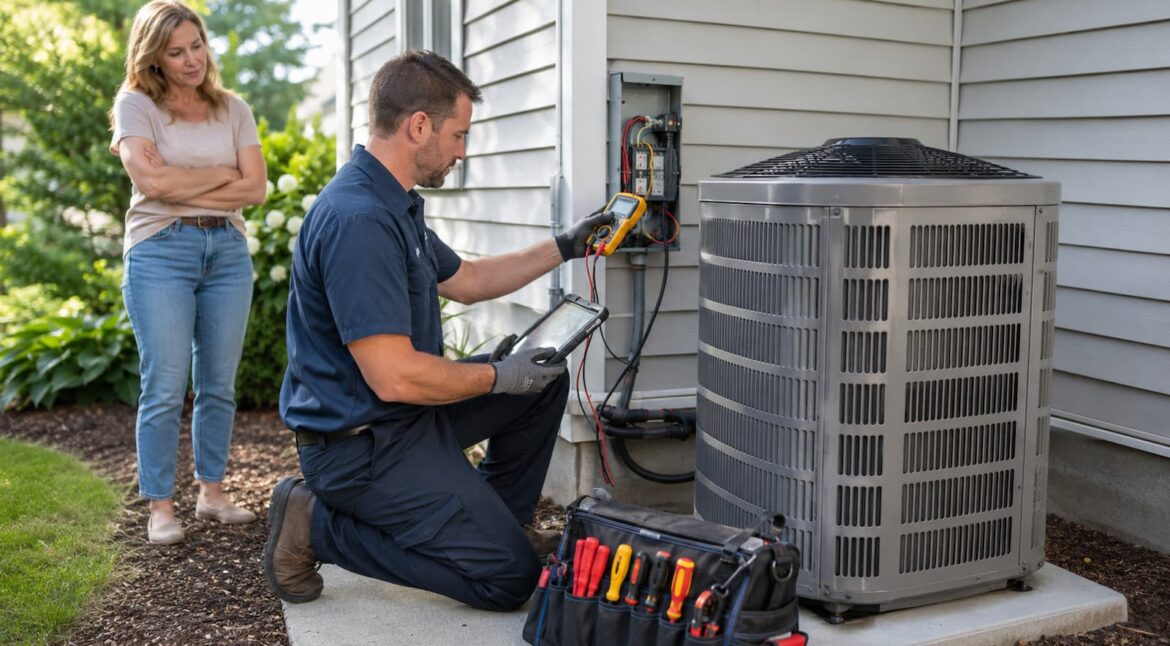
A proper diagnosis should determine whether the problem is in the AC equipment, the circuit, the breaker, or a combination of issues. The technician will not only reset the breaker and watch the unit run. They will test the electrical and mechanical conditions that caused the trip.
An HVAC diagnostic visit may include:
- Checking breaker behavior and service history.
- Verifying indoor and outdoor power supply.
- Inspecting the outdoor disconnect.
- Testing capacitors.
- Inspecting the contactor.
- Checking condenser fan motor operation.
- Checking indoor blower motor operation.
- Measuring compressor amp draw.
- Testing compressor windings where appropriate.
- Inspecting wiring for heat damage, shorts, loose connections, or corrosion.
- Checking condenser coil condition.
- Checking air filter, airflow, and signs of freezing.
- Reviewing refrigerant performance if the system can safely run.
- Determining whether an electrician is needed for breaker or panel issues.
If the breaker trips before the system can run long enough for full testing, the technician may need to isolate components and test them separately. Electrical diagnosis should be methodical because replacing parts without finding the cause can lead to repeat failures.
HVAC Technician or Electrician: Who Should You Call?
If the breaker trips only when the AC runs, an HVAC technician is usually the best first call. The problem often involves the condenser, compressor, fan motor, capacitor, contactor, blower, or HVAC wiring. The technician can test whether the AC is causing the breaker trip.
An electrician may be needed if the breaker itself is failing, the panel is overheating, the circuit is damaged, the wiring between the panel and disconnect has problems, or the HVAC technician determines that the equipment is not the source of the trip.
In many cases, the best path is HVAC diagnosis first when the trip happens during cooling operation, followed by electrical evaluation if the HVAC equipment tests normally or panel/circuit problems are suspected.
Can Maintenance Prevent AC Breaker Trips?
Maintenance cannot prevent every electrical failure, but it can reduce many common conditions that contribute to breaker trips. Dirty coils, clogged filters, weak capacitors, loose electrical connections, worn motors, and poor airflow are all issues that can be found during preventive service.
During seasonal AC maintenance, a technician can check electrical components, clean or inspect coils, test capacitors, review airflow, inspect drains, and look for signs of overheating or component wear. These checks are especially valuable before the first major heat wave, when weak parts are more likely to fail.
Maintenance can help reduce breaker trips by:
- Improving airflow with clean filters and coils.
- Reducing compressor stress through better heat transfer.
- Finding weak capacitors before they fail.
- Identifying loose or overheated electrical connections.
- Checking fan motors before they seize or overheat.
- Spotting refrigerant or freezing issues early.
- Preventing extended runtime caused by poor performance.
Repair or Replace: What If the Breaker Trip Means a Major Failure?
Many breaker-trip causes are repairable. A weak capacitor, bad contactor, dirty condenser coil, loose electrical connection, or fan motor issue may be fixable without replacing the entire AC. But if the breaker trip is caused by a grounded compressor, major electrical damage, severe refrigerant circuit problem, or multiple failures on an older system, replacement may need to be considered.
Repair often makes sense when:
- The system is relatively young.
- The failed part is isolated.
- The compressor tests normally.
- The repair cost is reasonable.
- The AC cools well when operating properly.
- There is no history of repeated major repairs.
Replacement may be worth discussing when:
- The compressor is grounded or has failed internally.
- The system is older and unreliable.
- The AC has needed repeated electrical repairs.
- Major components are failing together.
- Repair cost is high compared with replacement value.
- The system is inefficient and struggles to cool the home.
- The equipment uses older refrigerant or parts are difficult to source.
If the breaker trip leads to a major diagnosis on an aging system, comparing repair with air conditioning replacement can help you avoid spending heavily on equipment that may continue to fail.
Commercial AC Breakers Can Trip Too
Commercial HVAC systems, including rooftop units, can also trip breakers. The causes are similar but often larger in scale: compressor issues, dirty coils, condenser fan failures, belt and blower problems, economizer problems, control faults, high operating load, loose wiring, and aging electrical components.
In commercial buildings, a breaker trip can affect employees, tenants, customers, inventory, or business operations. Facility managers should not repeatedly reset breakers on rooftop units or commercial equipment. A repeated trip should be documented and diagnosed.
Timing matters in commercial settings too. A breaker that trips only during peak afternoon heat may point to load, coil, compressor, or fan problems. A breaker that trips immediately may point to a short, grounded component, or electrical fault. A technician should test the system before normal operation resumes.
What Not to Do When Your AC Breaker Keeps Tripping
A tripping breaker can make homeowners impatient, especially during hot weather. But some actions can make the situation more dangerous or more expensive.
- Do not keep resetting the breaker. If it trips again, leave it off.
- Do not replace the breaker with a larger one. Breaker size must match the circuit and equipment requirements.
- Do not open the condenser electrical compartment. High voltage and stored capacitor charge can be dangerous.
- Do not bypass safety switches. They are protecting equipment and property.
- Do not push-start the outdoor fan. It is unsafe and does not fix the motor or capacitor.
- Do not ignore burning smells. Shut the system down and call for help.
- Do not assume the breaker is bad. The AC equipment may be causing the trip.
Frequently Asked Questions
Why does my AC breaker keep tripping?
Common causes include dirty condenser coils, clogged filters, weak capacitors, failing fan motors, compressor problems, short circuits, loose wiring, bad contactors, grounded components, refrigerant-related compressor stress, or a failing breaker. A technician needs to test the system to identify the real cause.
Is it safe to keep resetting my AC breaker?
No. If the breaker trips again after one reset, leave it off. Repeated tripping means the problem still exists. Continuing to reset the breaker can create safety risks and may damage HVAC components.
Can a dirty air filter trip the AC breaker?
A dirty filter may not directly trip the breaker, but it can restrict airflow, cause freezing, increase runtime, strain the blower, and contribute to poor operating conditions. If the system is already weak or overheating, airflow restriction can make problems worse.
Can a dirty condenser coil cause breaker trips?
Yes. A dirty condenser coil can make it harder for the AC to reject heat. This can increase compressor stress, raise operating pressure, reduce cooling performance, and contribute to breaker trips under heavy load.
Why does the breaker trip when the outside AC unit turns on?
This often points to the outdoor unit. Possible causes include a weak capacitor, failing compressor, bad contactor, condenser fan motor problem, shorted wiring, or electrical fault. Turn the system off if it trips repeatedly.
Why does my AC breaker trip after running for a while?
A breaker that trips after the system runs for a while may point to overheating, dirty coils, failing motors, compressor stress, loose wiring, or high operating pressure. Heat-related electrical problems often appear after components warm up.
Could the breaker itself be bad?
Yes, a breaker can fail or become weak. But do not assume that first. The AC system should be tested to confirm whether it is drawing excessive current or has a fault. If the HVAC equipment tests normally, an electrician may need to evaluate the breaker and panel.
Can a capacitor cause the AC breaker to trip?
Yes. A weak or failed capacitor can make the compressor or fan motor struggle to start. That can increase current draw, cause humming, overheat components, and trip the breaker.
Should I call an HVAC technician or an electrician?
If the breaker trips only when the AC runs, start with an HVAC technician. If the technician finds that the AC equipment is operating normally or suspects a panel, breaker, or circuit issue, an electrician may be needed.
When is an AC breaker trip an emergency?
Treat it as urgent if there are burning smells, smoke, sparks, a hot electrical panel, repeated immediate trips, water near electrical equipment, or the home is becoming unsafe due to heat. Turn the system off and call for professional help.
Bottom Line: A Tripping AC Breaker Is a Warning, Not an Inconvenience
If your AC breaker keeps tripping, the system is not just being difficult. The breaker is responding to a condition that needs attention. It may be a dirty coil, clogged filter, weak capacitor, failing fan motor, compressor problem, short circuit, loose wire, bad contactor, grounded compressor, or breaker issue.
You can safely check the thermostat, filter, outdoor unit clearance, visible ice, and obvious water around the indoor unit. You can reset the breaker once if there are no warning signs. But if it trips again, leave it off.
The safest next step is a proper diagnosis. A technician can test the electrical components, motors, compressor, coils, airflow, refrigerant performance, and breaker behavior to find the real cause. Fixing the cause protects the equipment, reduces safety risk, and helps prevent a small electrical warning from becoming a major AC failure.