

How Much Does AC Repair Usually Cost? What Affects the Price
When your air conditioner stops cooling, starts making strange noises, freezes up, leaks water, or refuses to turn on, one of the first questions is usually the same: how much is this going to cost? It is a fair question. AC problems often happen during the hottest weather, when you need the system most and when waiting too long can make the house uncomfortable fast.
The honest answer is that AC repair cost depends on what failed, how difficult it is to access, whether the system needs parts, whether refrigerant work is involved, how old the equipment is, and how urgent the service call is. A clogged drain line or failed capacitor may be a relatively straightforward repair. A refrigerant leak, evaporator coil problem, blower motor failure, control board issue, or compressor trouble can cost much more.
This guide explains typical AC repair cost ranges, what affects the final price, why a diagnostic visit matters, how to think about repair versus replacement, and what you can do to avoid paying for preventable breakdowns. If your system is already not cooling properly, scheduling professional air conditioning repair is usually the best way to get a real answer instead of guessing from symptoms.
Quick answer: Many common AC repairs fall somewhere in the low hundreds to mid hundreds, while major repairs involving refrigerant leaks, motors, coils, compressors, or hard-to-access components can reach $1,000 or more. The only reliable way to price the repair is to diagnose the system first, because the same symptom can have several very different causes.
Why AC Repair Prices Vary So Much
Two homeowners can describe the same problem — “my AC is not cooling” — and end up with completely different repair bills. That is because symptoms do not equal diagnoses. Warm air from the vents could be caused by a dirty filter, a failed capacitor, a refrigerant leak, a frozen coil, a bad blower motor, a failed compressor, a thermostat issue, or a control problem. Some of those are simple. Some are major.
AC repair cost is built from several parts: the service call or diagnostic fee, labor time, replacement parts, refrigerant if needed, leak detection if needed, system accessibility, urgency, warranty status, and sometimes code or installation issues discovered during the repair. The final number is not just “the price of the part.” It is the cost of finding the problem, repairing it correctly, testing the system, and making sure it is operating safely.
That is why very low phone estimates can be misleading. A company can sometimes give a rough range for common repairs, but no technician can honestly quote a precise repair price before knowing what is wrong. A frozen coil, for example, might be caused by a clogged filter, dirty evaporator coil, low refrigerant, failing blower motor, duct restriction, or a metering device problem. Each cause has a different cost.
Typical AC Repair Cost Ranges
The ranges below are general planning ranges, not fixed quotes. Prices vary by local labor rates, equipment brand, part availability, system age, warranty status, service timing, and the exact repair required. Still, it helps to understand which repairs are usually minor and which ones tend to be more expensive.
| Repair Type | Typical Cost Level | Why the Price Varies |
|---|---|---|
| Thermostat issue | Low to moderate | Depends on thermostat type, wiring, configuration, and whether the thermostat is actually the problem. |
| Clogged drain line | Low to moderate | Depends on clog severity, drain access, float switch testing, pump condition, and water damage concerns. |
| Capacitor replacement | Usually moderate | Depends on capacitor type, system size, accessibility, and whether other electrical components were damaged. |
| Contactor replacement | Usually moderate | Depends on part type, wiring condition, electrical wear, and whether the contactor failed alone or with another component. |
| Blower motor repair or replacement | Moderate to high | Depends on motor type, ECM vs PSC design, module availability, labor time, and access to the indoor unit. |
| Condenser fan motor | Moderate to high | Depends on motor type, blade condition, capacitor condition, and whether overheating affected other components. |
| Refrigerant leak repair | Moderate to very high | Depends on leak location, leak detection time, refrigerant type, coil condition, repairability, and recharge amount. |
| Evaporator coil repair or replacement | High | Depends on coil availability, refrigerant recovery, brazing, access, system age, and whether replacement makes more sense. |
| Compressor repair or replacement | High to very high | Depends on compressor type, warranty, refrigerant, contamination, labor, system age, and whether full replacement is more practical. |
The most important takeaway is that the cheapest repair is not always the best repair, and the most expensive recommendation is not always necessary. The right repair should be based on a proper diagnosis, the system’s condition, and the likelihood that the repair will actually solve the problem long-term.
What Is Included in an AC Diagnostic Fee?
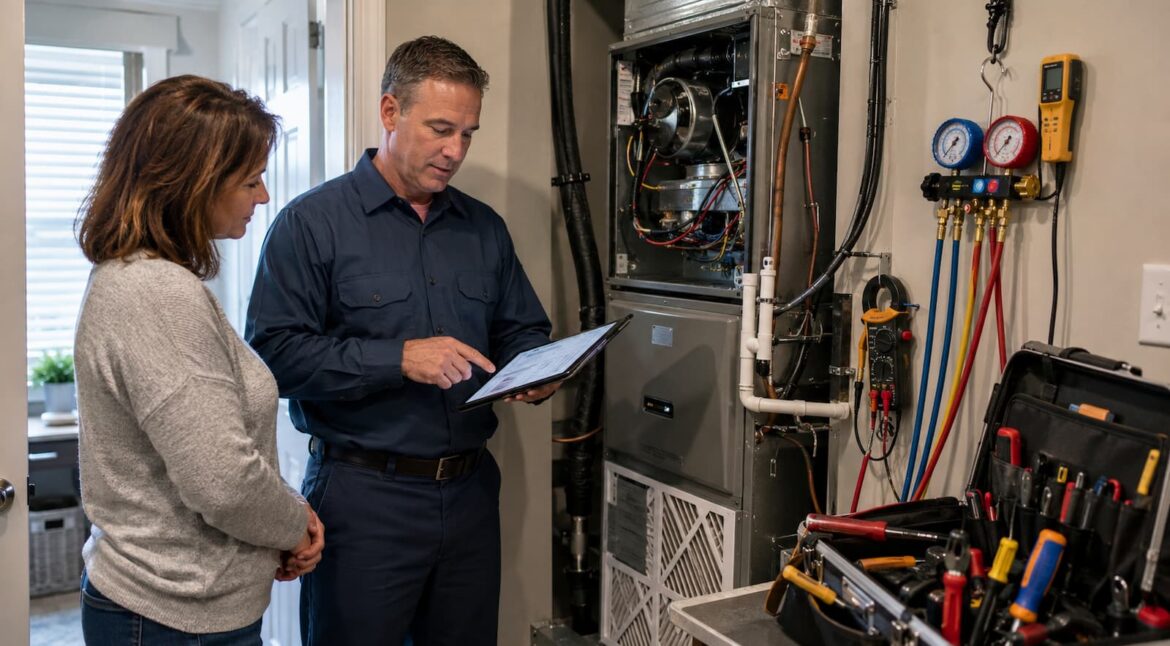
A diagnostic fee or service call fee covers the technician’s time to come to the property, inspect the system, test components, and identify the likely cause of the problem. This is not just a “show up” charge. A proper diagnostic process requires tools, training, safety procedures, and time.
Depending on the symptom, a technician may check:
- Thermostat settings, wiring, and control signals
- Indoor and outdoor electrical power
- Capacitor and contactor condition
- Blower motor operation and airflow
- Condenser fan motor operation
- Air filter condition and filter fit
- Evaporator coil and condenser coil condition
- Condensate drain, pan, pump, and float switch operation
- Refrigerant pressures and temperature readings
- Signs of refrigerant leaks
- Compressor amp draw and startup behavior
- Safety controls and control board operation
Many companies apply the diagnostic fee toward the repair if you approve the work, but policies vary. It is reasonable to ask how the diagnostic fee works when scheduling the appointment.
The Biggest Factors That Affect AC Repair Cost
AC repair pricing is not random. Most of the cost comes from a few predictable factors. Understanding these can help you interpret an estimate more confidently.
1. What Part Failed
The failed component is usually the biggest pricing factor. A thermostat setting issue, clogged drain line, or failed capacitor is generally less expensive than a compressor, evaporator coil, refrigerant leak, or major motor replacement. Some parts are small and common. Others are large, brand-specific, difficult to access, or tied to refrigerant handling.
However, part price alone does not tell the full story. A relatively inexpensive part may take significant labor to access, test, remove, install, and verify. A more expensive part may be quick to replace if access is easy. That is why estimates usually combine part cost, labor, and diagnostic time.
2. Labor Time and Difficulty
Labor cost depends on how long the job takes and how complex it is. Replacing a capacitor in an accessible outdoor unit is very different from replacing an evaporator coil in a tight attic or repairing a refrigerant leak in a difficult-to-reach location.
Labor time can increase when:
- The air handler is in a cramped attic, crawl space, closet, or finished area
- The system requires refrigerant recovery and recharge
- The failed part is hard to access
- Electrical wiring is damaged or unsafe
- The system needs multiple tests to confirm the root cause
- The repair requires brazing, evacuation, pressure testing, or leak detection
- The equipment is old and parts are difficult to match
3. System Type
Central AC systems, heat pumps, ductless mini-splits, packaged units, rooftop units, and commercial HVAC systems can all have different repair costs. A basic residential split system may have different parts and labor needs than a commercial rooftop unit or a multi-zone mini-split.
System type affects diagnostics too. For example, a mini-split may require different control diagnostics than a conventional central AC. A heat pump may require checking reversing valves and heating/cooling operation. A rooftop unit may involve roof access, economizer controls, belts, dampers, commercial filters, and larger components.
4. Equipment Size and Capacity
Larger systems often use larger or more expensive components. A capacitor, compressor, blower motor, fan motor, or coil for a larger-capacity unit can cost more than parts for a smaller residential system. Larger systems may also require more refrigerant and more labor for certain repairs.
Size is not just about square footage. It is about system tonnage, airflow requirements, refrigerant charge, duct design, and equipment configuration. A larger system can be more expensive to service when major components are involved.
5. Refrigerant Type and Refrigerant Work
Refrigerant-related repairs tend to cost more because they require specialized tools, proper handling, leak detection, pressure testing, evacuation, and careful charging. If a system is low on refrigerant, the real question is not only “how much to add refrigerant?” The real question is “why is it low?”
Air conditioners are sealed systems. Refrigerant does not get used up like gasoline. If refrigerant is low, there is usually a leak or another issue. Adding refrigerant without addressing the cause may only create a temporary fix. The system may cool for a while and then fail again.
Older refrigerants, newer refrigerants, system age, leak location, and the amount of refrigerant needed can all change the cost. Refrigerant repairs are one of the biggest reasons a simple no-cooling call can become a more expensive repair.
6. Warranty Status
Warranty can make a major difference. If the failed part is still under manufacturer warranty, the part cost may be covered, but labor, refrigerant, shipping, diagnostic fees, and related materials may still be the homeowner’s responsibility. Warranty terms vary by brand, registration status, installation date, and maintenance history.
If your system is relatively new, have the model number, serial number, and installation information available. A technician can often help determine whether a part may be under warranty.
7. Age and Condition of the System
Older systems can be more expensive to repair for several reasons. Parts may be harder to find. Refrigerant may be more costly. Electrical components may be brittle or worn. Coils may be corroded. A repair may reveal other weaknesses that were not obvious at first.
Age also affects the repair-versus-replacement decision. A $400 repair on a newer system may be an easy yes. A $2,000 repair on a very old system with poor efficiency and repeated breakdowns may be harder to justify.
8. Time of Service
Emergency calls, after-hours service, weekend repairs, holiday calls, and peak-season demand can affect cost. During extreme heat, HVAC companies receive more urgent no-cooling calls. Parts may be in higher demand, schedules fill quickly, and after-hours availability may cost more.
If the situation is urgent — for example, the home is becoming unsafe, vulnerable occupants are affected, or the system has electrical warning signs — it may be worth paying for faster service. For serious no-cooling situations in the service area, emergency HVAC repair may be the right choice.
9. Accessibility of the Equipment
Where the equipment is located matters. A condenser with clear access on level ground is easier to service than an indoor coil in a tight attic, a rooftop unit on a commercial building, or an air handler packed into a small closet. Difficult access can add labor time and safety considerations.
Accessibility can also affect how quickly a technician can confirm the diagnosis. If panels are blocked, attic temperatures are extreme, or the system is installed in a difficult location, the job may take longer.
10. Whether One Problem Caused Another
AC problems often cascade. A dirty condenser coil can stress the compressor. Low airflow can freeze the evaporator coil. A weak capacitor can overheat a motor. A clogged drain can trigger a float switch and shut the system down. A refrigerant leak can make the system run longer and increase wear.
If a technician replaces one failed part but the root cause remains, the system may fail again. A good repair should address both the failed component and the condition that contributed to the failure when possible.
Common AC Repairs and What Usually Affects Their Price
Below are common AC repair categories and the factors that usually make them cheaper or more expensive.
Thermostat Repairs or Replacement
Thermostat issues can be relatively simple if the thermostat is old, misconfigured, or not communicating properly. However, thermostat symptoms can also be misleading. A blank thermostat may be caused by dead batteries, a blown low-voltage fuse, a failed transformer, a tripped float switch, or an indoor unit power issue.
The cost depends on whether the thermostat itself needs replacement, whether wiring needs correction, whether a common wire is needed, and whether the system is conventional, heat pump, multi-stage, or communicating. Smart thermostat compatibility can also affect the work required.
Capacitor Replacement
Capacitors help motors start and run. A failed capacitor can cause the outdoor unit to hum, the fan not to spin, the compressor not to start, or the AC to stop cooling. This is a common repair during hot weather because capacitors are under more stress when systems run heavily.
Capacitor replacement is often one of the more straightforward AC repairs, but it still requires safe electrical handling. Capacitors can hold electrical charge even when power is off. Cost varies by capacitor type, system size, accessibility, and whether the failed capacitor damaged or was caused by another component.
Contactor Replacement
The contactor is an electrical switch that sends power to the outdoor unit when the thermostat calls for cooling. If the contactor is burned, stuck, pitted, or not pulling in correctly, the condenser may not run. If it sticks closed, the outdoor unit may continue running even when the thermostat is not calling.
Price depends on the specific contactor, wiring condition, electrical damage, and whether the control circuit is also involved. A failed contactor may be a simple replacement, or it may be part of a larger electrical issue.
Drain Line Cleaning and Condensate Repairs
Air conditioners remove moisture from indoor air. That water should drain away through the condensate system. If the drain line clogs, water can back up into the pan, trigger a float switch, shut down the AC, or leak around the indoor unit.
A simple drain clearing may be relatively affordable. Cost increases if there is a failed condensate pump, damaged pan, inaccessible drain, repeated algae buildup, improper drain slope, water damage, or a float switch that needs replacement or rewiring.
Blower Motor Repairs
The blower motor moves indoor air across the evaporator coil and through the duct system. If it fails or runs weakly, the house may not cool, airflow may drop, and the coil may freeze. Blower repairs can vary widely because motor types vary widely.
Older PSC motors may be less expensive than some variable-speed ECM motors or modules. Cost also depends on access, whether the blower wheel needs cleaning, whether the control board is involved, and whether airflow problems caused the motor to overheat.
Condenser Fan Motor Repairs
The condenser fan helps release heat outdoors. If the fan motor fails, the compressor can overheat or shut down. Symptoms may include an outdoor unit that hums, a fan that does not spin, warm air from vents, or a system that runs briefly and stops.
Cost depends on motor type, blade condition, capacitor condition, wiring, and whether the compressor was stressed by overheating. If the fan has been failing for a while, there may be additional damage.
Refrigerant Leak Detection and Repair
Refrigerant leak repairs can be among the most variable AC repair costs. Finding the leak can take time. The leak may be at a coil, joint, valve, line set, or fitting. Some leaks are repairable. Others may require coil replacement or make replacement of the system more practical.
Leak repair may involve detection, recovery, brazing, pressure testing, evacuation, recharge, and verification. Refrigerant type and quantity also affect cost. A technician should not simply add refrigerant and leave if the system is losing charge. That may only delay the same problem.
Evaporator Coil Replacement
The evaporator coil is located inside the indoor unit and absorbs heat from the air. Coil replacement may be needed if the coil is leaking, severely corroded, damaged, or not practical to repair. This is a more involved repair because it usually requires refrigerant recovery, cutting and brazing refrigerant lines, installing the new coil, pressure testing, evacuation, and recharging.
Coil replacement cost depends on coil type, cabinet fit, brand, refrigerant, access, and system age. If the AC is older, replacing a major coil may not always be the best long-term decision.
Compressor Repair or Replacement
The compressor is one of the most expensive components in an air conditioning system. If the compressor has failed internally, replacement can be costly. But not every compressor symptom means the compressor is bad. A failed capacitor, contactor, low voltage issue, dirty coil, or refrigerant problem can sometimes make a good compressor appear to struggle.
Before approving a compressor replacement, it is reasonable to ask what tests were performed and whether other causes were ruled out. On older systems, a major compressor repair often leads to a repair-versus-replacement conversation.
Why “Just Add Refrigerant” Can Become Expensive
Many homeowners ask for a “recharge” when the AC is not cooling. But if the system is low on refrigerant, the refrigerant went somewhere. A properly sealed AC should not need frequent refrigerant added. If a system needs refrigerant every season, there is likely a leak.
Adding refrigerant without finding the leak can lead to repeat costs. The system may cool temporarily, then lose performance again. Low refrigerant can also cause the coil to freeze and may contribute to compressor stress. In some cases, the leak repair is minor. In others, it may involve a coil replacement or a larger equipment decision.
A proper refrigerant-related repair should answer these questions:
- Is the system actually low on refrigerant?
- What refrigerant type does the system use?
- Is there evidence of a leak?
- Where is the leak likely located?
- Is the leak repairable?
- Is the coil or line set compromised?
- Is repair cost reasonable compared with system age?
Emergency AC Repair: Why It Can Cost More
Emergency AC repair can cost more because it may involve after-hours dispatch, weekend scheduling, urgent technician availability, parts sourcing outside normal supply hours, or priority response during peak heat. The repair itself may be the same, but the timing and urgency can affect the total.
That said, waiting is not always cheaper. If the system is frozen, leaking water, tripping breakers, making electrical noises, or struggling to start, delaying service can increase risk. A small electrical issue can damage a motor. A refrigerant problem can stress the compressor. A clogged drain can damage ceilings, floors, or walls.
Emergency service makes the most sense when comfort, safety, property damage, or business operations are at risk. If the situation is not urgent, scheduling during normal service hours may be more cost-effective.
Repair or Replace: When AC Repair May Not Be Worth It
AC repair is often the right decision, especially for newer systems or minor failures. But there are times when repair is not the best long-term value. The question is not only “can it be fixed?” Most systems can be fixed. The better question is “does this repair make sense compared with the age, condition, reliability, and efficiency of the system?”
Replacement may be worth discussing if:
- The AC is older and has repeated breakdowns
- The repair involves a compressor, major coil, or serious refrigerant leak
- Parts are hard to find or expensive
- The system uses older refrigerant that is costly to service
- Energy bills are high and comfort is poor
- The system is improperly sized for the home
- You have already paid for multiple repairs recently
- The repair cost is a large percentage of replacement cost
If your AC needs a major repair, it can be helpful to compare the repair estimate with the cost and benefits of air conditioning replacement. A good contractor should explain both options clearly rather than pushing one answer for every situation.
How to Read an AC Repair Estimate
A good AC repair estimate should be clear enough that you understand what is being repaired and why. It does not need to be overly complicated, but it should not be vague either.
Look for these details:
- The diagnosed problem: What failed or what condition was found?
- The recommended repair: What part or service is being proposed?
- The reason: Why is this repair necessary?
- Parts and labor: What is included in the quoted price?
- Warranty: Is there a parts or labor warranty on the repair?
- Additional risks: Are there other issues that may appear after the repair?
- System condition: Is the equipment otherwise in good shape?
Be cautious with estimates that only say “AC repair” with no explanation. Also be cautious with anyone who recommends major replacement without explaining the failed component, test results, and repair alternatives.
Questions to Ask Before Approving AC Repair
You do not need to become an HVAC expert, but asking a few questions can help you make a better decision.
- What exactly failed?
- How did you confirm that diagnosis?
- Is this a common repair for this system?
- Is the part under warranty?
- Could anything else have caused this part to fail?
- Will this repair fully restore cooling?
- Are there signs of refrigerant leaks, airflow problems, or dirty coils?
- How old is the equipment, and is repair still practical?
- What happens if I delay the repair?
- Is there a maintenance issue that can prevent this from happening again?
A professional technician should be able to explain the issue in plain language. If the answer is confusing or rushed, ask for clarification before approving the work.
Can Maintenance Lower AC Repair Costs?
Maintenance does not eliminate every repair, but it can reduce preventable breakdowns and catch problems before they become expensive. Many AC failures are connected to dirty coils, clogged filters, weak capacitors, clogged drains, low airflow, loose electrical connections, or neglected components.
During maintenance, a technician can inspect electrical components, test system operation, clean or recommend cleaning coils, check condensate drainage, evaluate airflow, look for early signs of refrigerant issues, and make sure the system is ready for heavy summer use.
Preventive AC maintenance is especially useful before cooling season. A weak capacitor found during a spring visit is usually less disruptive than a no-cooling breakdown during a heat wave.
How to Avoid Overpaying for AC Repair
The goal is not to find the cheapest possible repair. The goal is to pay for the right repair. A cheap repair that does not solve the cause can cost more in the long run.
To avoid overpaying:
- Ask what diagnostic tests were performed.
- Get a clear explanation of the failed part or issue.
- Ask whether the repair addresses the root cause.
- Check whether parts are under warranty.
- Ask about repair warranty terms.
- Be cautious with repeated refrigerant top-offs without leak investigation.
- Compare repair versus replacement for major repairs on older systems.
- Do not ignore small problems until they become emergency calls.
If a repair estimate seems high, it is reasonable to ask for details. A good contractor should be able to explain why the repair costs what it costs.
Why DIY AC Repair Can Cost More
Some homeowner checks are safe: changing the filter, checking thermostat settings, making sure vents are open, clearing debris around the outdoor unit, and looking for visible ice or water. But many AC repairs are not DIY-friendly.
Avoid DIY work involving:
- Capacitors
- Contactors
- High-voltage wiring
- Control boards
- Refrigerant lines
- Refrigerant charging
- Compressor testing
- Brazing or line set repairs
- Bypassing safety switches
DIY mistakes can damage equipment, void warranties, create electrical hazards, or turn a smaller repair into a bigger one. If the repair requires meters, gauges, refrigerant handling, electrical testing, or opening equipment panels, it is usually time for a technician.
Residential vs. Commercial AC Repair Costs
Commercial AC repair often costs more than residential repair because equipment can be larger, access may be more complex, and downtime can affect business operations. Rooftop units, packaged systems, commercial controls, economizers, belts, dampers, zoning, and larger motors can all affect cost.
Commercial repairs may also require coordination with building management, roof access, tenant schedules, safety requirements, and parts that are not carried on every service vehicle. For businesses, the cost of delayed repair may include uncomfortable employees, customer complaints, product issues, or lost productivity.
If your business system is not cooling properly, professional commercial HVAC repair can help determine whether the issue is a failed part, poor airflow, control problem, refrigerant issue, or system age.
Frequently Asked Questions About AC Repair Cost
How much does AC repair usually cost?
Many common AC repairs fall somewhere in the low hundreds to mid hundreds, while major repairs can cost much more. Minor problems such as drain clogs, thermostat issues, or capacitor failures are usually less expensive than refrigerant leaks, blower motors, condenser fan motors, coils, or compressors. The exact cost depends on diagnosis, parts, labor, system type, and urgency.
Why do HVAC companies charge a diagnostic fee?
A diagnostic fee covers the technician’s time, travel, tools, testing, and expertise needed to identify the problem. AC symptoms can be misleading, so diagnosis is necessary before an accurate repair estimate can be provided.
Is AC repair cheaper than replacement?
Usually, yes, especially for minor or moderate repairs on a system that is otherwise in good condition. But if the AC is old, inefficient, unreliable, or needs a major compressor or coil repair, replacement may be the better long-term value.
Why is refrigerant leak repair expensive?
Refrigerant leak repair can be expensive because the technician must find the leak, determine whether it is repairable, recover refrigerant if needed, repair the leak, pressure test, evacuate the system, recharge it correctly, and verify performance. The cost also depends on refrigerant type and leak location.
Can I just add refrigerant instead of fixing the leak?
Adding refrigerant without addressing the leak may only be temporary. Since AC systems are sealed, low refrigerant usually means there is a leak or another problem. Repeated top-offs can become expensive and may allow the system to keep operating under poor conditions.
What is the cheapest AC repair?
Simple issues such as thermostat settings, clogged filters, minor drain clogs, or basic electrical connections are often among the lower-cost fixes. However, the final price depends on what the technician finds during diagnosis.
What is the most expensive AC repair?
Compressor replacement, evaporator coil replacement, major refrigerant leak repairs, and extensive electrical or motor repairs are often among the most expensive. On older systems, these repairs may lead to a replacement discussion.
Does AC warranty cover repair cost?
Warranty may cover certain parts if the system is still within the manufacturer warranty period and registration requirements were met. Labor, refrigerant, diagnostic fees, shipping, and related materials may not be covered. Warranty terms vary by brand and installation details.
Why is emergency AC repair more expensive?
Emergency repair can cost more because it may require after-hours service, weekend scheduling, urgent dispatch, or special parts coordination. During heat waves, demand is also higher, which can affect availability and response options.
How can I reduce future AC repair costs?
Change filters regularly, keep outdoor units clear, schedule seasonal maintenance, do not ignore weak airflow or unusual noises, and address refrigerant or drain problems early. Preventive service can catch small issues before they become major repairs.
Bottom Line: AC Repair Cost Depends on the Diagnosis
AC repair can be relatively simple or surprisingly expensive depending on what failed. A clogged drain, dirty filter, thermostat issue, capacitor, or contactor is very different from a refrigerant leak, coil replacement, blower motor failure, or compressor problem. That is why a proper diagnostic visit matters.
If your AC is not cooling, do not judge the likely cost by the symptom alone. Warm air, constant running, freezing, water leaks, weak airflow, and startup problems can each have several possible causes. The right technician will test the system, explain the findings, and help you understand whether repair, maintenance, or replacement is the most practical option.
The best repair is not always the cheapest immediate fix. It is the repair that solves the actual problem, protects the equipment, restores comfort, and makes sense for the age and condition of your air conditioning system.