
AC Freezing Up: Why It Happens and What You Should Do
An air conditioner is supposed to make your home cooler, so seeing ice on the system can feel confusing at first. You may notice frost on the copper refrigerant line outside, ice around the indoor coil cabinet, weak airflow from the vents, water near the indoor unit, or an AC that runs for hours but barely cools the house. Sometimes the system stops working completely after freezing. Other times it keeps running while the ice gets worse.
Here is the important part: an AC freezing up is not normal. Ice is not a sign that the system is “cooling extra well.” It is usually a symptom of a problem with airflow, refrigerant, the evaporator coil, the blower, the thermostat, or the conditions under which the system is operating. If the issue is ignored, a frozen AC can lead to poor comfort, water damage, repeated shutdowns, and in more serious cases, compressor damage.
This guide explains why AC systems freeze, what you should do right away, what you can safely check yourself, what you should not touch, and when to schedule professional service. If your system keeps freezing or you already see heavy ice buildup, professional air conditioning repair is usually the safest next step.
Quick answer: If your AC is frozen, turn cooling off, switch the fan to “On” if the blower is working, check the air filter, make sure vents and returns are open, and let the ice melt completely before trying cooling again. Do not chip away the ice, pour hot water into the system, bypass safety controls, or keep running the AC while it is frozen.
What Does It Mean When Your AC Freezes Up?
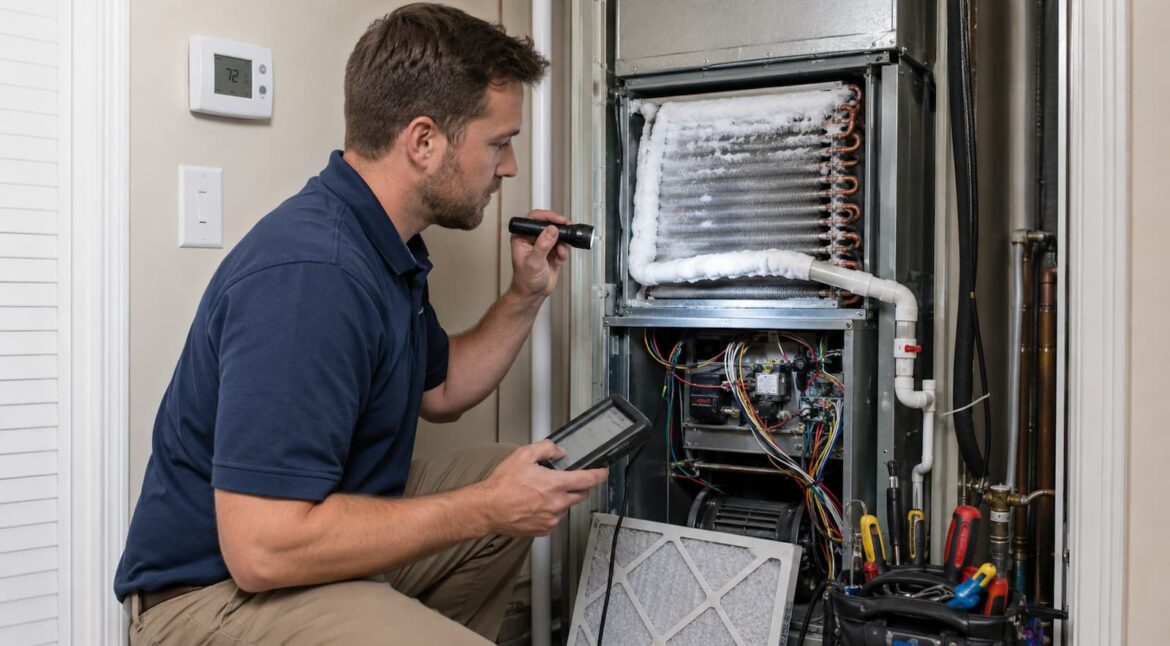
A frozen AC usually means the evaporator coil has dropped below freezing and moisture in the air has turned into frost or ice. The evaporator coil is the cold coil located inside the indoor unit, usually in or near the air handler or furnace cabinet. Warm indoor air passes over this coil. Refrigerant inside the coil absorbs heat from the air, and the blower sends cooled air through the duct system.
Under normal conditions, the coil gets cold but should not become a block of ice. It needs enough warm indoor air moving across it to keep the refrigerant cycle balanced. If airflow is too low, if refrigerant pressure is abnormal, if the coil is dirty, or if the blower is not moving enough air, the coil temperature can fall below freezing. Once frost starts forming, it restricts airflow even more. That makes the coil colder, which creates more ice. The problem can snowball quickly.
A frozen AC may show up in different ways. Some homeowners first see ice on the larger insulated copper line near the outdoor unit. Others notice water pooling near the indoor unit after the ice melts. Some hear the system running but feel almost no air from the vents. In many cases, the AC runs longer and longer because it cannot remove heat properly.
What to Do Right Away If Your AC Is Frozen
If you see ice on your AC, do not keep running it in cooling mode. The system needs to thaw before it can be diagnosed properly. Continuing to run a frozen AC can make the ice thicker, restrict airflow further, and put extra stress on the compressor.
1. Turn Cooling Off at the Thermostat
Set the thermostat from “Cool” to “Off.” This stops the refrigeration cycle and prevents the outdoor unit from continuing to run while the indoor coil is frozen. Do not simply raise the temperature a few degrees. Turn cooling off completely.
If the outdoor unit continues running after you turn the thermostat off, that can indicate a stuck contactor or control issue. In that situation, shut the system down at the breaker or service disconnect if you can do so safely, and call a technician.
2. Turn the Fan to “On” If the Blower Still Works
If your thermostat has a fan setting, switch the fan from “Auto” to “On.” This runs the indoor blower without running the outdoor cooling cycle. Moving room-temperature air across the frozen coil can help the ice melt faster.
If little or no air comes from the vents even with the fan on, the blower may not be working, the coil may be heavily iced over, or there may be a severe airflow restriction. Leave cooling off and schedule service.
3. Check and Replace the Air Filter
A clogged filter is one of the most common and easiest-to-check causes of AC freezing. If the filter is packed with dust, pet hair, lint, or renovation debris, airflow across the evaporator coil can drop too low. Replace the filter with the correct size and make sure the airflow arrow points in the right direction.
Do not remove the filter and run the system long-term without one. That can allow dust to collect on the blower wheel and evaporator coil, making airflow problems worse over time.
4. Open Supply Vents and Clear Return Grilles
Make sure supply vents are open and not blocked by furniture, rugs, curtains, or storage. Check return grilles too. Return airflow is just as important as supply airflow because the system needs to pull enough warm indoor air back to the coil.
If several rooms have closed vents, open them. Closing vents may seem like a way to save energy or redirect air, but it can increase static pressure and reduce total airflow through the system. In some homes, that can contribute to freezing.
5. Let the Ice Melt Completely
A frozen AC can take several hours to thaw, depending on how much ice has formed. Heavy ice on the coil may take much longer than light frost on the refrigerant line. Put towels around the indoor unit if needed, because melting ice can create water around the air handler or furnace cabinet.
Do not chip, scrape, or break the ice off. The evaporator coil and refrigerant lines can be damaged. Do not use a hair dryer inside the unit unless directed by a professional; water and electrical components are a bad combination. Let the system thaw naturally with cooling off and fan on, if possible.
6. Try Cooling Again Only After the System Is Fully Thawed
Once the ice is gone, the filter is clean, and airflow paths are open, you may try cooling again. Watch the system closely for the next hour. If airflow remains weak, if ice returns, if the outdoor unit sounds unusual, or if cooling is poor, shut the system down and schedule service.
Ice that comes back after a clean filter and open vents usually means there is a deeper issue: low refrigerant, dirty coil, blower problem, duct restriction, metering device issue, or control problem.
What Not to Do When Your AC Freezes
A frozen AC often creates panic, especially during hot weather. But several common “quick fixes” can make the situation worse.
- Do not keep running the AC in cooling mode. It will usually build more ice and stress the compressor.
- Do not chip ice off the coil. The coil fins and refrigerant tubing are delicate.
- Do not pour hot water into the air handler. You can damage electrical components or create a water problem.
- Do not bypass float switches or safety controls. Those controls protect your home and equipment.
- Do not add refrigerant as a guess. Low refrigerant means the system needs proper diagnosis, not a blind top-off.
- Do not ignore repeated freezing. If the coil freezes more than once, something needs attention.
The Main Reasons an AC Freezes Up
Most frozen AC problems fall into two broad categories: not enough airflow or abnormal refrigerant/coil conditions. The system needs a balance between air moving across the coil and refrigerant absorbing heat inside the coil. When that balance is disrupted, freezing becomes more likely.
1. Dirty or Clogged Air Filter
A dirty air filter is the first thing to check because it is simple, common, and can have a major effect on airflow. As the filter loads with dust and debris, the blower has to work harder to pull air through it. Less warm indoor air reaches the evaporator coil. With less heat passing over the coil, the coil temperature can drop below freezing.
Filters can clog faster than expected in homes with pets, high dust levels, open windows, nearby construction, frequent cooking, renovation work, or continuous fan operation. A filter rated for “up to 90 days” may not actually last 90 days in every home. During peak cooling season, checking it monthly is a safer habit.
2. Dirty Evaporator Coil
The evaporator coil needs direct contact with moving air. If the coil is coated with dust, pet hair, biological buildup, or sticky debris, heat transfer suffers. A dirty coil can act almost like an insulating blanket. The refrigerant inside may get too cold because it is not absorbing heat efficiently from the air.
Coil dirt can also restrict airflow physically, especially if the coil fins are matted with debris. This is more likely when filters are missing, poorly fitted, changed too rarely, or installed incorrectly. Coil cleaning is usually a professional maintenance task because access can be limited and the coil is easy to damage.
If your system has not been serviced in a while, scheduling AC maintenance can help address dirty coils, weak airflow, drain issues, and electrical wear before they create another breakdown.
3. Low Refrigerant or Refrigerant Leak
Low refrigerant is one of the most misunderstood causes of freezing. Many homeowners say the system “needs Freon,” but refrigerant is not fuel and should not disappear during normal operation. If the refrigerant charge is low, there is usually a leak or another problem that needs diagnosis.
When refrigerant levels are low, pressure inside the evaporator coil can drop. Lower pressure can lower the coil temperature, making it easier for moisture to freeze on the coil. The system may also run longer because it cannot absorb and move heat properly. Longer runtime gives more time for ice to develop.
Signs that may point toward low refrigerant include repeated freezing, poor cooling even after filter replacement, hissing sounds, oily residue near refrigerant lines or coils, longer run times, and ice that returns soon after thawing. Refrigerant work requires proper tools, training, and certification, so this is not a DIY repair.
4. Blower Motor Problems
The blower motor is responsible for moving indoor air across the evaporator coil. If the blower is weak, failing, overheating, set to the wrong speed, or not running consistently, the coil can freeze because not enough warm air is moving across it.
Blower issues can show up as weak airflow, intermittent airflow, strange humming, burning smells, loud vibration, or vents that barely move air. In some cases, the outdoor unit may run while the indoor blower does not. That is a serious problem because the coil can freeze quickly without airflow.
5. Blocked or Undersized Return Air
Your HVAC system does not only push air into rooms; it also needs to pull air back through return grilles. If return airflow is blocked or undersized, total system airflow drops. This can happen when return grilles are covered by furniture, filters are too restrictive, doors are closed without transfer paths, or the duct system was poorly designed.
A common comfort complaint tied to return problems is uneven cooling. Some rooms may feel stuffy while the system runs constantly. If airflow across the coil is low enough, freezing can occur even if the filter looks clean.
6. Closed Supply Vents or Duct Restrictions
Closing a few vents may not freeze every system, but closing many vents can reduce airflow and raise duct pressure. Crushed flex duct, collapsed duct lining, disconnected duct runs, dirty registers, blocked dampers, and poor duct design can also reduce airflow enough to affect the evaporator coil.
If your AC freezes and certain rooms have very weak airflow, the duct system may need inspection. Airflow problems are not always visible at the unit itself.
7. Running the AC When Outdoor Temperatures Are Too Low
Standard residential air conditioners are not always designed to run in cool outdoor conditions. If you run cooling when the outdoor temperature is too low, refrigerant pressures can fall outside normal operating range and the indoor coil may freeze. This sometimes happens in spring, fall, or in homes where people want cooling at night despite mild outdoor weather.
Some systems can be equipped for low-ambient cooling, but that is not the default for most standard residential setups. For normal homes, if it is cool outside, opening windows may make more sense than running the AC.
8. Thermostat or Control Issues
A thermostat that is malfunctioning, poorly located, misconfigured, or calling for cooling too aggressively can contribute to long run times or abnormal operation. If the thermostat is installed near heat sources, direct sunlight, electronics, a draft, or a poorly representative area of the home, it may not sense the home accurately.
Control issues can also cause the outdoor unit and indoor blower to operate out of sequence. If the cooling side runs without proper blower operation, freezing can happen quickly. This requires professional diagnosis because it may involve thermostat wiring, relays, a control board, blower controls, or equipment configuration.
9. Drainage Problems After the Coil Freezes
A clogged condensate drain may not always be the original reason the coil froze, but it can become part of the problem. When ice melts, it creates a lot of water. If the drain pan or condensate line cannot handle it, water may overflow, trigger a float switch, or leak around the indoor unit.
If your AC froze and then you found water around the indoor unit, do not assume the drain alone caused the freezing. The drain may need service, but the original freezing cause still needs to be found.
10. Oversized or Poorly Matched Equipment
An oversized AC can cool the thermostat area quickly but may not run long enough to manage humidity properly. Oversizing is more often associated with short cycling and comfort problems, but poor equipment matching, incorrect blower settings, or improper installation can also affect coil performance and airflow.
If a system has frozen repeatedly since installation, the issue may be more than a dirty filter. It may require an airflow check, duct evaluation, blower speed verification, refrigerant charge verification, and installation review.
Why Ice Makes the Problem Worse
Once ice starts forming on the evaporator coil, it reduces airflow even more. Air cannot pass through a block of ice the same way it passes through a clean coil. The blower may continue running, but the air coming from the vents becomes weaker. With less warm air passing over the coil, the coil gets colder, and more moisture freezes.
This feedback loop is why a frozen AC can go from light frost to heavy ice. The system may run continuously because the thermostat is never satisfied. Meanwhile, the compressor is operating under poor conditions. If liquid refrigerant returns to the compressor or the compressor overheats, repair costs can rise dramatically.
That is why the first step is not “keep cooling and see what happens.” The first step is to stop cooling, thaw the coil, and then identify why the freeze happened.
Where You May See Ice on the AC System
The location of the ice can give clues, although it does not prove the exact cause by itself.
Ice on the Indoor Coil Cabinet
Ice around the indoor air handler, furnace cabinet, or coil access area usually means the evaporator coil is frozen. You may not be able to see the actual coil without opening panels, but frost or condensation around the cabinet can be a sign.
Ice on the Larger Copper Refrigerant Line
The larger insulated copper line, often called the suction line, may develop frost or ice when the evaporator coil is freezing. You may notice this line near the outdoor unit or where it enters the indoor unit. Ice here often points to airflow or refrigerant problems.
Ice on the Outdoor Unit
Ice on an outdoor AC unit during cooling season can happen when the indoor coil is frozen and refrigerant conditions are abnormal. However, do not confuse this with frost on a heat pump during heating mode in winter. Heat pumps can develop outdoor frost during heating operation and use a defrost cycle. A standard AC freezing in summer is a different issue.
Water Around the Indoor Unit After Ice Melts
If you do not see ice but notice water around the indoor unit, the system may have frozen earlier and thawed. Water can also come from a clogged drain, cracked pan, disconnected drain line, or pump issue. If water appears after poor cooling or weak airflow, a frozen coil should be considered.
Can You Keep Using an AC After It Freezes?
You should not keep using the AC in cooling mode while it is frozen. After the ice melts and you correct any obvious airflow issue, such as a clogged filter or blocked return, you can test the system. But if ice returns, stop using cooling and call for service.
Repeated freezing is not just inconvenient. It can cause:
- Reduced cooling performance
- Higher energy use from long run times
- Water leaks when ice melts
- Mold or microbial growth concerns if moisture is not controlled
- Blower strain from restricted airflow
- Compressor stress or failure in severe cases
- Recurring no-cooling calls during hot weather
If your AC freezes more than once, it deserves a proper diagnostic visit. A technician can separate a simple maintenance problem from a refrigerant, electrical, blower, or installation issue.
How a Technician Diagnoses a Frozen AC
A frozen coil must be thawed before a full diagnosis. Ice hides the coil surface and changes system readings. Once the system is thawed, a technician will usually work through airflow, electrical, refrigerant, and control checks.
A professional diagnostic process may include:
- Inspecting and measuring airflow
- Checking filter size, fit, and restriction
- Inspecting the evaporator coil condition
- Checking blower motor operation and speed
- Inspecting the blower wheel for dirt buildup
- Checking return and supply duct restrictions
- Testing thermostat operation and control sequence
- Measuring refrigerant pressures and temperatures
- Checking superheat and subcooling where appropriate
- Looking for signs of refrigerant leaks
- Inspecting the condenser coil and outdoor fan operation
- Checking condensate drainage and float switches
- Verifying the system runs safely after service
A quick refrigerant top-off without airflow checks is not a complete diagnosis. A quick filter change without checking refrigerant and blower operation may also miss the real cause. Frozen AC problems often require looking at the system as a whole.
Is a Frozen AC Always Low on Refrigerant?
No. Low refrigerant is a common cause, but it is not the only cause. Many frozen AC systems are caused by airflow problems. A clogged filter, dirty coil, weak blower, blocked return, closed vents, or duct restriction can all cause freezing even when refrigerant charge is not the primary issue.
This distinction matters because adding refrigerant to a system with an airflow problem will not fix the airflow problem. It may even create improper charge conditions once airflow is corrected. On the other hand, replacing filters and cleaning coils will not fix a real refrigerant leak. The system needs the right diagnosis.
Is a Frozen AC an Emergency?
A frozen AC is not always an emergency in the same way as smoke, burning electrical smells, or a repeatedly tripping breaker. But it can become urgent depending on the conditions. If the home is getting dangerously hot, if there are vulnerable occupants, if water is leaking near ceilings or finished spaces, or if the system is making electrical noises, you should not wait.
It is especially important to respond quickly if the AC is frozen and:
- The breaker trips
- You smell burning or melting plastic
- Water is leaking through a ceiling or finished wall
- The outdoor unit hums but will not run properly
- The blower will not operate
- The system freezes again soon after thawing
- The home temperature is becoming unsafe
For urgent no-cooling situations, especially when comfort, safety, or property damage is involved, you may need emergency HVAC repair.
Frozen AC vs. Normal Condensation: How to Tell the Difference
Air conditioners naturally produce condensation. Moisture from indoor air collects on the cold evaporator coil and drains away through the condensate system. That is normal. Ice is different.
Normal operation may include:
- Water draining through the condensate line
- A damp evaporator coil during operation
- Cool air from vents
- Some condensation on cold surfaces in humid conditions
A freezing problem may include:
- Visible frost or ice on copper lines
- Ice on or around the indoor coil cabinet
- Weak airflow
- AC running constantly but not cooling well
- Water pooling after the ice melts
- System shutting off unexpectedly
If you are not sure whether you are seeing normal condensation or freezing, turn cooling off and check whether ice is forming on the refrigerant line or coil area. If ice is present, treat it as a freezing problem.
Can a Frozen AC Damage the Compressor?
Yes, a frozen AC can contribute to compressor damage if the underlying condition is severe or ignored. The compressor is designed to compress refrigerant vapor, not liquid. When airflow or refrigerant conditions are wrong, there is a risk that refrigerant may not evaporate properly in the indoor coil. In severe cases, liquid refrigerant can return toward the compressor, which can damage internal components.
Compressor damage is one of the reasons you should not keep running a frozen system. A filter, capacitor, blower repair, coil cleaning, or leak repair is usually much less costly than compressor replacement. If your AC is older and a major compressor repair is needed, it may also lead to a larger conversation about whether repair or AC replacement makes more sense.
How to Prevent Your AC From Freezing Again
Prevention comes down to maintaining airflow, keeping coils clean, catching refrigerant issues early, and making sure the system runs under proper conditions.
Change Filters Before They Become Restrictive
Check your filter regularly during cooling season. If it looks dirty, replace it. Homes with pets, high occupancy, dusty conditions, or frequent system use usually need more frequent filter changes. Also make sure the filter fits tightly in the rack. Air bypass around the filter can lead to dirty coils.
Do Not Overuse High-MERV Filters Without Checking Airflow
Better filtration can be helpful, but very restrictive filters can reduce airflow if the system was not designed for them. If you want to use a higher-MERV filter, make sure the system can handle it. A thicker media filter cabinet may be a better solution than forcing a restrictive one-inch filter into a system that struggles with airflow.
Keep Vents and Returns Open
Avoid closing many vents. Keep return grilles clear. Make sure furniture, rugs, and curtains are not blocking airflow. If certain rooms are uncomfortable, the better solution is usually airflow balancing, duct evaluation, or system assessment — not starving the system of air.
Schedule Seasonal AC Maintenance
A maintenance visit can identify the issues that often lead to frozen coils: dirty evaporator coils, dirty condenser coils, weak capacitors, blower problems, clogged drain lines, poor airflow, and refrigerant concerns. Maintenance is especially valuable before summer because freezing often happens when the system is under long daily run times.
Pay Attention to Early Warning Signs
Before a system freezes, it may show signs that something is wrong. Watch for weak airflow, longer cooling cycles, rooms that never reach temperature, rising energy bills, unusual noises, musty odors, water near the unit, or a refrigerant line that starts frosting. Calling early is usually better than waiting until the coil is frozen solid.
Frequently Asked Questions About AC Freezing Up
Why is my AC freezing up in summer?
The most common reasons are restricted airflow, a dirty filter, dirty evaporator coil, low refrigerant, blower problems, blocked return airflow, closed vents, or a refrigerant control issue. Summer heat can make the problem more noticeable because the system runs longer and has less recovery time.
Should I turn off my AC if it is frozen?
Yes. Turn cooling off at the thermostat. If the indoor blower works, set the fan to “On” to help thaw the coil. Do not continue running cooling mode while ice is present.
How long does it take for a frozen AC to thaw?
Light frost may thaw in a relatively short time, but a heavily frozen evaporator coil can take several hours or longer. Keep cooling off until the ice is completely gone. Running the system before it fully thaws can make the problem return quickly.
Can I pour hot water on a frozen AC coil?
No. Pouring water into or around the indoor unit can damage electrical components, create drainage problems, or cause water damage. Let the coil thaw naturally with cooling off and fan on if the blower operates.
Will changing the filter fix a frozen AC?
It may fix the problem if the filter was the main cause of restricted airflow. However, if the system freezes again after the filter is replaced and the vents are open, there is likely another issue such as low refrigerant, dirty coil, blower trouble, or duct restriction.
Does a frozen AC mean I need refrigerant?
Not always. Low refrigerant can cause freezing, but airflow problems are also very common. A technician should check airflow, coil condition, blower operation, and refrigerant readings before deciding what repair is needed.
Can I run the fan while the AC is frozen?
Yes, if the blower works normally. Running the fan without cooling can help thaw the evaporator coil. If the fan does not run or airflow is extremely weak, leave the system off and call for service.
Why does my AC freeze at night?
Freezing at night can happen when outdoor temperatures drop, airflow is already marginal, the filter is dirty, refrigerant is low, or the thermostat keeps the system running under conditions it was not designed for. If it happens repeatedly, the system needs diagnosis.
Why is there ice on the copper pipe outside?
Ice on the larger copper refrigerant line often means the indoor evaporator coil is freezing. The cause may be airflow restriction, low refrigerant, dirty coil, blower problems, or another refrigerant system issue.
Is a frozen AC dangerous?
The ice itself is not usually dangerous, but continuing to run the system can damage equipment. Water from melting ice can also cause property damage, and electrical symptoms such as burning smells or breaker trips should be treated as urgent.
Bottom Line: Ice Is a Symptom, Not the Real Problem
If your AC is freezing up, the ice is telling you that the cooling process is out of balance. The most common reasons are restricted airflow, dirty filters, dirty coils, blower problems, low refrigerant, blocked ducts, or control issues. The right response is to turn cooling off, help the system thaw safely, check the filter and airflow, and avoid forcing the AC to keep running.
If the ice comes back, the system needs professional attention. A frozen coil can hide the real issue, and repeated freezing can put expensive components at risk. The sooner the cause is found, the better the chance of preventing compressor damage, water damage, and repeated no-cooling problems.
A properly diagnosed AC freezing problem is usually fixable. The key is not to treat the ice as the problem itself. Treat it as a warning sign that your system needs better airflow, proper refrigerant performance, clean components, or professional repair before the next hot day pushes it even harder.