Why Is My AC Not Turning On? Common Causes and What to Check First
When your air conditioner does not turn on, it can feel like the whole house stops working with it. One minute the system seems fine, and the next minute the thermostat is calling for cooling but nothing happens. No indoor fan. No outdoor unit. No cool air. Maybe the thermostat screen is blank. Maybe the indoor blower runs, but the outdoor condenser stays silent. Or maybe the system tries to start, clicks once, and shuts back down.
The good news is that not every “AC will not turn on” problem means the system has failed. Sometimes the cause is simple: a thermostat setting, a tripped breaker, a loose access panel, a clogged condensate drain safety switch, or a dirty air filter that caused the system to shut down. The bad news is that some causes are electrical or mechanical and should not be handled as a DIY repair. Air conditioners use high-voltage power, motors, capacitors, control wiring, refrigerant circuits, and safety switches. A wrong guess can damage the equipment or create a real safety risk.
This guide walks you through what you can safely check first, what each symptom usually means, and when it is time to stop troubleshooting and call a professional. If you are in the Linden, NJ area and your system is not starting after the basic checks, Sadowski HVAC can help with professional air conditioning repair in Linden, NJ.
Quick safety note: This article covers homeowner-level checks such as thermostat settings, breakers, filters, switches, and visible water safety issues. Do not open sealed electrical compartments, touch exposed wiring, test capacitors, bypass safety switches, or handle refrigerant. Those steps require proper tools, training, and safety procedures.
First, Identify What “Not Turning On” Actually Means
Before you start checking anything, try to describe the symptom as accurately as possible. “My AC will not turn on” can mean several different things, and each version points to a different group of causes. A technician will usually start by narrowing down exactly which part of the system is not responding.
Here are the most common scenarios:
- The thermostat is blank. This often points to a power issue, dead batteries, a tripped float switch, a blown low-voltage fuse, or a control transformer problem.
- The thermostat is on, but nothing runs. Possible causes include thermostat settings, a service switch, breaker, control board issue, low-voltage problem, or safety switch interruption.
- The indoor fan runs, but the outdoor unit does not. This often points to a condenser-side problem such as a tripped breaker, disconnect issue, failed capacitor, failed contactor, bad condenser fan motor, compressor problem, or control signal issue.
- The outdoor unit hums or clicks but will not start. A weak capacitor, stuck contactor, locked compressor, or motor failure may be involved.
- The AC starts and then shuts off quickly. This may be short cycling, overheating, a pressure switch issue, a clogged filter, frozen coil, drain safety switch, or an oversized/struggling system.
- The system worked earlier today, then suddenly stopped. This can happen after a storm, power interruption, clogged drain, overheated motor, breaker trip, or failed electrical component.
This matters because an AC system is not one single appliance. A typical central air conditioning system includes the thermostat, indoor air handler or furnace blower, evaporator coil, condensate drain, control board, low-voltage wiring, outdoor condenser, compressor, condenser fan, contactor, capacitor, refrigerant circuit, and multiple electrical protections. Any one of those can stop the cooling cycle from starting.
What to Check First Before Calling for AC Repair
Start with the safest and simplest checks. These steps will not solve every problem, but they can rule out common issues and help you explain the situation clearly if you need a technician.
1. Check the Thermostat Mode and Temperature Setting
It sounds obvious, but thermostat settings are one of the first things to verify. Make sure the thermostat is set to Cool, not Heat, Off, Auto mode confusion, or fan-only operation. Then set the temperature at least 3 to 5 degrees below the current room temperature. Some thermostats have a built-in delay and may wait several minutes before sending a cooling signal, especially after a recent shutdown.
If the thermostat says “Cool On,” “Cooling,” or shows a snowflake icon, it is asking the system to cool. If nothing happens after several minutes, the problem may be with power, wiring, a safety switch, the indoor unit, or the outdoor unit. If the thermostat does not show that it is calling for cooling, the issue may be the thermostat settings, schedule, sensor reading, or programming.
Smart thermostats add another layer. They may be affected by Wi-Fi schedules, eco mode, geofencing, vacation settings, or app-based temperature holds. If the AC does not start, check the thermostat itself, not only the phone app.
2. Replace Thermostat Batteries If Your Model Uses Them
Some thermostats are battery-powered, while others are powered by the HVAC system through a common wire. If your thermostat has batteries and the display is dim, flickering, or blank, replace them. Use fresh batteries of the correct type and install them in the proper direction.
If the thermostat screen comes back on after new batteries, wait a few minutes and test cooling again. If the screen stays blank, the thermostat may not be receiving power, or another safety/control issue may be interrupting the circuit.
3. Check the Main Electrical Panel
Your AC usually has more than one electrical circuit. The indoor unit and outdoor unit may be on separate breakers. Go to your electrical panel and look for breakers labeled AC, condenser, air handler, furnace, HVAC, or cooling. A tripped breaker may not always look fully “off.” Sometimes it sits in the middle position.
To reset a tripped breaker, turn it fully off, then back on. Do not repeatedly reset a breaker that trips again. A breaker that trips immediately or repeatedly is not a nuisance; it is a warning sign. It may indicate a short, grounded compressor, failing motor, damaged wiring, bad capacitor, or other electrical fault. At that point, stop and call a professional.
Important: If the breaker trips again after reset, do not keep forcing it on. The breaker is protecting the circuit. Repeated resets can worsen equipment damage and may create a fire hazard.
4. Check the Outdoor Disconnect Switch
Near the outdoor condenser, there is usually a service disconnect box mounted on the wall. It allows technicians to shut off power to the outdoor unit during service. Sometimes the disconnect is switched off, pulled out, loose, or affected after recent maintenance, yard work, or storm activity.
You can visually check whether the disconnect appears properly seated and whether the switch is in the on position, depending on the type. Do not open the box if you are not comfortable, and do not touch wiring. If anything looks burned, melted, loose, corroded, or damaged, leave it alone and call an HVAC technician or licensed electrician as appropriate.
5. Check the Indoor Service Switch
Many indoor HVAC units have a service switch near the furnace or air handler. It may look like a regular light switch. In basements, closets, attics, and utility rooms, this switch can accidentally be turned off by someone looking for a light switch. If the indoor unit has no power, the thermostat may be blank and the AC will not run.
Make sure the switch is on. Also check that the blower compartment door is fully closed. Many systems have a door safety switch that prevents operation if the access panel is not seated correctly. If the filter was recently changed and the panel was not closed properly, the system may not start.
6. Check the Air Filter
A dirty air filter may not always stop an AC from turning on immediately, but it can contribute to several shutdown conditions. Restricted airflow can cause the evaporator coil to get too cold and freeze. It can also make the blower motor work harder, reduce cooling capacity, and trigger limit or safety issues in certain systems.
Pull the filter and inspect it. If it is heavily loaded with dust, pet hair, construction debris, or lint, replace it with the correct size and type. Pay attention to the airflow arrow on the filter frame. Installing the filter backward can increase resistance and reduce airflow.
If the system begins running after a filter change but airflow still feels weak, there may be deeper problems: a dirty evaporator coil, blower issue, duct restriction, closed dampers, blocked return grille, or an undersized return air path. Regular air conditioning maintenance can catch these issues before they turn into no-cooling calls during the hottest part of the season.
7. Look for Water Near the Indoor Unit
Central AC systems remove moisture from indoor air. That moisture collects on the evaporator coil and drains away through a condensate drain line. If the drain line clogs, water can back up into the drain pan. Many modern systems have a float switch or wet switch that shuts the system off to prevent water damage.
If your thermostat is blank or the system suddenly stopped and you notice water around the indoor unit, a condensate safety switch may have opened the low-voltage circuit. This is a common reason an AC stops without warning. The switch may be doing exactly what it is supposed to do: preventing overflow.
Do not bypass the float switch. It is there to protect your ceiling, floor, walls, and equipment. If the drain line is clogged or the pan is full, the cause needs to be cleared properly. A technician can clean the drain, inspect the trap, check slope, test the safety switch, and verify that water is draining correctly.
8. Make Sure Air Vents and Returns Are Not Blocked
Blocked supply vents and return grilles can create airflow problems that make the system struggle. Furniture, rugs, storage boxes, curtains, pet beds, and closed doors can all reduce airflow. While this may not be the direct reason the AC will not turn on, poor airflow can contribute to freezing, overheating of motors, pressure issues, and poor comfort.
Check that return grilles are clear and that supply vents are open. Avoid closing a large number of vents to “push” air elsewhere. Residential duct systems are designed around a certain airflow range. Closing too many vents can increase static pressure and make the equipment work harder.
9. Wait Through the Built-In Delay
Many thermostats and air conditioning systems use a short compressor protection delay. This delay often lasts about 3 to 5 minutes after a power interruption or thermostat change. It helps prevent the compressor from restarting under high pressure immediately after shutdown.
If you just changed settings, reset a breaker, replaced batteries, or restored power, wait a few minutes. Do not rapidly switch the thermostat on and off. Fast cycling commands can confuse controls or stress the equipment.
Common Reasons Your AC Will Not Turn On
If the basic checks do not solve the problem, the cause may be inside the electrical, control, mechanical, or refrigerant side of the system. Here are the most common issues technicians look for.
Tripped Breaker or Electrical Fault
A breaker may trip because of a temporary overload, but if it trips repeatedly, something is wrong. The outdoor condenser has high-demand components, especially the compressor and condenser fan motor. If a motor is failing, a wire is damaged, a capacitor is weak, or the compressor is drawing excessive current, the breaker may shut the circuit down.
Repeated breaker trips are one of the clearest signs that the system needs professional diagnosis. A technician can measure voltage, amp draw, continuity, capacitor strength, compressor condition, and wiring safety. Guessing is risky because the visible symptom — a tripped breaker — may be caused by several different failures.
Failed Capacitor
Capacitors help motors start and run. In many outdoor condensers, a capacitor supports the compressor, condenser fan motor, or both. When a capacitor weakens or fails, the outdoor unit may hum, click, buzz, or do nothing at all. Sometimes the fan will not spin. Sometimes the compressor tries to start but cannot.
Capacitor problems are especially common during hot weather because high outdoor temperatures put extra stress on electrical components. Capacitors can also fail with age, power surges, poor ventilation, or heavy cycling. Even when the system is off, a capacitor can hold an electrical charge, so this is not a safe DIY part to test or replace unless you are trained.
Bad Contactor
The contactor is an electrical switch inside the outdoor unit. When the thermostat calls for cooling, low-voltage control power energizes the contactor, and the contactor allows high-voltage power to reach the condenser components. If the contactor is burned, pitted, stuck, or not receiving the correct signal, the outdoor unit may not turn on.
A failed contactor can create symptoms that look like a thermostat issue or outdoor unit failure. A technician will typically check whether the contactor is receiving a call for cooling and whether line voltage and load voltage are present where they should be.
Clogged Condensate Drain or Float Switch Shutdown
A clogged condensate line is one of the more homeowner-visible reasons an AC may stop. If water backs up, a float switch can shut off the system. Depending on the wiring, this may make the thermostat go blank or prevent cooling from starting while the fan or other components remain off.
Condensate clogs can be caused by algae, dust, slime buildup, poor drain slope, a dry trap, debris in the pan, or improper drain design. In humid weather, the AC may produce a surprising amount of water, so a partial clog can become a shutdown problem quickly.
Blown Low-Voltage Fuse
Many indoor control boards have a small low-voltage fuse, often protecting the 24-volt control circuit. If this fuse blows, the thermostat may lose power and the system may not respond. A blown fuse can happen because of a short in thermostat wiring, outdoor unit control wiring, a contactor coil, a condensate switch circuit, or accidental wire contact during thermostat replacement.
Replacing the fuse without finding the cause may only lead to another blown fuse. The real repair is locating the short or failed low-voltage component.
Failed Transformer
The transformer steps high-voltage power down to low-voltage control power. This low-voltage circuit powers many thermostats and controls. If the transformer fails, the thermostat may be blank and the AC may not start. Transformer failure can be caused by age, overheating, wiring shorts, or control circuit faults.
A technician will verify incoming power, output voltage, fuse condition, wiring continuity, and whether the transformer failed on its own or because another component caused it to overload.
Thermostat Wiring or Thermostat Failure
Thermostats can fail, but they are also sometimes blamed for problems elsewhere. A thermostat sends low-voltage signals to the HVAC system. If wires are loose, corroded, damaged, incorrectly connected, or shorted, the system may not receive the call for cooling.
Problems sometimes appear after a thermostat replacement. Common issues include missing common wire compatibility, incorrect terminal connections, wires touching each other, or settings that do not match the equipment type. Heat pump systems, conventional AC/furnace systems, and multi-stage systems may require different configuration.
Dirty or Frozen Evaporator Coil
If the evaporator coil freezes, the AC may stop cooling and eventually stop operating normally. A frozen coil can be caused by low airflow, dirty filters, dirty coils, blower problems, low refrigerant, metering device problems, or running the system when indoor conditions are not suitable.
If you see ice on the refrigerant line or indoor coil area, turn cooling off and set the fan to On if the blower is working. Do not chip the ice. Let it thaw. A frozen coil can hide the real diagnosis until the ice is gone. Running the system while frozen can send liquid refrigerant back toward the compressor and cause more serious damage.
Failed Blower Motor
The indoor blower moves air across the evaporator coil and through the duct system. If the blower motor fails, the outdoor unit may or may not run depending on the system controls, but the house will not cool properly. Some systems may shut down to protect the coil from freezing or the equipment from operating without airflow.
Warning signs before blower failure may include weak airflow, unusual humming, burning smells, intermittent operation, or the fan starting only sometimes. Blower problems can involve the motor, module, capacitor, relay, control board, wiring, or wheel assembly.
Failed Condenser Fan Motor
The condenser fan pulls air through the outdoor coil to reject heat outside. If the condenser fan does not run, the compressor can overheat or shut off on internal protection. You may hear the outdoor unit hum while the fan is still, or the unit may start briefly and then stop.
Do not push-start the fan with a stick or tool. That old “trick” is unsafe and does not fix the underlying issue. A non-running condenser fan may be caused by a failed capacitor, bad motor, wiring issue, contactor problem, or control fault.
Compressor Trouble
The compressor is the heart of the cooling system. If it cannot start, the outdoor unit may hum, click, trip the breaker, or shut down quickly. Compressor issues can be caused by electrical problems, capacitor failure, overheating, refrigerant problems, age, poor maintenance, or internal mechanical failure.
Not every compressor symptom means the compressor is dead. Sometimes a failed capacitor or contactor prevents a good compressor from starting. That is why proper diagnosis matters. Replacing a compressor is a major repair, and on older equipment it may raise the question of whether replacement is more practical than repair.
Refrigerant Pressure or Safety Lockout
Some systems include pressure switches or controls that may prevent operation if refrigerant pressures are outside safe limits. Low refrigerant from a leak, restricted airflow, dirty coils, failed fans, or other refrigeration circuit issues can all affect pressure.
Refrigerant is not something a homeowner should add or handle. If the system is low, there is usually a reason. Air conditioners are sealed systems; refrigerant does not get “used up” during normal operation. A proper repair should identify whether there is a leak, restriction, or other cause rather than simply adding refrigerant and hoping the problem goes away.
Control Board Failure
The control board manages signals between the thermostat, blower, safety switches, and outdoor unit. A failed board can cause confusing symptoms: thermostat power issues, no fan, no cooling call, intermittent starts, or random shutdowns. Boards can fail from age, moisture, power surges, overheating, or wiring faults.
Because control board issues can mimic many other problems, technicians usually test surrounding components before condemning the board. Replacing a board without finding the cause can be expensive and may not solve the underlying issue.
Troubleshooting by Symptom
If you can describe what is happening, you can narrow the possibilities. Use the sections below to match your symptom.
Thermostat Is Blank and AC Will Not Turn On
Possible causes include:
- Dead thermostat batteries
- Indoor service switch turned off
- Tripped indoor unit breaker
- Loose blower door panel
- Clogged condensate drain triggering a float switch
- Blown low-voltage fuse
- Failed transformer
- Thermostat wiring issue
Start with batteries, service switch, breaker, and access panel. Then look for water at the indoor unit. If all of those look normal and the thermostat remains blank, the problem likely requires electrical diagnosis.
Thermostat Says “Cool On,” But Nothing Happens
If the thermostat is definitely calling for cooling but neither the indoor nor outdoor unit starts, the system may not be receiving or processing the cooling signal. This can involve low-voltage wiring, a control board, safety switch, fuse, transformer, thermostat configuration, or indoor unit power problem.
Wait 5 minutes first to rule out a compressor delay. If there is still no response, check the service switch, breaker, filter access panel, and drain safety switch area. If the thermostat continues to call but the system does not respond, it is time for a diagnostic visit.
Indoor Fan Runs, But Outdoor Unit Does Not
This is one of the most common AC not turning on scenarios. The thermostat may be working, and the indoor blower may be moving air, but the outdoor condenser is silent. The air from the vents may feel room temperature or slightly warm because the refrigerant cycle is not running.
Possible causes include:
- Outdoor breaker tripped
- Outdoor disconnect off or damaged
- Failed capacitor
- Bad contactor
- Failed condenser fan motor
- Compressor not starting
- Low-voltage signal not reaching the outdoor unit
- Pressure switch or safety lockout
You can check the breaker and disconnect visually. Beyond that, the outdoor unit should be diagnosed by a professional because it contains high-voltage components and refrigerant equipment.
Outdoor Unit Clicks But Does Not Start
A click may mean the contactor is pulling in, but the compressor or fan is not starting. That can point to a capacitor, motor, compressor, or voltage issue. A single click followed by silence can also occur when a protection device opens or the system fails to complete the start sequence.
If you hear repeated clicking, buzzing, or humming, turn the system off and call for service. Electrical components that are trying and failing to start can overheat.
AC Turns On, Then Shuts Off Quickly
This is often called short cycling. It may be caused by a dirty filter, frozen coil, oversized system, low refrigerant, faulty thermostat location, pressure switch issue, electrical problem, or overheating component. Short cycling is not only uncomfortable; it is hard on the compressor and can raise energy use.
If this happens once after a power interruption, wait and monitor it. If it happens repeatedly, schedule service. Repeated short cycles can turn a smaller issue into a larger repair.
AC Stopped After a Storm or Power Outage
Storms and outages can affect AC systems through breaker trips, power surges, control board damage, thermostat resets, blown fuses, or outdoor electrical issues. After power is restored, check the thermostat, breaker, service switch, and outdoor disconnect. Then wait through the equipment delay.
If the system does not restart, or if it starts with unusual noises or trips the breaker, do not keep testing it. Surge-related damage can involve sensitive electronics or high-voltage components.
When You Should Stop Troubleshooting and Call a Technician
Homeowner checks are useful, but there is a clear line between safe troubleshooting and unsafe repair work. Stop and call a professional if you notice any of the following:
- The breaker trips again after reset
- You smell burning, melting plastic, or electrical odor
- The outdoor unit hums but does not start
- The thermostat is blank after battery and switch checks
- There is water around the indoor unit and the system has shut down
- The unit starts and stops repeatedly
- You see ice on the refrigerant line or coil area
- The outdoor fan is not spinning while the system is calling for cooling
- You hear loud buzzing, grinding, screeching, or clicking
- The system stopped after a storm or power surge
- You suspect a refrigerant leak
In hot weather, a non-working AC can also become urgent for households with older adults, infants, health-sensitive occupants, pets, or poor ventilation. If the home is getting dangerously hot or the system failure cannot wait, consider scheduling emergency HVAC repair in Linden, NJ.
What an HVAC Technician Will Usually Check
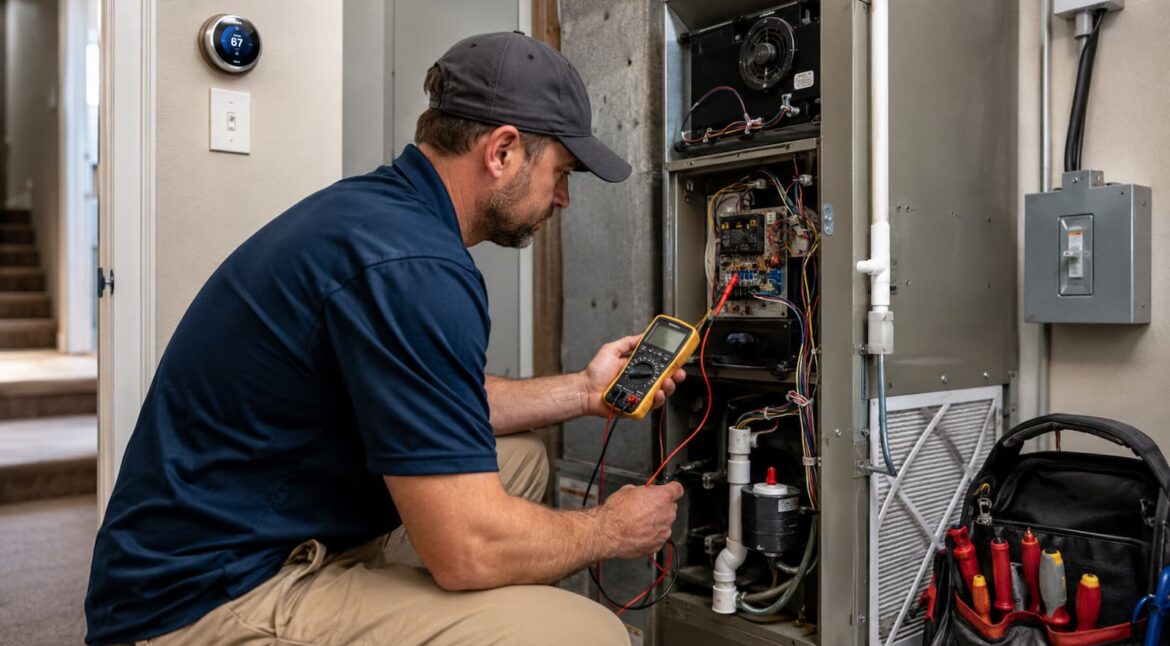
A professional diagnostic visit is not just “looking at the unit.” A good technician follows the sequence of operation and tests where the system is losing power, signal, airflow, or mechanical function. The exact process depends on the equipment, but it often includes:
- Verifying thermostat operation and configuration
- Checking line voltage to the indoor and outdoor units
- Testing low-voltage control power
- Inspecting fuses, transformer, control board, and wiring
- Checking condensate safety switches and drain condition
- Testing the contactor and capacitor
- Measuring motor and compressor amp draw
- Inspecting the blower motor and airflow path
- Checking the outdoor fan motor and condenser coil condition
- Looking for signs of overheating, burned wiring, or component failure
- Evaluating refrigerant pressures and temperature readings when appropriate
- Confirming safe operation after repair
This step-by-step approach matters because AC failures can stack on top of each other. For example, a dirty condenser coil can increase compressor stress. A weak capacitor can make a motor run hot. A clogged filter can freeze the coil. A clogged drain can shut down the thermostat circuit. Replacing the first visible failed part may not be enough if the root cause remains.
Repair or Replace: What If the AC Is Older?
If your air conditioner is relatively new and the issue is a capacitor, contactor, drain switch, thermostat, or minor electrical repair, fixing it usually makes sense. But if the system is older, unreliable, inefficient, or facing a major compressor or coil repair, replacement may be worth discussing.
The decision depends on several factors:
- Age of the system: Older equipment may be closer to the end of its expected service life.
- Repair cost: A small electrical repair is different from a compressor or coil replacement.
- Repair history: Repeated breakdowns suggest the system may be declining.
- Comfort problems: If the system never cooled evenly, repair may not solve design or sizing issues.
- Efficiency: Older systems may cost more to run, especially during long summer heat waves.
- Refrigerant type and parts availability: Some older systems may become more expensive to repair over time.
- Home plans: If you plan to stay in the home, long-term comfort and operating cost matter more.
If your technician finds a major failure and your system is already near the end of its useful life, it may be practical to compare repair against air conditioning replacement. The goal is not to replace equipment unnecessarily; it is to avoid putting serious money into a system that may continue failing.
How to Prevent Future “AC Will Not Turn On” Problems
You cannot prevent every failure, but many no-start calls are connected to neglected maintenance, airflow restrictions, dirty coils, drain clogs, and electrical wear that could have been caught earlier.
Change Filters on a Realistic Schedule
Filter life depends on the filter type, system runtime, pets, dust, renovation activity, and household conditions. A one-inch filter in a busy home may need attention much more often than a thicker media filter in a cleaner environment. Do not rely only on the date printed on the package. Check it visually, especially during peak cooling season.
Keep the Outdoor Unit Clear
The condenser needs airflow to reject heat. Keep grass clippings, leaves, weeds, mulch, storage items, and debris away from the unit. Do not wrap the unit tightly or block the coil. Restricted outdoor airflow raises operating pressures and can stress the compressor and fan motor.
Watch the Condensate Drain
If you have had drain clogs before, pay attention to slow drainage, water stains, algae buildup, musty odors, or repeated float switch shutdowns. Condensate issues are especially common in humid weather because the system removes more moisture from the air.
Schedule Maintenance Before the Hottest Weather
A spring maintenance visit gives a technician a chance to inspect electrical components, clean coils as needed, test capacitors, check refrigerant performance, clear drain concerns, verify airflow, and confirm safe startup before the system is under peak summer load. Many AC failures show warning signs before they become complete shutdowns.
Do Not Ignore Small Starting Problems
If the AC sometimes hesitates, buzzes before starting, trips once in a while, or needs thermostat resets, treat that as an early warning. Intermittent problems often become permanent failures during heat waves because the system runs longer and hotter.
Frequently Asked Questions
Why will my AC not turn on even though the thermostat is working?
If the thermostat is working and calling for cooling, the issue may be with the indoor unit power, low-voltage circuit, safety switches, control board, outdoor unit breaker, contactor, capacitor, fan motor, compressor, or refrigerant safety controls. The thermostat can ask for cooling, but the system still needs proper power and functioning components to respond.
Why is my thermostat blank and my AC not working?
A blank thermostat may be caused by dead batteries, a turned-off indoor service switch, a tripped breaker, a loose blower door, a clogged condensate drain float switch, a blown low-voltage fuse, transformer failure, or wiring issue. If new batteries and basic power checks do not restore the display, professional diagnosis is usually needed.
Why does my AC click but not start?
Clicking can mean the system is trying to start but cannot complete the startup sequence. Common causes include a failed capacitor, bad contactor, motor issue, compressor problem, voltage problem, or control fault. If clicking repeats or the unit hums without starting, shut the system off and call a technician.
Can a dirty filter stop my AC from turning on?
A dirty filter may not always prevent startup directly, but it can cause airflow restriction, coil freezing, overheating, poor cooling, and system stress. In some situations, airflow-related problems can contribute to shutdowns or protective lockouts. Replacing a dirty filter is one of the safest first checks.
Should I reset the AC breaker?
You can reset a tripped breaker once by turning it fully off and then back on. If it trips again, do not keep resetting it. A repeatedly tripping breaker may indicate an electrical fault, failing motor, compressor issue, shorted wiring, or other unsafe condition.
How long should I wait after changing thermostat settings?
Wait at least 3 to 5 minutes. Many thermostats and AC systems have a built-in compressor protection delay. Rapidly changing settings or turning the system on and off repeatedly can stress equipment and make troubleshooting harder.
Is it safe to replace an AC capacitor myself?
No, not for most homeowners. Capacitors can hold an electrical charge even when power is off, and the outdoor unit contains high-voltage components. Capacitor diagnosis and replacement should be handled with proper electrical safety procedures.
Why did my AC stop after leaking water?
Your condensate drain line may be clogged, causing water to back up into the drain pan. A float switch may have shut the system off to prevent water damage. Do not bypass the switch. The drain issue should be cleared and tested.
Can low refrigerant keep my AC from turning on?
In some systems, abnormal refrigerant pressure can trigger safety controls or prevent normal operation. Low refrigerant usually means there is a leak or another issue. It should be diagnosed by a technician because refrigerant handling requires proper equipment and certification.
When is an AC not turning on considered an emergency?
It may be an emergency if indoor temperatures are becoming unsafe, vulnerable occupants are in the home, the system has electrical burning smells, the breaker keeps tripping, water is overflowing, or the failure affects a business, medical need, or critical indoor environment. When safety or property damage is involved, do not wait.
Bottom Line: Start Simple, But Do Not Force the System
If your AC is not turning on, start with the basics: thermostat settings, batteries, breakers, service switches, access panels, air filter, vents, and signs of condensate backup. These checks can solve simple problems or at least help you understand what is happening.
But if the system still does not start, clicks or hums without running, trips the breaker, has a blank thermostat after basic checks, leaks water, freezes, or shuts down repeatedly, the issue likely needs professional diagnosis. AC systems involve high voltage, moving parts, refrigerant, and built-in safety controls. Guessing can turn a repairable problem into a more expensive one.
A careful HVAC technician can trace the problem through the thermostat, control circuit, safety switches, indoor unit, outdoor unit, electrical components, airflow path, and refrigerant system. The right diagnosis does more than get the AC running again; it helps protect the equipment, your home, and your comfort during the next hot day.